


Carbon capture and synthetic fuel production have long been treated as separate industrial problems, each with its own energy bill, infrastructure, and inefficiencies. A new perspective published in Frontiers in Environmental Engineering argues that the fastest route to merging them may lie in a single class of materials that can do both jobs at once. Writing from the Iberian Centre for Research in Energy Storage in Spain, J. M. González Carballo and C. Gutiérrez survey the rapidly evolving field of dual functional materials, or DFMs, solids that combine CO2 adsorption sites with catalytic conversion phases so that captured carbon can be turned directly into synthetic methane inside the same reactor.
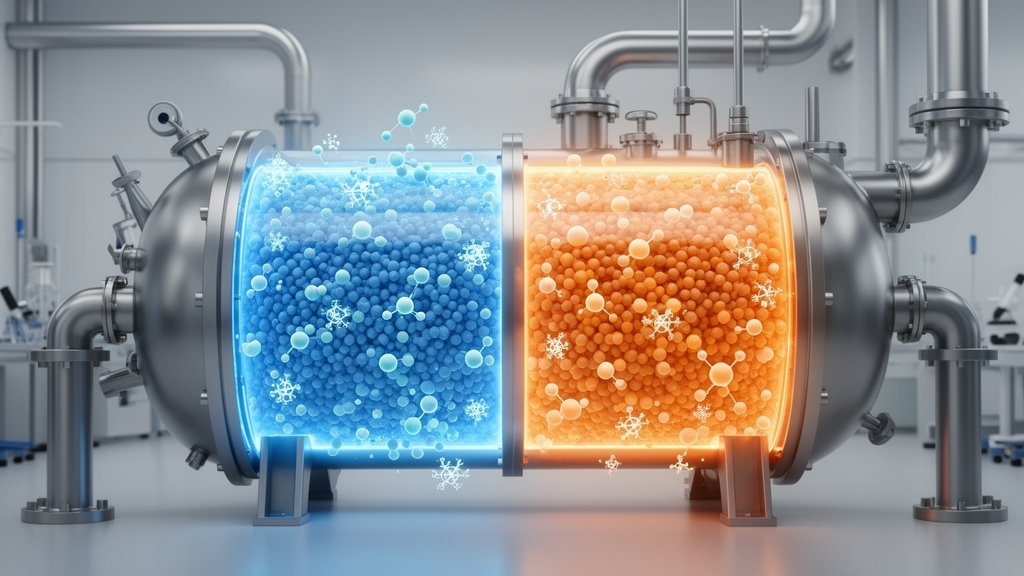
The appeal of the concept is rooted in process intensification. Conventional carbon capture and utilization chains require CO2 to be purified, compressed, transported, and then converted in discrete stages, each adding energy penalties and capital cost. DFMs collapse these steps into a cyclic process: during the capture stage the material adsorbs CO2 from a flue gas or other dilute stream, and during the hydrogenation stage renewable hydrogen reacts with the stored carbon to release methane. Because the Sabatier reaction, which converts CO2 and hydrogen into methane and water, is technologically mature and highly selective, methanation has become the dominant application in DFM research, well ahead of routes to carbon monoxide, methanol, or higher hydrocarbons.
Synthetic methane itself carries strategic weight. It is fully compatible with existing natural gas storage, transport, and distribution networks, which means renewable energy captured as gas needs no new infrastructure. Within the Power-to-Gas framework, methanation offers a way to store surplus wind and solar electricity in chemical form while valorising CO2 emissions from hard-to-abate sectors such as cement, steel, and chemical production, where direct electrification remains impractical. The Sabatier reaction runs over nickel, ruthenium, cobalt, iron, rhodium, or palladium catalysts at near atmospheric pressure and temperatures between roughly 100 and 400 degrees Celsius, depending on the metal chosen.
Most DFMs reported to date are built on porous supports with surface areas exceeding 200 square metres per gram, which disperses both adsorbent and catalytic sites and eases mass transfer during cyclic operation. Alumina remains the workhorse support thanks to its thermal stability, tunable porosity, and favourable metal-support interactions, but silica, ceria, titania, zeolites, activated carbons, and even biochar-derived materials are attracting attention for their ability to tune surface basicity, improve CO2 accessibility, or offer cheaper and more sustainable platforms. Hierarchical pore networks spanning micro-, meso-, and macroporous domains are seen as a way to reconcile high adsorption capacity with rapid diffusion of reactants and products.
The capture function is typically supplied by alkali and alkaline-earth metal oxides and carbonates, including calcium, magnesium, sodium, potassium, and lithium-based phases, which operate in the 300 to 450 degree Celsius window relevant to methanation. Comparative studies show that the choice of sorbent matters enormously: sodium oxide delivered 0.614 millimoles of methane per gram of material, calcium oxide 0.610, potassium oxide 0.466, and magnesium oxide just 0.213, reflecting how adsorption strength, carbonate stability, and regenerability jointly govern performance. More recently, amine-functionalised DFMs have emerged as candidates for lower-temperature operation, capturing CO2 through chemisorbed amine species that may access alternative, less energy-intensive hydrogenation pathways, although the underlying mechanisms remain largely unresolved.
On the catalytic side, oxygen vacancies in reducible oxides promote CO2 activation by stabilising bent carbonate, bicarbonate, or formate intermediates that are far more reactive than gaseous CO2. In situ infrared studies of ruthenium-based DFMs have confirmed a formate-mediated spillover mechanism, and work incorporating sodium into ruthenium on alumina systems shows how the exact nature of adsorbed carbonate species and the extent of spillover depend on the material’s architecture. Ruthenium and rhodium offer superior activity and resistance to deactivation, but nickel remains the most investigated catalyst because of its favourable balance of activity, availability, and cost, despite its susceptibility to oxidation, sintering, and carbon deposition under cyclic conditions. Promoters based on cerium, lanthanum, zirconium, magnesium, and alkali metals can enhance surface basicity, oxygen mobility, metal dispersion, and sintering resistance, with effects that depend strongly on loading and preparation method.
The authors are candid about the bottlenecks standing between laboratory demonstrations and robust deployment. Excessive or poorly controlled interactions between adsorption sites and catalytic phases can compromise CO2 uptake, activity, selectivity, or regeneration, while realistic flue gases containing steam, oxygen, and acidic impurities promote sintering, poisoning, and irreversible carbonate formation. These degradation pathways are rarely independent: metal sintering reduces the density of hydrogenation sites while simultaneously altering the local basicity of the support, so adsorption capacity and catalytic activity decline in a coupled fashion. When DFMs are shaped into pellets or structured forms, the strongly exothermic Sabatier reaction creates local temperature gradients that accelerate deactivation and push selectivity toward unwanted by-products, meaning intrinsic material performance and macroscopic transport phenomena cannot be optimised separately.
Overcoming these constraints, the authors argue, requires treating DFMs not as adsorbents and catalysts co-located in one solid but as engineered reaction environments in which capture, intermediate transport, and hydrogenation are deliberately organised across length scales. Core-shell architectures can limit metal sintering while preserving site accessibility, hierarchically porous structures can decouple transport length scales from active site size, and compositional-gradient materials can independently tune local basicity, redox state, and hydrogen availability. The critical design variable is the interface between adsorption and catalytic domains, which must be close enough for rapid intermediate migration yet sufficiently segregated to avoid site blockage and competitive adsorption. Emerging synthesis tools, including templating, additive manufacturing, and self-assembly, combined with density functional theory, microkinetic modelling, and machine learning, could replace trial-and-error screening with predictive design rules. Machine learning has already guided the discovery of optimized CO2 hydrogenation catalysts for jet-fuel-range hydrocarbons, hinting at what data-driven approaches might do for DFMs.
The perspective also calls for a cultural shift in how the field measures success. Rather than reporting single-pass adsorption capacities and methane yields under idealised conditions, future studies should evaluate cyclic stability over hundreds of cycles, methane productivity per unit mass and time, carbon balance, hydrogen utilisation efficiency, regeneration energy, and tolerance to sulfur, steam, and oxygen, using gas compositions representative of real flue gas, biogas, or direct air capture streams. Scale-up must likewise bridge the gap between powder-based proof-of-concept work and structured reactors, addressing heat removal, pressure drop, mechanical attrition, and reactor packing, with 3D-printed structured supports offering a promising means of decoupling heat management from bed pressure drop. Techno-economic assessment and life-cycle analysis under intermittent renewable hydrogen supply, rather than steady-state assumptions, should be built in from the start.
The most consequential open question, in the authors’ view, concerns amine-based capture chemistry. Unlike alkaline-earth carbonates, amines chemisorb CO2 under far milder conditions, potentially decoupling integrated capture and methanation from the narrow 300 to 450 degree Celsius window and slashing process energy demand. Whether amine-bound CO2 species can access genuinely distinct, lower-barrier reaction pathways rather than inefficiently mimicking carbonate routes is unresolved, and their oxidative and thermal degradation under repeated cycling remains a principal barrier to long-term operation. If solved, the authors believe such materials could operate directly on the dilute streams characteristic of direct air capture and accommodate fluctuating renewable hydrogen supply. In their assessment, it is this operational flexibility, rather than incremental gains in methane yield, that will determine whether DFMs mature from a laboratory concept into a genuinely deployable platform for a circular carbon economy.
Subject of Research: Dual functional materials for integrated CO2 capture and methanation to synthetic methane
Article Title: From CO2 capture to synthetic methane: the emerging role of dual functional materials
Article References: González Carballo, J. M., & Gutiérrez, C. (2026). From CO2 capture to synthetic methane: the emerging role of dual functional materials. Frontiers in Environmental Engineering, 5, Article 1925304. https://doi.org/10.3389/fenve.2026.1925304
Image Credits: AI Generated
DOI: 10.3389/fenve.2026.1925304
Keywords: carbon capture, dual functional materials, synthetic methane, power-to-gas, CO2 methanation, catalysis, circular carbon economy, capture, synthetic, methane, emerging, role
Cite Scienmag News
Denise Maddox. (October 16, 2026). Dual functional materials turn CO2 capture into synthetic methane in a single reactor. Scienmag. https://scienmag.com/dual-functional-materials-turn-co2-capture-into-synthetic-methane-in-a-single-reactor/
Denise Maddox. "Dual functional materials turn CO2 capture into synthetic methane in a single reactor." Scienmag, 16 October 2026, https://scienmag.com/dual-functional-materials-turn-co2-capture-into-synthetic-methane-in-a-single-reactor/. Accessed 16 October 2026.
Denise Maddox. "Dual functional materials turn CO2 capture into synthetic methane in a single reactor." Scienmag. October 16, 2026. https://scienmag.com/dual-functional-materials-turn-co2-capture-into-synthetic-methane-in-a-single-reactor/


