


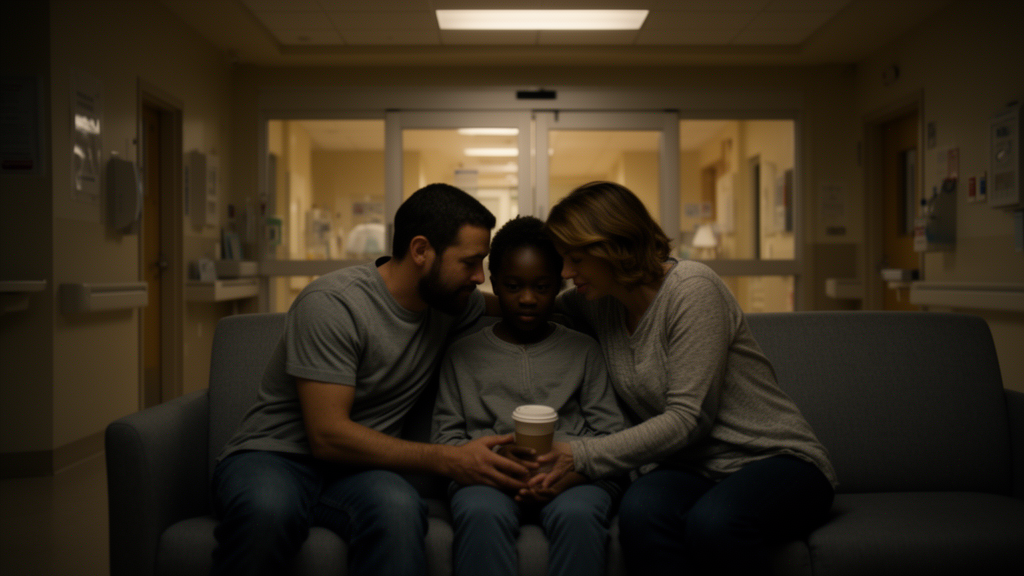
When a loved one is rushed into an intensive care unit, the family members waiting outside the glass doors become, in a very real sense, second patients. Their hearts race, their sleep collapses, and their minds loop endlessly over questions about survival, machines, and meaning. A new mixed-methods study published in BMC Nursing by a research team at Lanzhou University in China has now mapped what those family members actually need psychologically, and the results reveal a striking gap between what standardized questionnaires can measure and what families experience in the rawest moments of critical illness.
The research, led by Haohao Xie, Lulu Han, and Tian Hao with corresponding author Zhigang Zhang, was conducted at a tertiary hospital in China and combined two complementary ways of knowing. On the quantitative side, 200 family members of ICU patients completed the Critical Care Family Needs Inventory, a validated instrument that scores needs across five dimensions: assurance, information, proximity, support, and comfort. On the qualitative side, 16 family members sat down for semi-structured interviews analyzed with Colaizzi’s phenomenological method, which seeks to preserve the lived texture of experience rather than reduce it to numbers. The team then integrated both strands using a joint display approach, placing numerical and narrative findings side by side to see where they converged, diverged, or expanded one another.
The headline quantitative finding was an overall psychological-needs score of 145.39 with a standard deviation of 19.59, indicating that family members report substantial and widely shared needs across the ICU experience. Within that overall picture, the five dimensions were far from equal. Assurance had the highest mean item score at 3.75, followed by information at 3.51, proximity at 3.45, support at 2.89, and comfort at 2.78. In plain terms, what families want most is to be reassured, to be informed, and to be physically close to the patient. Emotional support and physical comfort, while still important, scored noticeably lower on the standardized instrument.
But the regression analysis, which used multiple linear modeling to identify which characteristics of family members were associated with higher or lower needs, showed that these five dimensions are not driven by the same factors. Assurance needs varied with ICU experience and occupation. Support needs were linked to residence and how well family members understood the patient’s illness. Information needs rose and fell with cohabitation status, ethnicity, illness understanding, and age. Proximity needs tracked occupation, and comfort needs were associated with religious belief. This dimension-specific pattern matters clinically because it suggests that a one-size-fits-all family support protocol will inevitably miss some people. A rural family member who does not fully grasp the diagnosis may need a different kind of communication than an urban relative with medical literacy, and a person with strong religious conviction may carry comfort needs that a secular checklist never anticipates.
It is in the qualitative interviews that the study becomes genuinely revealing. From the 16 conversations, five major domains emerged: personal distress, assurance needs, information and communication needs, proximity needs, and guidance needs. Three of these, assurance, information and communication, and proximity, converged neatly with the quantitative findings, validating that the questionnaire captures real and central concerns. Support needs only partially converged, hinting that the instrument’s support dimension does not fully align with what family members describe in their own words. And two domains, personal distress and guidance needs, expanded the quantitative assessment entirely, revealing needs that the standardized inventory simply does not register.
Personal distress, in particular, stands out as a blind spot of conventional measurement. Family members described their own emotional suffering, anxiety, and helplessness as a psychological burden in its own right, not merely as a backdrop to their needs for information or proximity. This finding echoes a growing body of ICU research showing that family members of critically ill patients are at elevated risk for psychological symptoms that can persist long after discharge, sometimes meeting criteria for post-traumatic stress related to the ICU experience itself. When the person waiting in the hallway is suffering, the suffering is not incidental to care; it is part of the clinical picture.
Guidance needs, the other domain that emerged only from the interviews, refer to family members’ desire for direction from healthcare professionals about how to act, what to expect, and how to navigate the unfamiliar terrain of critical illness. Families are not passive recipients of updates; they are actively trying to figure out their role, and they want clinicians to guide them. This is a fundamentally different kind of need from being informed about a prognosis. It is a need for mentorship in crisis, and it is precisely the kind of need that a Likert-scale inventory, however well designed, struggles to surface because respondents may not think to endorse an item about something they have never been offered.
The study’s methodological architecture deserves attention because the discrepancy between measured and lived experience is itself the central scientific finding. A purely quantitative study would have concluded that assurance, information, and proximity are the top needs and stopped there. A purely qualitative study would have generated rich themes but no generalizable numerical hierarchy. By running both in parallel and integrating them, the researchers exposed the limits of each approach in isolation. The convergence on three dimensions strengthens confidence that those needs are real and widespread. The partial convergence on support suggests measurement noise or conceptual mismatch. The expansion into personal distress and guidance needs demonstrates that the questionnaire, despite its long history in critical care research, underrecognizes emotional and navigational dimensions of family experience.
From a clinical translation standpoint, the implications are concrete. Patient- and family-centered care, often abbreviated as PFCC in the critical care literature, has increasingly been recognized as a framework that treats families as partners rather than visitors. This study adds empirical weight to that movement by showing that family needs are not only substantial but also heterogeneous, shaped by demographics, residence, occupation, religious belief, illness understanding, and prior ICU exposure. Hospitals could use the dimension-specific determinants identified here to triage family support more intelligently, for example by prioritizing communication interventions for family members who report poor illness understanding or by offering targeted reassurance to those without previous ICU experience.
The broader lesson for science and medicine is that the tools we use to measure human experience shape what we are able to see. The Critical Care Family Needs Inventory has been a workhorse of critical care research for decades, and this study does not discard it. Instead, the Lanzhou team shows that when you hold the instrument up against the unfiltered voices of family members, the instrument reveals its own edges. Emotional support and guidance, the study concludes, are often underrecognized in routine clinical practice, and the psychological needs of ICU patients’ family members extend beyond what quantitative measures capture. In an era when intensive care units are increasingly asked to care not just for organs but for whole persons and the people who love them, that conclusion may be the most important number-free finding of all.
Subject of Research: Psychology
Article Title: Psychological needs and their determinants among family members of ICU patients: a mixed-methods study
Article References: Xie, H., Han, L., Hao, T., Niu, W., Qi, R., Zhang, L., Jia, D., Wang, H., & Zhang, Z. (2026). Psychological needs and their determinants among family members of ICU patients: a mixed-methods study. BMC Nursing. https://doi.org/10.1186/s12912-026-05533-8
Image Credits: AI Generated
DOI: 10.1186/s12912-026-05533-8
Keywords: Psychological, needs, determinants, family, members, patients, mixed-methods, scientific research
Cite Scienmag News
Ophelia Keating. (October 16, 2026). What Families Really Need When a Loved One Lands in the ICU. Scienmag. https://scienmag.com/what-families-really-need-when-a-loved-one-lands-in-the-icu/
Ophelia Keating. "What Families Really Need When a Loved One Lands in the ICU." Scienmag, 16 October 2026, https://scienmag.com/what-families-really-need-when-a-loved-one-lands-in-the-icu/. Accessed 16 October 2026.
Ophelia Keating. "What Families Really Need When a Loved One Lands in the ICU." Scienmag. October 16, 2026. https://scienmag.com/what-families-really-need-when-a-loved-one-lands-in-the-icu/


