


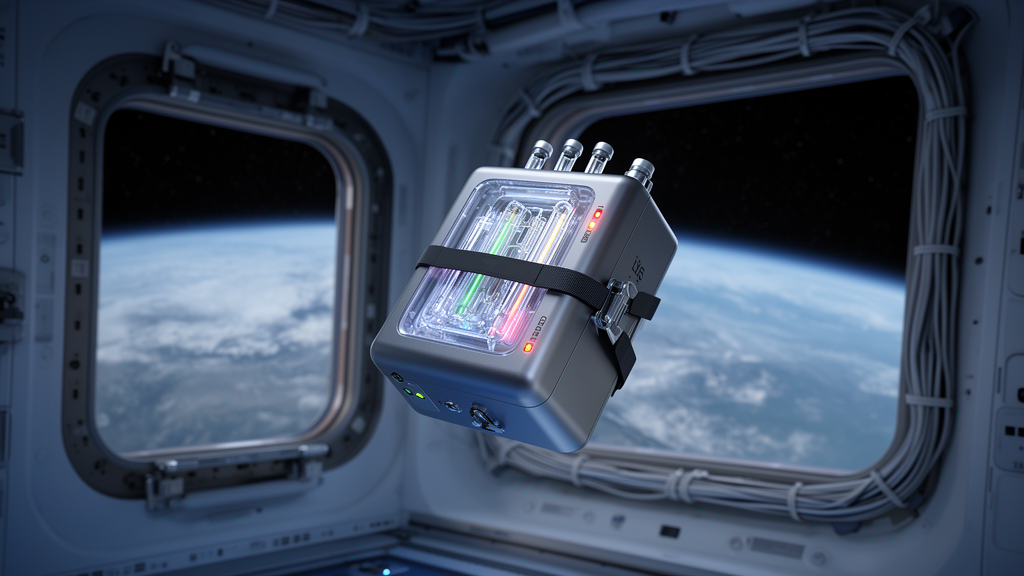
As NASA and its partners push toward a long-term human presence on the Moon and, eventually, Mars, one of the most pressing questions is not how to build bigger rockets but how living cells cope with deep space. A new perspective article published in Frontiers in Space Technologies by researchers at NASA Ames Research Center and collaborators lays out two decades of automated biosensor development and argues that miniaturized, self-running laboratories on small satellites are the key to understanding biology beyond the protective shield of Earth’s magnetic field. The paper, led by Neha Lingam and Alina Shkurikhina with senior author Sergio R. Santa Maria, traces a technological lineage that runs from a shoebox-sized satellite carrying E. coli in 2006 to yeast cells now drifting more than 95 million kilometers from Earth.
The stakes are considerable. Beyond low Earth orbit, astronauts face a suite of hazards that include galactic cosmic radiation, sporadic solar particle events, altered gravity, isolation, and sheer distance from home. The radiation environment is particularly unforgiving: galactic cosmic rays consist of a steady flux of high-energy protons and highly energetic heavy particles originating outside the solar system, while solar particle events erupt from coronal mass ejections and consist mostly of protons and helium nuclei. Both are modulated by the 11-year solar cycle, with solar storms peaking at solar maximum and cosmic rays intensifying at solar minimum. These forms of ionizing radiation can damage both electronic components and living tissue, and the authors stress that the stressors can exacerbate one another’s effects in complex organisms like humans.
Ground-based simulators, valuable as they are, cannot fully reproduce the deep space environment. The protracted, omnidirectional nature of galactic cosmic radiation is extremely difficult to replicate in the laboratory, and microgravity simulators are rarely combined with ionizing radiation sources. On the lunar surface the problem grows more tangled still, because cosmic rays striking the regolith generate albedo neutrons that add a secondary radiation component. That gap between simulation and reality is precisely why the authors advocate in situ experiments: automated payloads flying through interplanetary space or sitting on the Moon can measure biological responses under the genuine article, informing the design of life support systems and countermeasures for future crews.
The platform of choice has been the CubeSat, a standardized small satellite whose basic one-unit form is a 10-centimeter cube weighing roughly one kilogram. Their affordability and modularity have opened space biology to universities, companies, and government agencies alike. NASA Ames pioneered biosensor payloads in this format more than 20 years ago, and the lineage began with GeneSat-1, launched in December 2006 into an orbit about 450 kilometers above Earth. The 3U satellite carried genetically modified E. coli expressing green fluorescent protein inside a 12-well microfluidic card, each well equipped with its own fluorescence excitation LED, optical filters, and a photodetector. After remote activation raised the temperature to 34 degrees Celsius, growth medium flowed into the wells, and both gene expression and bacterial growth were successfully observed, with growth rates actually lower in orbit than on the ground.
Successive missions scaled up the concept. PharmaSat, launched in 2009, packed 48 wells into its fluidic card and delivered different doses of the antifungal voriconazole to budding yeast, tracking cell growth and metabolic activity every 15 minutes for three days using a three-color LED system and the redox dye alamarBlue. O/OREOS, launched in 2010 to a higher orbit with roughly 12 to 15 times the radiation dose rate, carried desiccated Bacillus subtilis spores and activated three separate fluidic cards at two weeks, three months, and six months, demonstrating that dried biology can survive long enough to study cumulative radiation exposure. SporeSat in 2014 introduced lab-on-a-chip devices with calcium-sensitive electrodes and minicentrifuges generating artificial gravity for fern spores; although a light failure prevented germination, the artificial gravity technology worked. EcAMSat, the first 6U biological satellite deployed from the International Space Station in 2017, tested whether uropathogenic E. coli gain antibiotic resistance in microgravity and found no enhanced resistance to gentamicin.
International teams have since joined in. Israel’s SpacePharma flew DIDO-2 and DIDO-3, whose spectrophotometry showed that bacterial conjugation and the spread of antibiotic resistance genes can occur in orbit. Poland’s LabSat attempted to grow cress and fungi together in glass and 3D-printed lab-on-chip devices before communications failed on day 14. Chile’s PlantSat carried the hardy desert plant Tillandsia along with extremophiles. Italy’s GreenCube and AstroBio, launched on the maiden flight of the Vega-C rocket in July 2022 into medium Earth orbit at roughly 6,000 kilometers, achieved autonomous plant cultivation to the microgreen stage in a closed hydroponic system and validated an origami-like paper-based analytical device for chemiluminescence assays, respectively. Each mission, successful or not, refined the automated fluidics, optics, and thermal control that the next generation would inherit.
That inheritance culminated in BioSentinel, the first CubeSat built to run biological experiments in deep space and NASA’s first biology mission outside Earth’s magnetic field since Apollo 17 in 1972. Launched on Artemis I in November 2022, it swung past the Moon at about 400 kilometers and settled into a heliocentric orbit, where it remains more than 95 million kilometers from Earth. Its 4U BioSensor payload holds eighteen microfluidic cards with sixteen wells each, organized into two manifolds with embedded desiccant chambers, integrated valves, and bubble traps. Desiccated budding yeast, chosen for its ability to survive long-term drying, is rehydrated by a pump-and-valve system, and a three-color LED array reads the oxidized and reduced forms of alamarBlue at 630 and 570 nanometers while a third LED at 850 nanometers measures light scattering from growing cells. Measurements are taken every two minutes, and dedicated thermal control keeps active cards at 23 degrees Celsius while the rest sit near 5 degrees, allowing two cards to be activated at a time up to nine times across the mission.
BioSentinel’s story is also one of hard lessons. Although every subsystem, from fluidics to optics to data telemetry, was validated both on the space station and in deep space, the BioSensor had to be switched off after a few weeks when electronics inside the enclosure failed, likely due to high relative humidity. Its companion instrument, a Timepix-based linear energy transfer spectrometer mounted outside the enclosure, has meanwhile operated flawlessly, logging dozens of solar particle events through solar maximum and deepening understanding of the radiation environment beyond the Earth-Moon system. The mission’s engineering lessons flow directly into LEIA, the Lunar Explorer Instrument for space biology Applications, selected through NASA’s PRISM program and slated to launch on a commercial lander no earlier than October 2027 as the agency’s first biological mission on the Moon since 1972. LEIA’s BioSensor will carry sixteen cards on two manifolds with enlarged desiccant chambers, a redesigned enclosure with an open top for late loading, and up to sixteen engineered yeast strains. Half will probe DNA damage and stress response under lunar gravity and radiation; the rest will produce carotenoid antioxidants as a test of biomanufacturing, monitored by swapping the 570-nanometer LED for a 465-nanometer one.
Other payloads are queuing up. The Deep Space Radiation Genomics experiment flew inside Orion on Artemis I, using barcoded genome-wide yeast knockout and overexpression collections rehydrated automatically beyond Earth’s magnetic field. On Artemis II, the AVATAR experiment flew organ chips grown from the astronauts’ own bone marrow cells along the same trajectory, the first organ chips used beyond low Earth orbit. The proposed MINERVA CubeSat from Mahidol University aims to place tardigrade-derived Dsup proteins into roundworms on a cislunar orbit to test radiation resistance, while LEAF, selected for Artemis, will grow model crops on the lunar surface with capillary hydroponics and autonomous environmental control, echoing China’s Chang’e-4 biosphere that germinated cotton on the lunar far side in 2019. The authors also confront the practical constraints: payloads must often be delivered up to a year before launch, forcing organisms into long stasis; humidity, sterilization residues, and bubble formation threaten sealed fluidics; and communications shift from direct-to-Earth links to the Deep Space Network and specialized transponders like the Iris radio flown on BioSentinel.
Looking ahead, the authors envision the BioSensor architecture expanding beyond yeast to cyanobacteria, algae, and microgreen crops, with fluorescence and luminescence assays added without major redesign, and eventually miniaturized DNA and RNA sequencers, microscopes, and human organ chips riding on the same automated platforms. Artificial intelligence tools should help manage the data flood that high-resolution imaging and sequencing will generate, while planetary protection protocols, with the Moon classified as a category II body requiring documentation and organic inventory tracking, keep the science clean. With lunar surface deliveries moving from aspiration to high-cadence reality and NASA’s announced Moon Base plans, the message of the perspective is clear: robust, self-running biological laboratories are no longer a novelty but a necessity for keeping future explorers alive and productive beyond low Earth orbit.
Subject of Research: Development of automated biosensor technologies for future biological research beyond low Earth orbit
Article Title: Development of automated biosensor technologies for future biological research beyond low Earth orbit
Article References: Lingam, N., Shkurikhina, A., Wu, J. W., Shuman, D. M., & Santa Maria, S. R. (2026). Development of automated biosensor technologies for future biological research beyond low Earth orbit. Frontiers in Space Technologies, 7, Article 1877143. https://doi.org/10.3389/frspt.2026.1877143
Image Credits: AI Generated
DOI: 10.3389/frspt.2026.1877143
Keywords: Development, automated, biosensor, technologies, future, biological, research, beyond, Earth, orbit, scientific research
Cite Scienmag News
Denise Maddox. (October 16, 2026). Automated Biosensors Head Beyond Low Earth Orbit to Prepare Biology for Deep Space. Scienmag. https://scienmag.com/automated-biosensors-head-beyond-low-earth-orbit-to-prepare-biology-for-deep-space/
Denise Maddox. "Automated Biosensors Head Beyond Low Earth Orbit to Prepare Biology for Deep Space." Scienmag, 16 October 2026, https://scienmag.com/automated-biosensors-head-beyond-low-earth-orbit-to-prepare-biology-for-deep-space/. Accessed 16 October 2026.
Denise Maddox. "Automated Biosensors Head Beyond Low Earth Orbit to Prepare Biology for Deep Space." Scienmag. October 16, 2026. https://scienmag.com/automated-biosensors-head-beyond-low-earth-orbit-to-prepare-biology-for-deep-space/


