


The global race to decarbonize electricity grids, industries and transport systems has produced a striking paradox: technologies that are cheaper and cleaner than ever before are still failing to deliver transitions that are fair, durable or economically coherent. A new editorial published in Frontiers in Sustainable Energy Policy argues that this gap is not primarily a problem of engineering but of governance, finance and equity. Drawing together a multi-country collection of studies under the research topic Environmentally just and economically sustainable low-carbon transitions, the editorial team led by Olubayo Babatunde of Durban University of Technology contends that decarbonization must be understood as a socio-technical transformation rather than a purely technological substitution. The message is blunt: cutting emissions fast is necessary, but doing so without institutional capacity, distributional safeguards and ecological accounting risks undermining both the legitimacy and the longevity of climate policy.
The editorial frames the core challenge in terms of balance. Successful decarbonization policies, the authors write, must strike the right equilibrium between the speed of emissions reduction and the institutional capacity, investment patterns and distributional factors that determine whether policies survive politically. This reflects a growing consensus in the sustainability transition literature that climate goals cannot be pursued in isolation from social welfare outcomes. When renewable energy mandates are imposed on regions lacking grid infrastructure, skilled workers or financing channels, the result is often stalled projects, public backlash and missed targets. The contributors therefore call for interdisciplinary research that explicitly links climate ambition to employment quality, energy access and regional development, treating justice and economic sustainability as design constraints rather than afterthoughts.
One of the most consequential contributions to the collection is a comprehensive review by Ayompe and Egoh examining the interactions between renewable energy deployment and ecosystem services. The review affirms that renewable systems deliver substantial socio-economic benefits, including job creation, improved public health and enhanced energy security. Yet it also documents a set of ecological trade-offs that are frequently absent from energy planning models: land-use conversion, biodiversity loss and disruption of environmental stability. Large-scale solar and wind installations, hydropower reservoirs and bioenergy plantations all occupy land and alter habitats, and the authors argue that these impacts must be quantified and managed rather than dismissed as negligible. Their remedy is a systems approach built on long-term monitoring, adaptive management and enhanced data systems, so that energy planners can weigh emissions savings against ecosystem damage on comparable terms. In this framing, a renewable megaproject that devastates a wetland is not automatically a climate win.
Sectoral heterogeneity emerges as another central theme. Khan and colleagues analyzed the environmental performance of subsectors within the Chinese tourism industry and found striking disparities in ecological intensity and development outcomes. Lodging, they show, disproportionately drives greenhouse gas emissions and ecological footprint growth within the sector, while entertainment activities generate comparatively greater returns in human development terms. Just as notably, the study finds that regulatory instruments consistently improve environmental performance, whereas fiscal tools produce inconsistent effects that depend on the subsector to which they are applied. The implication is that blanket policies applied to an entire industry can misallocate effort and resources. A hotel operator and a tour entertainment company face different cost structures, emission profiles and abatement options, and the authors argue that governance should be differentiated accordingly, with sub-sectoral policy frameworks that harmonize tourism growth with environmental and developmental goals.
Institutional capacity, the collection suggests, may be the single most underrated variable in transition outcomes. Oladejo and colleagues studied renewable energy adoption in South African local governments, focusing on workforce competence and administrative ability. Their qualitative data reveal a significant skills shortage among municipal officials that directly impedes local renewable energy initiatives, regardless of national policy support. The authors recommend targeted training programs, structured stakeholder engagement and institutional learning mechanisms as prerequisites for local governments to convert renewable energy policy into economic and social benefits. This finding resonates far beyond South Africa: transition policies frequently fail not because the technology is unavailable or unaffordable, but because the institutions responsible for implementation lack the human capital and organizational routines to execute them. The editorial treats such implementation capacity gaps as first-order policy problems, on par with financing and technology.
At the level of individual firms, Yuning and colleagues examined how institutional pressure shapes low-carbon innovation among manufacturing companies. Their results indicate that environmental management systems play a mediating role, transforming external regulatory pressure into concrete innovative outcomes, while governance heterogeneity and how environmental signals are interpreted within firms strongly condition their responses. In practical terms, the same regulation can produce aggressive clean innovation in one company and symbolic compliance in another, depending on internal governance design and managerial framing. The study concludes that successful decarbonization depends on the internalization of environmental policy signals by organizations, which places governance design, corporate boards, reporting structures and incentive systems, at the center of the innovation diffusion process.
Financial architecture receives equally rigorous attention. Li and colleagues exploited a quasi-natural experiment created by a Chinese policy change that lifted foreign ownership limits, allowing them to measure how banking liberalization affects corporate environmental, social and governance performance. Their findings show that financial reform enhances ESG performance by raising transparency, easing financing constraints and curbing managerial short-termism, and that these benefits exhibit regional spillover effects, suggesting systemic gains in environmental governance. The study demonstrates that capital allocation decisions are environmental decisions: when firms can access patient, well-regulated capital, they invest in sustainability; when financing is scarce or short-termist, environmental performance deteriorates. Hao and Arshad extend this macroeconomic lens to the G5 economies, modeling the drivers of carbon emissions across green technology, energy intensity, environmental performance and economic growth. Their results show that green technological development and economic growth can reduce emissions in high-emission contexts, opening environmentally sustainable development paths, but rising energy intensity and weak environmental policy effectiveness continue to frustrate mitigation. The combined lesson is that innovation support, energy efficiency mandates and institutional reform must be packaged together rather than pursued piecemeal.
Two further studies broaden the geographic and developmental scope of the collection. Ullah and Lin tested the impacts of technological cooperation, grants and energy depletion on environmental sustainability in Pakistan, finding that international technological collaboration, through ecological capacity enhancement, exerts a major positive effect on environmental safety, while industrialization and resource depletion damage it. Their work underscores the importance of cross-border technology transfer and aligned policy frameworks for emerging economies that cannot generate all needed green technologies domestically. Liang and Qiao, meanwhile, evaluated China’s low-carbon city pilot policies for their effects on common prosperity, a policy objective emphasizing inclusive growth. They find positive effects on employment quality and human capital formation, but these benefits are region-specific and materialize over the long term, implying that regional economic structure and institutional adjustment strongly condition who gains from decarbonization. The authors call for dynamic policy evaluation systems, region-specific implementation strategies and enhanced interregional coordination to ensure that low-carbon urban transformation supports equitable development rather than concentrating its rewards.
Taken together, the editorial distills three cross-cutting insights from the research topic. First, environmental justice requires embedding ecological perspectives directly into technological and economic planning, not treating environmental protection as a peripheral add-on. Second, climate policies must be matched with financial systems, industrial organization and labor market development to be economically sustainable; a carbon target without a financing strategy and a workforce plan is a slogan, not a policy. Third, institutions mediate everything: governance coherence, regulatory clarity and administrative capacity frequently determine whether technological opportunities translate into meaningful change. The editors also chart future research directions, including integrated analytical frameworks that connect environmental performance, economic sustainability and social equity within a single assessment structure, improved metrics for distributional performance covering job quality, spatial inequality and clean energy access, and expanded international collaboration on technology transfer, financial governance and institutional capacity building.
As climate pressure intensifies and decarbonization accelerates worldwide, the design dilemma identified by the editorial, achieving transitions that are simultaneously environmentally responsible, economically viable and socially inclusive, will remain at the center of the global policy agenda. The collection’s contribution is to demonstrate, across macroeconomic modeling, sector analysis, institutional studies and ecosystem-based evaluation, that low-carbon transitions succeed when they are engineered as socio-technical systems and fail when they are pursued as narrow technological fixes. For policymakers, the practical takeaway is a checklist of sorts: pair every emissions target with financing reform, workforce development, sub-sector-specific regulation and ecological monitoring. For researchers, the agenda is interdisciplinary by necessity. The editors express confidence that this integrated discussion will inspire new investigations and guide policy strategies capable of producing transitions that are not only low-carbon, but just and durable.
Subject of Research: Editorial: Environmentally just and economically sustainable low-carbon transitions
Article Title: Editorial: Environmentally just and economically sustainable low-carbon transitions
Article References: Editorial: Environmentally just and economically sustainable low-carbon transitions. (n.d.). https://doi.org/10.3389/fsuep.2026.1838153
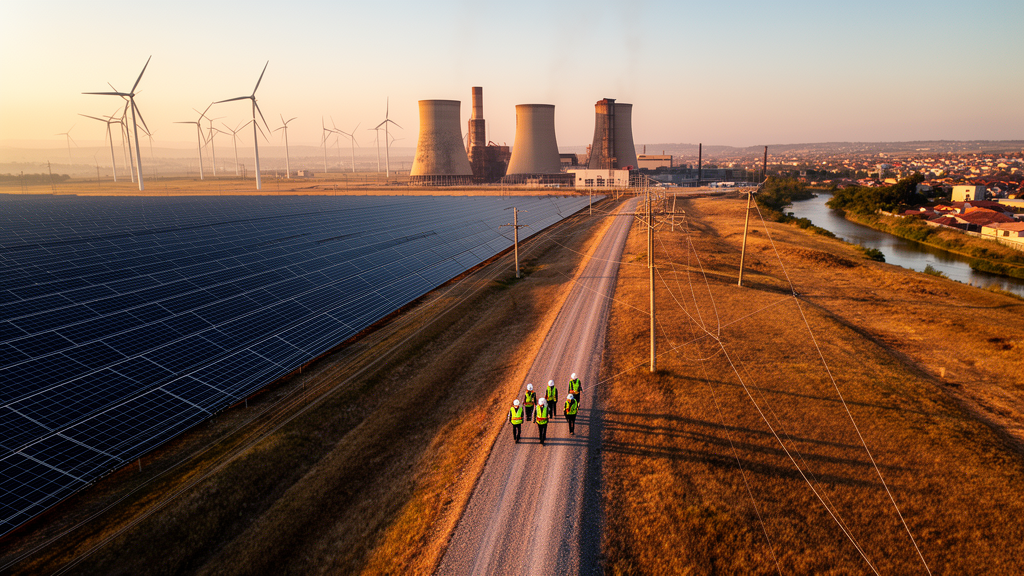
Image Credits: AI Generated
DOI: 10.3389/fsuep.2026.1838153
Keywords: low-carbon transition, environmental justice, energy policy, renewable energy, ecosystem services, ESG, green technology, institutional capacity, decarbonization, sustainable development, China, South Africa
Cite Scienmag News
Sloane Callahan. (October 16, 2026). Why Low-Carbon Transitions Fail Without Justice, Institutions and Finance. Scienmag. https://scienmag.com/why-low-carbon-transitions-fail-without-justice-institutions-and-finance/
Sloane Callahan. "Why Low-Carbon Transitions Fail Without Justice, Institutions and Finance." Scienmag, 16 October 2026, https://scienmag.com/why-low-carbon-transitions-fail-without-justice-institutions-and-finance/. Accessed 16 October 2026.
Sloane Callahan. "Why Low-Carbon Transitions Fail Without Justice, Institutions and Finance." Scienmag. October 16, 2026. https://scienmag.com/why-low-carbon-transitions-fail-without-justice-institutions-and-finance/


