


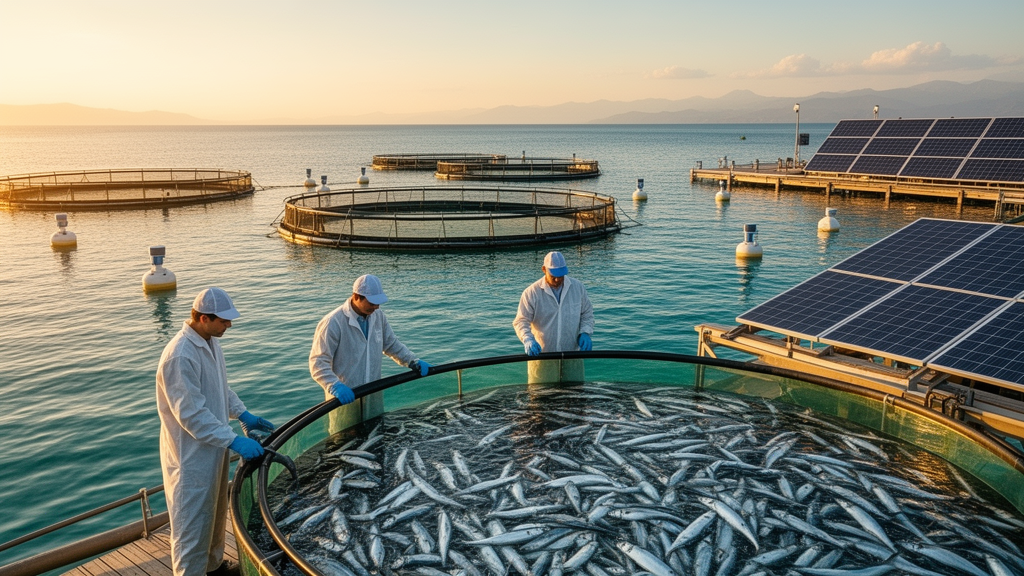
Aquaculture has quietly become the fastest-growing food production sector on the planet, and a new editorial published in Frontiers in Aquaculture argues that its future hinges on a sweeping convergence of technologies. As capture fisheries reach or exceed sustainable harvest thresholds, farmed aquatic animals now supply the primary source of aquatic protein for billions of people. Yet the same rapid expansion that has made aquaculture indispensable has also raised serious concerns about ecological damage, disease proliferation, resource depletion, climate change impacts, biodiversity loss, and socioeconomic strain. The editorial, led by Neelesh Kumar of Rani Lakshmi Bai Central Agricultural University together with colleagues from Acharya Narendra Deva University of Agriculture and Technology and the National Fisheries Development Board in India, synthesizes a large international research collection showing that sustainable aquaculture now depends on integrating complementary advances rather than on any single breakthrough.
The most visible transformation is happening inside the production systems themselves. Recirculating aquaculture systems, or RAS, continuously filter and reuse water within closed loops, allowing high-density fish production with minimal freshwater withdrawal and dramatically reduced waste discharge. Biofloc technology takes a different route: it cultivates dense microbial communities within the culture water that convert dissolved nitrogenous waste into microbial protein, which fish can then graze upon, simultaneously cleaning the water and recycling nutrients into feed value. Aquaponics couples fish culture with hydroponic plant production so that effluent nutrients fertilize crops before the water returns to the tanks. Integrated multi-trophic aquaculture, meanwhile, stacks species with complementary ecological roles, such as finfish, shellfish, and seaweeds, so that the waste of one trophic level becomes nourishment for the next. Recent evaluations highlighted in the collection emphasize refined feeding strategies for these intensive systems, concentrating on optimal nutrient utilization and sustainable growth performance.
Feed formulation is undergoing an equally profound rethink. Conventional aquafeeds have long depended on fishmeal and fish oil harvested from wild marine stocks, a dependency that links farm productivity to ocean extraction. The editorial documents a growing portfolio of alternatives, including insect meals, microbial proteins, algae-derived components, fermented agricultural by-products, and aquatic macrophytes. Substituting these ingredients advances circular bioeconomies in which agricultural residues and industrial side-streams are upcycled into high-value aquafeed. Beyond raw nutrition, functional feeds augmented with probiotics, prebiotics, phytobiotics, immunostimulants, medicinal plant extracts, and bioactive substances are shown to boost disease resistance, gut health, and feed conversion efficiency while reducing reliance on antibiotics. These dietary innovations enhance animal welfare, promote environmental sustainability, and bolster the economic resilience of farming operations.
Disease management remains one of the most persistent threats to aquaculture profitability, and the research collection makes a strong case for shifting from reactive chemotherapeutics to preventative health. Contemporary approaches prioritize vaccination programs, immune-nutrition, molecular diagnostics, rigorous biosafety protocols, selective breeding for disease resistance, and proactive water quality management. The editorial highlights specific advances in shellfish immunity, aquatic animal health, and innovative biosafety technology that strengthen farm resilience against pathogens. Molecular diagnostics now allow earlier and more precise identification of infectious agents, giving farmers a window to intervene before outbreaks cascade through a facility. According to the authors, transitioning to preventative healthcare is essential for sustainable aquaculture practice, because it reduces chemical inputs, limits the evolution of drug-resistant pathogens, and protects surrounding ecosystems from therapeutic discharge.
Molecular biology and genomics are rapidly transforming breeding and conservation initiatives across the sector. Techniques such as high-throughput sequencing, genomic selection, transcriptomics, mitochondrial DNA analysis, environmental DNA, and marker-assisted breeding now provide precise identification of improved broodstock, monitoring of genetic diversity, and conservation of threatened aquatic species. Environmental DNA sampling, in particular, allows researchers to detect the presence of species from water samples alone, offering a non-invasive tool for biodiversity surveillance in and around farms. Genomic selection accelerates genetic gain for commercially important traits such as growth rate and disease resistance, compressing breeding cycles that once took decades. The editorial underscores the growing importance of these genetic methodologies in both commercial aquaculture and conservation biology, enhancing aquatic efficiency while promoting biodiversity and long-term ecosystem health.
Digital technologies are enabling a new era of precision aquaculture management. Artificial intelligence, Internet of Things sensor networks, machine vision, underwater robotics, cloud computing, digital twins, and real-time environmental monitoring now provide continuous surveillance of dissolved oxygen, temperature, ammonia levels, fish behavior, feeding efficiency, and health status. Machine vision systems can track feeding intensity and appetite in real time, allowing automated feeders to deliver feed only when fish are actively consuming it, which cuts waste and improves feed conversion ratios. Digital twins, virtual replicas of physical farm systems, let managers simulate scenarios and optimize operations before implementing changes in the real world. Predictive analytics and decision-support systems enhance efficiency by identifying disease risks and environmental challenges at an early stage, helping farmers make informed decisions while reducing labor and operational expenses.
Environmental sustainability challenges loom large over the entire enterprise. Climate change, water scarcity, microplastic contamination, eutrophication, and novel pollutants increasingly jeopardize aquatic ecosystems, and the research collection tackles these issues through enhanced environmental monitoring, ecological risk assessment, and ecosystem-oriented management. Studies on dissolved oxygen dynamics, microplastic toxicity, and aquatic ecosystem health provide critical insights for developing resilient aquaculture systems capable of adapting to environmental change. The editorial argues that this evidence highlights the necessity of integrating environmental stewardship into aquaculture policies, ensuring that farm-level productivity gains do not come at the expense of the ecosystems on which the industry ultimately depends.
The circular economy concept emerges as a unifying theme throughout the collection. Aquaculture waste is increasingly regarded as a resource rather than refuse. Fish by-products can be converted into collagen, nutraceuticals, fertilizers, biofertilizers, animal feed, and bioactive chemicals, thereby enhancing resource efficiency and mitigating environmental impacts. Aquatic vegetation and microbial systems facilitate nutrient reclamation and water filtration, promoting closed-loop systems that enhance sustainability across the entire value chain. This reframing transforms the economics of waste management: effluent streams that once represented disposal costs become revenue opportunities, and processing residues become feedstocks for adjacent industries, knitting aquaculture into broader bioeconomic networks.
Despite substantial technological advances, the editorial is candid that achieving sustainable aquaculture requires more than innovation. Societal acceptance, economic feasibility, governance, agricultural education, equitable access to technologies, and supportive policies are equally essential. Small-scale producers, particularly in developing countries, encounter significant obstacles including insufficient capital, limited technical expertise, and inadequate infrastructure when implementing new technologies. Sustainable intensification strategies must be tailored to local ecological, economic, and cultural contexts to ensure that the benefits of technological advancement reach producers of all scales. The authors emphasize interdisciplinary collaboration, drawing on nutritionists, veterinarians, geneticists, engineers, environmental scientists, microbiologists, economists, and policymakers, as the mechanism that translates fragmented research findings into practical improvements benefiting fish farmers, entrepreneurs, and consumers.
Looking ahead, the editorial identifies several critical research goals that must be addressed to accelerate the global transition. Future endeavors should focus on developing climate-resilient aquaculture systems, reducing dependence on finite marine feed resources, advancing selective breeding through genomic technologies, enhancing the use of artificial intelligence in farm management, prioritizing the welfare of aquatic animals, refining disease surveillance, and facilitating ecosystem restoration through nature-based solutions. Harmonized regulations, multinational research partnerships, open data dissemination, and capacity-building initiatives will be essential to speeding worldwide adoption of sustainable technologies. The authors conclude that the published studies demonstrate sustainability and productivity can coexist when propelled by scientific innovation and judicious resource use, offering pragmatic solutions aligned with the United Nations Sustainable Development Goals on food security, sustainable agriculture, climate action, biodiversity preservation, and poverty alleviation. By harmonizing scientific advancement with ecological conservation, the aquaculture sector can continue to provide nutritional sustenance, sustainable employment, and healthy aquatic environments for future generations.
Subject of Research: Editorial: Recent advanced techniques for sustainable aquaculture production
Article Title: Editorial: Recent advanced techniques for sustainable aquaculture production
Article References: Kumar, N., Srivastava, A., Singh, C. P., Tyagi, A., Behera, B. K., & Pandey, P. K. (2026). Editorial: Recent advanced techniques for sustainable aquaculture production. Frontiers in Aquaculture, 5, Article 1933359. https://doi.org/10.3389/faquc.2026.1933359
Image Credits: AI Generated
DOI: 10.3389/faquc.2026.1933359
Keywords: aquaculture, sustainable food production, biofloc technology, recirculating aquaculture systems, genomic selection, precision aquaculture, circular economy, Editorial, Recent, advanced, techniques, sustainable
Cite Scienmag News
Margaret Porter. (October 16, 2026). How Advanced Techniques Are Reshaping Sustainable Aquaculture Production. Scienmag. https://scienmag.com/how-advanced-techniques-are-reshaping-sustainable-aquaculture-production/
Margaret Porter. "How Advanced Techniques Are Reshaping Sustainable Aquaculture Production." Scienmag, 16 October 2026, https://scienmag.com/how-advanced-techniques-are-reshaping-sustainable-aquaculture-production/. Accessed 16 October 2026.
Margaret Porter. "How Advanced Techniques Are Reshaping Sustainable Aquaculture Production." Scienmag. October 16, 2026. https://scienmag.com/how-advanced-techniques-are-reshaping-sustainable-aquaculture-production/


