


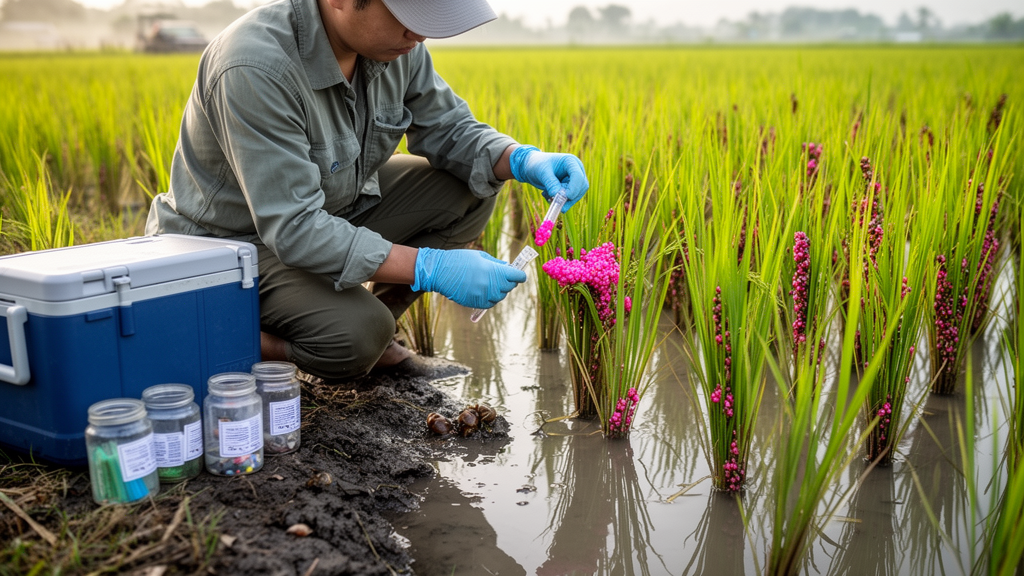
Invasive apple snails of the genus Pomacea have earned their place among the world’s worst aquatic pests, devouring rice and taro seedlings, degrading freshwater ecosystems, and even carrying parasites that threaten human health. Now, one of the largest mitochondrial DNA studies ever attempted on these mollusks has reconstructed, in unprecedented detail, how they spread from their South American homeland to Asia, North America, Europe, Pacific islands, and most recently East Africa. The findings, published in the journal NeoBiota, reveal that the world’s most destructive apple snail invader owes its success to repeated human-mediated introductions of genetically distinct lineages, while a cryptic sister species may be far more widespread in China than anyone realized.
The research team, led by scientists analyzing the invasion history of three apple snail species, assembled 428 complete mitochondrial genomes from Pomacea canaliculata, Pomacea maculata, and the recently described cryptic species Pomacea occulta, sampled from more than 40 localities across China and Southeast Asia. To place these high-resolution genomes in a global context, the researchers also compiled 2,704 publicly available COI barcode sequences covering the native range in South America and invasive populations across Asia, North America, Europe, and the Pacific. When combined with the COI fragments extracted from the newly sequenced mitogenomes, the final dataset encompassed 3,132 sequences, making it one of the most comprehensive genetic resources ever assembled for tracking freshwater invertebrate invasions.
Between 2020 and 2023, the team collected 260 adult apple snails from 15 cities across 11 provinces in mainland China, preserving them in ethanol or at –80 °C for DNA extraction. The researchers used next-generation sequencing on the DNBSEQ-T1 platform at BGI-Shenzhen to generate paired-end reads, then mapped these reads to a combined reference consisting of the P. canaliculata nuclear genome and representative mitogenomes of all three species. Mitochondrial sequences were enriched computationally, and complete circular mitogenomes were assembled using NOVOPLASTY, MITOZ, and GETORGANELLE, with the best-supported assembly selected for each individual based on gene completeness, circularization status, and read-mapping support. The resulting mitogenomes ranged from approximately 15,453 to 15,916 base pairs in P. canaliculata, with slight variation across the three species, and all retained the complete set of 13 mitochondrial protein-coding genes used for phylogenetic reconstruction.
The global COI haplotype network revealed a strikingly complex picture for P. canaliculata. Two massive star-like clusters, centered on the PC2 and PC3 haplotypes, each represented more than 1,000 individuals. The PC2 cluster showed a trans-oceanic distribution, spanning native lineages from Argentina and Chile as well as introduced populations in Papua New Guinea, Hawaii, and widespread Asia. Critically, the sharing of the central PC2 haplotype between native and invasive ranges was observed exclusively with Argentine populations, while Chilean and Uruguayan samples formed entirely separate branches in the network. This pattern strongly supports Argentina as the primary invasion source for the globally dominant lineage of P. canaliculata. Within mainland China, the PC2 haplotype was present at nearly all sampling sites, underscoring how thoroughly this single maternal lineage has permeated the country since apple snails were first introduced from China-Taiwan to Guangdong in 1981 for aquaculture.
Perhaps the most consequential discovery involved the haplotype PC1, which provided a unique genetic link between the extensive Asian population and the recent invasion of P. canaliculata in Kenya, first reported in 2021. To determine whether the Kenyan population arrived directly from the native South American range or secondarily through already-invaded regions, the researchers employed approximate Bayesian computation with random-forest model choice, testing five invasion scenarios using the 556-base-pair COI fragment. While individual scenarios did not produce a single definitive route, grouping the alternatives revealed that Asia-related scenarios were selected in 9 of 10 replicate analyses, with posterior probabilities ranging from 0.507 to 0.652. This tentative but consistent support points to a bridgehead effect, in which established Asian populations served as the source for the African invasion, a hypothesis reinforced by the intensification of trade and agricultural partnerships between Asia and East Africa over the past decade.
Complete mitochondrial genomes proved dramatically more informative than the classical COI barcode alone. The globally dominant PC2 haplotype, which appeared as a single unit in the COI network, was resolved into nine distinct mitogenomic haplotypes with recognizable geographic distributions. Similarly, PC3 was subdivided into ten mitogenomic haplotypes. This finer resolution enabled the researchers to partition global P. canaliculata into three major maternal lineages, designated Clades a, b, and c, with mean pairwise distances ranging from 4.20 to 4.55 percent among them. The mitogenomic data also resolved a long-standing phylogenetic conflict: while the short COI fragment placed P. canaliculata and P. occulta as sister taxa, the full 13-gene dataset consistently paired P. maculata and P. occulta instead, matching most previous mitogenomic studies. The researchers attributed the COI-based discrepancy to mutational saturation in short fragments, a topological artifact that full mitogenomes effectively overcome.
The three species displayed fundamentally different invasion strategies at the genetic level. P. canaliculata maintained remarkably high haplotype diversity (0.813) and the highest nucleotide diversity among the three species, but this diversity was concentrated in the divergence among clades rather than within them, indicating that multiple independent introductions of pre-existing divergent lineages, rather than in-situ mutation, generated the observed pattern. These lineages co-occur across many Chinese provinces, from coastal Fujian and Zhejiang to inland Hunan and Guangxi, a geographic overlap that supports human-mediated dispersal through aquaculture and the aquarium trade rather than natural spread. In stark contrast, P. maculata in mainland China exhibited extreme genetic uniformity, with all 21 sampled individuals sharing a single mitogenomic haplotype, PM_Hap4, distributed across Jiangling, Chengdu, Hangzhou, Nanchang, and Vietnam. This finding demonstrates that successful regional establishment can occur even with a restricted maternal composition, likely driven by the proliferation of one well-adapted lineage.
Neutrality tests and mismatch distribution analyses revealed sharp demographic contrasts between invasive and native populations. Within P. canaliculata, Clade a showed the strongest expansion signal, with significantly negative Fu’s Fs (–68.38) and Tajima’s D (–2.43, P < 0.001) and a strict L-shaped mismatch distribution, while Clade c also displayed significantly negative Fu and Li’s indices. Native-range samples, by contrast, generally showed non-significant or positive neutrality indices and multimodal mismatch distributions, reflecting long-term demographic stability in their South American home ranges. For P. maculata, the mainland Chinese population showed significant negative values indicating recent rapid expansion, while the USA-dominated clade exhibited positive values and a broad mismatch peak, suggesting a distinctly different demographic history. The invasive P. occulta also displayed strong and consistent expansion signals, with significantly negative Tajima’s D and Fu’s Fs complemented by a unimodal mismatch distribution.
The study also sounded an alarm about P. occulta, a cryptic species described only in 2019 that has been frequently misidentified as P. canaliculata due to their morphological similarity. All sampled P. occulta sequences came exclusively from Chinese populations, yet the species harbored seven COI haplotypes within mainland China, surpassing the three identified in P. maculata, and its mitogenomic Clade e included samples from Chongqing, Yunnan, Hunan, Hubei, Guizhou, Jiangxi, and Shenzhen. The researchers concluded that the invasive threat from P. occulta has likely been underestimated, and that molecular identification will be essential for monitoring this widespread but cryptic invader in future management programs.
By integrating global COI data with high-resolution complete mitogenomes, the study established a robust mitochondrial framework for deciphering apple snail invasion histories and provided essential genetic resources for biosecurity management. The findings underscore that biological invasions can succeed through strikingly different genetic strategies, whether through the admixture of multiple divergent lineages that counteract founder effects, as in P. canaliculata, or through the rapid expansion of a single well-adapted maternal lineage, as in mainland Chinese P. maculata. As climate change continues to expand the potential range of these snails into subtropical and temperate zones, the high-resolution genetic tools developed in this study will be critical for tracing secondary spread, identifying source regions of newly invasive populations, and designing targeted control strategies before the next bridgehead effect takes hold.
Subject of Research: Phylogeographic analysis of complete mitochondrial genomes and global COI sequences reveals invasion pathways, bridgehead effects, and cryptic diversity in invasive apple snails
Article Title: Large-scale mitochondrial DNA analysis unravels the global invasion patterns of Pomacea snails ( Gastropoda , Caenogastropoda , Ampullariidae )
Article References: Large-scale mitochondrial DNA analysis unravels the global invasion patterns of Pomacea snails ( Gastropoda , Caenogastropoda , Ampullariidae ). (n.d.). https://doi.org/10.3897/neobiota.109.189265
Image Credits: AI Generated
DOI: 10.3897/neobiota.109.189265
Keywords: invasive species, apple snails, Pomacea, mitochondrial DNA, phylogeography, bridgehead effect, biosecurity, NeoBiota, Large-scale, mitochondrial, analysis, unravels
Cite Scienmag News
Patricia Pace. (October 16, 2026). Giant DNA Sweep Reveals How Invasive Apple Snails Conquered the World. Scienmag. https://scienmag.com/giant-dna-sweep-reveals-how-invasive-apple-snails-conquered-the-world/
Patricia Pace. "Giant DNA Sweep Reveals How Invasive Apple Snails Conquered the World." Scienmag, 16 October 2026, https://scienmag.com/giant-dna-sweep-reveals-how-invasive-apple-snails-conquered-the-world/. Accessed 16 October 2026.
Patricia Pace. "Giant DNA Sweep Reveals How Invasive Apple Snails Conquered the World." Scienmag. October 16, 2026. https://scienmag.com/giant-dna-sweep-reveals-how-invasive-apple-snails-conquered-the-world/


