


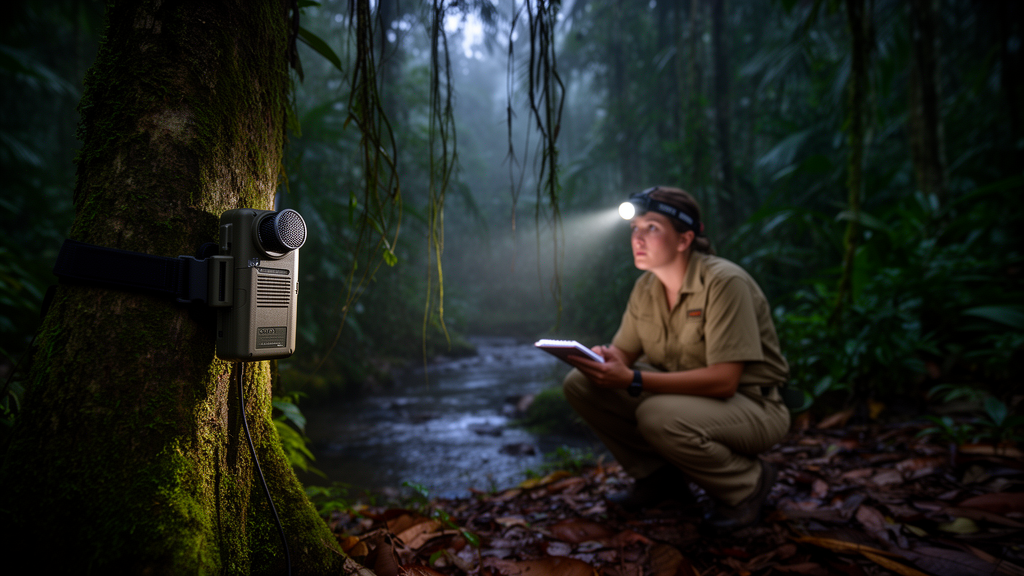
Deep inside a remote rainforest in Northeast India, tiny autonomous recorders strapped to trees have been eavesdropping on the night chorus of frogs, and what they heard is reshaping how scientists count amphibians in some of the planet’s most difficult terrain. A new study in the journal Herpetozoa provides the first comparison of passive acoustic monitoring and conventional visual encounter surveys for frogs in India, and the first anuran acoustic survey of its kind in Southeast Asia. The verdict: each method hears and sees a different slice of the frog community, and only by combining them do researchers get the full picture.
The research took place in and around Namdapha Tiger Reserve, a 1,985-square-kilometer protected area in Arunachal Pradesh that lies within the Indo-Burma biodiversity hotspot, one of the eight hottest hotspots on Earth. The reserve contains what is considered the northernmost lowland tropical wet evergreen forest in the world, and its enormous elevation range, from 200 to 4,571 meters, transitions from wet evergreen forests to wet temperate forests with increasing altitude. That habitat heterogeneity supports highly diverse species assemblages, including several endemic species found nowhere else. Yet previous amphibian surveys in this region relied entirely on observer-based methods and never incorporated passive acoustic monitoring.
Passive acoustic monitoring, or PAM, involves deploying autonomous recording units that capture the sounds of vocalizing species without any human presence during the recording period. The technology has grown rapidly more affordable over the last decade, opening acoustic surveys to wildlife researchers worldwide. But the field remains heavily skewed: until 2018, only about 12 percent of PAM studies focused on frogs, with bats and birds dominating the literature. More striking still, a recent review found no PAM studies of anurans in Asia between 2013 and 2023, even though the continent accounts for 25.5 percent of all frog species. The new study set out to close that gap in a landscape where rugged topography, dense vegetation, seasonal flooding, and logistical constraints have long hampered comprehensive biodiversity assessments.
The team selected fourteen sampling locations in the tropical evergreen forest zone, each corresponding to one of four habitats: lakes and ponds, rivers and streams, roadside water puddles, and swamps within the forest. Data were collected at the beginning of the wet season in May and June 2023, deliberately timed to avoid the risk of floods and landslides in the following months. Song Meter Micro units from Wildlife Acoustics served as the recorders, each powered by three AA alkaline batteries with silica bags inside to prevent moisture accumulation. The devices were configured to a sampling rate of 44.1 kHz with a gain of 18 dB, saving individual recordings as 60-minute files. Each unit was strapped securely to a tree or plant roughly two meters above the ground and set to record from dusk to midnight, coinciding with the peak activity period of amphibians.
To make the comparison fair, the researchers standardized effort between methods. Each recorder captured six hours of audio per site, while a nocturnal visual encounter survey conducted the following evening between 19:00 and 21:00 used three surveyors with flashlights searching for two hours, totaling six person-hours. For analysis, the acoustic data were subsampled to ten randomly selected minutes per hour of recording, yielding 60 minutes of call material per site. Using Raven Pro software, two team members with expertise in frog calls listened to the recordings and scanned spectrograms, annotating identified calls and measuring dominant frequencies. Species richness was then estimated for each method using a non-parametric bootstrap approach, resampling the fourteen sites with replacement 1,000 times, and the two estimates were compared statistically.
The headline result: both methods detected 19 amphibian species, belonging to 17 genera, with PAM capturing six families and VES seven. Both methods detected 11 endemic species, and the bootstrap-derived 95 percent confidence intervals for regional richness, ranging between 14 and 19 species, overlapped completely. A statistical test confirmed no significant difference in regional species richness between the two methods. But the composition of what each method detected told a subtler story. The Jaccard similarity coefficient came out at 0.652, meaning about 65 percent of species were recorded by both methods while roughly 17 percent were unique to each one.
Grouping species by ecological traits revealed where each method shines. PAM proved especially effective at detecting arboreal and fossorial frogs, animals hidden in the canopy or underground, outside the observer’s field of view. VES detected more species inhabiting streams, possibly because torrential ambient noise around waterways reduces acoustic detection rates. The acoustic recorders picked up calls from species that visual surveys missed entirely, including Nasutixalus jerdonii and Zhangixalus smaragdinus, both arboreal. Most remarkably, the recordings contained call types that turned out to be science entirely new. A low-frequency call attributed to a putative Limnonectes species was formally described as a new species, Limnonectes motijheel, documented calling from mud nests beneath leaf litter. Another previously undocumented call type, inferred from its spectral and temporal features to be a cryptic species within the genus Raorchestes, was subsequently described as Raorchestes nasuta. The PAM method also detected five species, including Microhyla eos, Hylarana leptoglossa, Nidirana noadihing, and Gracixalus patkaiensis, that had never been documented in earlier surveys of the landscape, which reported 14 species in 1984 and 22 in 2009.
Conversely, four species were detected only by visual surveys: Amolops adicola, Duttaphrynus melanostictus, Odorrana livida, and an unidentified Limnonectes. Many Odorrana species produce complex ultrasonic calls, likely outside the detection frequency range of the recorders. Amolops adicola, a riverine species with peak calling activity documented in October, was probably simply not vocalizing during the May-June study window. The Asian common toad Duttaphrynus melanostictus, terrestrial and conspicuous, produces low-frequency, low-intensity calls that ambient noise may mask. These patterns echo a broader truth: visual surveys perform well for amphibians that are non-vocal, call infrequently or quietly, or live in acoustically noisy habitats.
When the two methods were combined, the mixed approach recorded 23 species, 21 percent more than either method alone, and the richness estimate was significantly higher than for PAM or VES individually. Species accumulation curves showed new species still being detected at a decelerating but positive rate for all three methods, with each additional site adding roughly 0.46 to 0.53 species. Nearly half the species detected by the mixed method appeared at a maximum of two sites, reflecting both habitat complexity and incomplete sampling. Extrapolation suggested the curve would approach an asymptote at about three times the current sampling effort, meaning roughly 40 sites spanning different elevations and habitats would be needed for a comprehensive inventory of the Namdapha landscape.
The study was not without constraints. Resource limitations restricted each recorder to a single night per site, though PAM’s full potential is typically realized through long-term deployments. Sampling was confined to the onset of the wet season, excluding full seasonal variation, and locations were based on previously surveyed accessible sites rather than the reserve’s complete altitudinal range. Even so, PAM detected a diverse assemblage including acoustically distinct taxa never recorded before, underscoring its sensitivity even under limited effort. The authors recommend deploying recorders for longer durations, sampling across multiple seasons, and complementing acoustics with visual surveys wherever possible. As amphibians remain the most threatened vertebrate class with an extinction rate showing no sign of decline, and with roughly 780 new species described between 2016 and 2020 alone, the message is clear: in the world’s most rugged rainforests, listening devices and human eyes are better together than either is alone.
Subject of Research: Comparative effectiveness of passive acoustic monitoring and visual encounter surveys for detecting anuran species in a tropical wet evergreen forest in the Indo-Burma biodiversity hotspot
Article Title: Frogs in sight and sound: passive acoustics and visual surveys reveal complementary species detection in tropical rainforest anurans
Article References: Rajiv, N. V., & Das, A. (2026). Frogs in sight and sound: passive acoustics and visual surveys reveal complementary species detection in tropical rainforest anurans. Herpetozoa, 39, 261-271. https://doi.org/10.3897/herpetozoa.39.e168386
Image Credits: AI Generated
DOI: 10.3897/herpetozoa.39.e168386
Keywords: passive acoustic monitoring, visual encounter surveys, anurans, tropical rainforest, Indo-Burma biodiversity hotspot, Namdapha Tiger Reserve, amphibian surveys, autonomous recording units, species richness, Northeast India, bioacoustics, conservation
Cite Scienmag News
Margaret Porter. (October 16, 2026). Ears in the rainforest: Autonomous recorders and human surveys team up to count tropical frogs. Scienmag. https://scienmag.com/ears-in-the-rainforest-autonomous-recorders-and-human-surveys-team-up-to-count-tropical-frogs/
Margaret Porter. "Ears in the rainforest: Autonomous recorders and human surveys team up to count tropical frogs." Scienmag, 16 October 2026, https://scienmag.com/ears-in-the-rainforest-autonomous-recorders-and-human-surveys-team-up-to-count-tropical-frogs/. Accessed 16 October 2026.
Margaret Porter. "Ears in the rainforest: Autonomous recorders and human surveys team up to count tropical frogs." Scienmag. October 16, 2026. https://scienmag.com/ears-in-the-rainforest-autonomous-recorders-and-human-surveys-team-up-to-count-tropical-frogs/


