


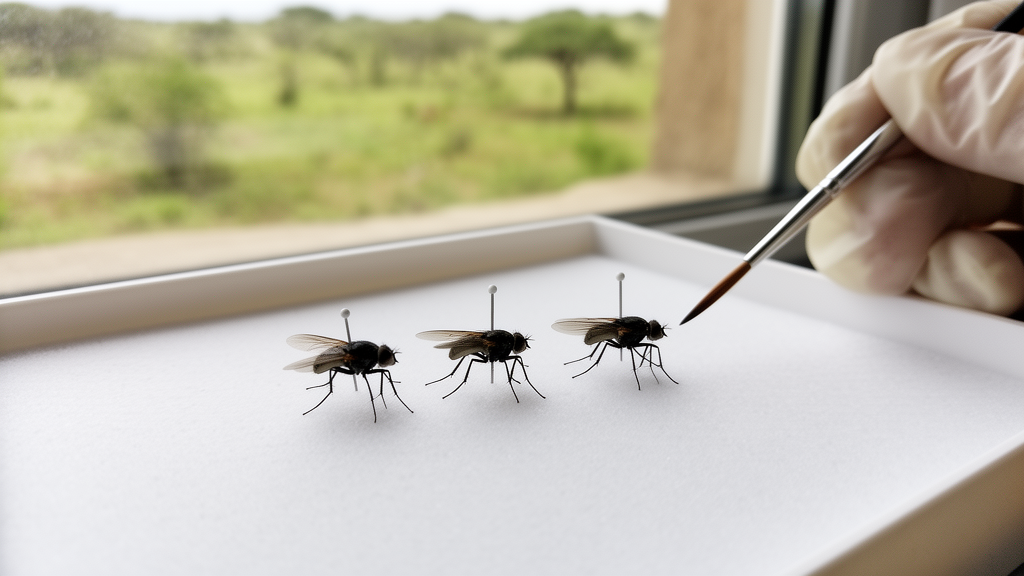
Deep in the Angolan wilderness, during a 2022 expedition to the remote source lake of the Cuanavale River, entomologists netted and trapped a group of flies that most people would swat away without a second glance. Those specimens have now yielded something remarkable: three species of shoot fly entirely new to science, alongside a suite of new country records that dramatically expand what is known about Angola’s insect fauna. The findings, published in the journal African Invertebrates, underscore how much biodiversity remains hidden in regions where decades of civil war kept scientists away.
The genus Atherigona, commonly known as shoot flies, belongs to the family Muscidae and ranks among its most speciose groups, with roughly 260 described species worldwide. About 172 of those occur in the Afrotropical region, and the flies inhabit every zoogeographical region except Antarctica. Their economic importance is considerable: the larvae of the nominate subgenus Atherigona feed mostly on grasses in the family Poaceae, which includes cereal crops, and their feeding behavior measurably reduces agricultural yields. The smaller subgenus Acritochaeta is generally composed of saprophages or facultative predators living in decaying organic matter, though one member, Atherigona orientalis, breaks the mold and attacks crops such as peppers, tomatoes, and sorghum.
Despite this agricultural significance, the diversity of shoot flies remains poorly understood, and nowhere more so than in Angola. The country’s ecological landscape spans rainforests, savannas, and dunes, providing habitat for a rich flora and fauna, but biodiversity research stalled for years during the civil war that ran from 1975 to 2002. Interest in Angolan biological collections has re-emerged in recent years, and a 2016 inventory of the country’s Muscidae listed 33 species, roughly 30 percent of which belonged to Atherigona. Taxonomic work on the group, however, remained scarce until now.
The new study, led by researcher Magoai with colleagues including collector T. Bellingan, catalogs a total of 13 Atherigona species from Angola. Nine were previously recorded, including Atherigona bedfordi, A. campestris, A. cogani, A. laevigata, both subspecies of A. lineata, A. matilei, A. mirabilis mirabilis, and A. ruficornis. One already-described species, A. albistyla, is added as a new record for the country, previously known from Burkina Faso, Kenya, Mali, Namibia, Nigeria, and Uganda. And three species are entirely new to science: Atherigona adelinahae, A. angolaensis, and A. cuanavaleensis.
The specimens behind the new species were collected during the Lisima Expedition in 2022 at three sites: the Cuanavale source lake in Moxico Province, a riverbank on the Lungwebungu River, and a location near Camacupa in Bié Province. Flies were captured either by hand with a sweep net or through Malaise traps, then micro-pinned in the field. Collecting and export permits were issued by Angola’s National Institute of Biodiversity and Conservation Areas, and the material is housed at the Albany Museum in Makhanda, South Africa.
Identifying Atherigona species is notoriously difficult and typically demands taxonomic expertise. The vast majority of species can only be distinguished using a special male terminal structure called the trifoliate process, or the shape of the eighth abdominal segment in females, combined with external color features. Most species descriptions are based solely on males, and because the sexes are sexually dimorphic, matching unknown females to male species is unreliable unless specimens are collected in copula or in large series from the same type locality. No single key covers all described species, though regional keys for the Afrotropical fauna provide useful guidance.
To make identification tractable, the researchers prepared a complete dichotomous key to the males of all 13 Angolan species, built around diagnostic characters such as the position of the r–m crossvein within the discal medial cell, the shape of the hypopygial prominence, and the detailed morphology of the trifoliate process. Specimens were macerated in heated potassium hydroxide to expose terminal structures, examined under a stereomicroscope, and illustrated with photographs and digital drawings. The key separates the two subgenera first: Acritochaeta species lack the trident-shaped trifoliate process and hypopygial prominence that define the nominate subgenus.
The three new species each carry distinctive signatures. Atherigona adelinahae, named in honor of the first author’s mother, is a dark fly most similar in appearance to A. binubila but distinguishable by a glossy frontal plate and a hypopygial prominence shaped like a truncated knob bearing four processes, two projecting forward and two backward, rather than the two processes of its relative. Atherigona angolaensis, named for the country itself, resembles A. ochripes but differs in having a widely knob-shaped hypopygial prominence with only weakly developed posterior processes. Atherigona cuanavaleensis, named after the Cuanavale River source lake where its holotype was caught, is closest to A. tigris but lacks the brown smoky wing suffusion of that species and shows subtle differences in the width of the lateral plates of its trifoliate process.
The study also corrected errors in earlier identification keys. Prior couplets dealing with A. albistyla erroneously stated that at least the fore tibia is largely infuscated, when in fact only the apical third shows darkening. Other couplets referred to the trifoliate process where the hypopygial prominence was actually meant. The researchers also documented that each process of the A. albistyla hypopygial prominence widens apically into anterior and posterior sub-processes, a feature not captured in the original description, and noted that the trifoliate process of the Angolan specimen ends more rounded than in previously published figures.
Beyond the new species and records, the work provides brief generic diagnoses and illustrations of most Angolan Atherigona species, creating a foundation for future taxonomic and agricultural research in a country whose insect fauna is only beginning to be surveyed in the post-war era. As interest in Angolan biodiversity continues to grow, studies like this one suggest that many more undescribed species are waiting in the country’s savannas, forests, and river systems, and that understanding them may matter not just for science but for the farmers whose crops these tiny flies quietly attack.
Subject of Research: Taxonomic revision of the shoot fly genus Atherigona in Angola, describing three new species and providing an identification key
Article Title: A contribution to the Atherigona ( Diptera , Muscidae ) fauna of Angola
Article References: A contribution to the Atherigona ( Diptera , Muscidae ) fauna of Angola. (n.d.). https://doi.org/10.3897/afrinvertebr.66.160212
Image Credits: AI Generated
DOI: 10.3897/afrinvertebr.66.160212
Keywords: Atherigona, shoot flies, Angola, Diptera, Muscidae, taxonomy, new species, biodiversity, agricultural pests, Afrotropical region, contribution, fauna
Cite Scienmag News
Gavin Prescott. (October 16, 2026). Three New Shoot Fly Species Revealed in Angola’s Little-Explored Insect Fauna. Scienmag. https://scienmag.com/three-new-shoot-fly-species-revealed-in-angolas-little-explored-insect-fauna/
Gavin Prescott. "Three New Shoot Fly Species Revealed in Angola’s Little-Explored Insect Fauna." Scienmag, 16 October 2026, https://scienmag.com/three-new-shoot-fly-species-revealed-in-angolas-little-explored-insect-fauna/. Accessed 16 October 2026.
Gavin Prescott. "Three New Shoot Fly Species Revealed in Angola’s Little-Explored Insect Fauna." Scienmag. October 16, 2026. https://scienmag.com/three-new-shoot-fly-species-revealed-in-angolas-little-explored-insect-fauna/


