


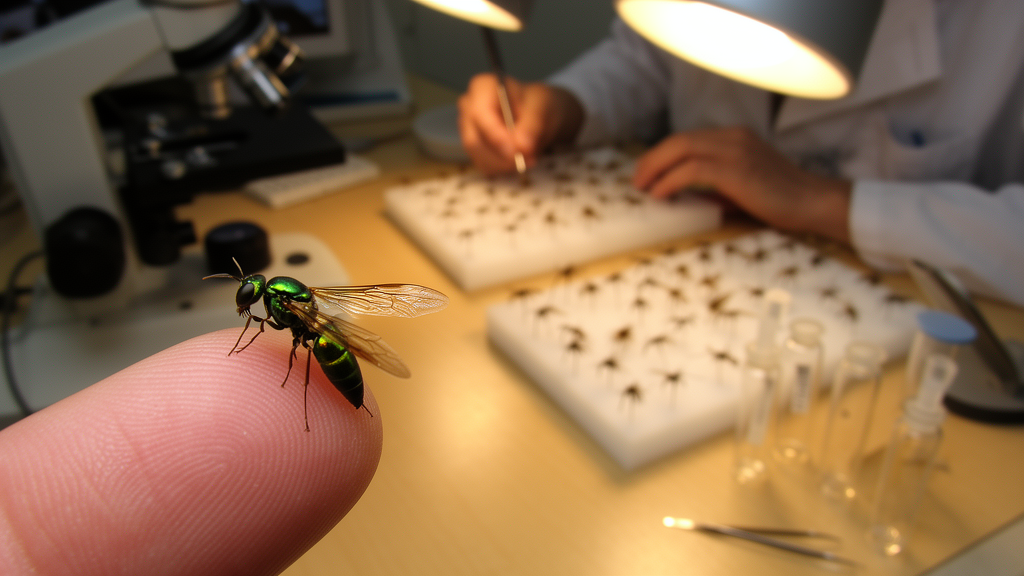
Deep in the collections of natural history museums across Europe and Asia, a quiet revolution has been underway among some of the planet’s smallest and least celebrated insects. A comprehensive review of the Palaearctic species of the parasitoid wasp genus Syntomopus, published in the Journal of Hymenoptera Research, has delivered a new species from Russia, Turkey, Kazakhstan and China, collapsed two long-accepted species into synonymy, and produced the first complete identification key for every member of the genus in the region. For a group of wasps that measure barely two to three millimetres from head to tail, the taxonomic shake-up carries consequences far beyond the museum drawer.
Syntomopus belongs to the family Pteromalidae, subfamily Miscogastrinae, a lineage of chalcidoid wasps whose ecological role is anything but trivial. Nearly all species in the genus are primary parasitoids of agromyzid flies, the leaf-mining and stem-boring dipterans that include some of agriculture’s most persistent pests, such as species of Agromyza, Liriomyza, Melanagromyza, Napomyza and Phytomyza. Two outliers in the genus have switched hosts entirely, attacking plume moths of the family Pterophoridae instead. Because these wasps regulate herbivorous fly populations naturally, knowing exactly which species exist, where they live and how to tell them apart is a prerequisite for any serious biological control programme.
Until this review, the genus comprised 19 valid species distributed across five biogeographic realms: the Palaearctic, Oriental, Nearctic, Neotropical and Australian regions. Only nine of those had been recorded in the Palaearctic. The new work, based on type material deposited in London, Budapest, Lund, Beijing, St Petersburg and Urumqi, redescribed and illustrated every available type and brought the Palaearctic fauna into a single, coherent framework. The authors followed modern morphological terminology, including sculpture and wing venation nomenclature, and used precise measurement conventions for head proportions, antennal segments and mesosomal structures to make the descriptions reproducible.
The centrepiece of the paper is Syntomopus dzhanokmenia sp. nov., described from a holotype collected in a Malaise trap at an agricultural market in Awat County, Xinjiang, China, at 1041 metres elevation, together with paratypes from Russia’s Altay, Khabarovsk, Primorsky and Sakhalin regions, from Adiyaman in Turkey, and from West Kazakhstan and Baicheng County in China. The species is named in honour of Dr Klarissa Alekseevna Dzhanokmen, a prominent entomologist and expert on Pteromalidae. Females measure 2.1 to 2.5 millimetres with fore wings of 1.7 to 2.0 millimetres; males are slightly smaller at 2.0 to 2.3 millimetres.
What makes S. dzhanokmenia diagnosable is a distinctive combination of characters. In frontal view the head is 1.15 to 1.25 times as broad as high and 1.23 to 1.3 times as broad as the mesoscutum. The antenna carries a yellow or yellowish-brown scape, and all femora are yellow, sometimes with brown hind femora. The propodeum, the dorsal plate of the middle body segment, is 0.67 to 0.87 times as long as the mesoscutellum and bears a full median carina, while the mesoscutellum itself is distinctly flat, 0.82 to 0.88 times as long as broad. The fore wing has a bare basal cell and a wing margin fringed with cilia. These traits separate it cleanly from its closest relative, S. incurvus, whose scape and femora are dark brown or metallic dark blue-green and whose basal cell carries one to four setae.
The synonymies are equally consequential. Examination of the holotype of Syntomopus crassicornis (Szelényi, 1970), the lectotype of S. incisus Thomson, 1878, and the lectotype of S. thoracicus Walker, 1833, together with fresh material from Europe, Russia and Central Asia, confirmed that all three names refer to a single species. S. crassicornis and S. incisus are now formally synonymised under S. thoracicus, the type species of the genus, originally described by Walker in 1833. The review also corrected a long-standing error: earlier identification keys by Graham and Hedqvist characterised S. thoracicus as having a propodeum with a full median carina, but the lectotype clearly shows an incomplete one. That mistake had led generations of workers to confuse S. thoracicus with S. incurvus, two species now separable by head and mesosomal coloration, the relative length of the pedicel against the first funicular segment, and the completeness of the propodeal median carina.
New faunal records extend the known ranges of two species. Syntomopus thoracicus is recorded for the first time from Uzbekistan, based on a male specimen from the Karakul Reserve, and S. oviceps Thomson, 1878 is recorded for the first time from Kazakhstan, from the Dzungarian Alatau. S. oviceps is one of the more peculiar members of the genus, instantly recognisable by its elongated head: in frontal view the head is only 0.8 to 0.9 times as broad as high in females, and the posterior ocellar line is 1.9 to 2.0 times as long as the ocello-ocular line, proportions that set it apart from every other Palaearctic Syntomopus.
The identification key provided covers females and males of seven Palaearctic species, built on quantitative characters rather than vague impressions. Females of S. oviceps are separated by head breadth-to-height ratios and POL-to-OOL proportions; S. turanicus Dzhanokmen, 2000 is distinguished by a POL 1.7 times as long as OOL, a marginal vein 1.4 to 1.6 times as long as the postmarginal vein, and a wing margin entirely without cilia. S. agromyzae Hedqvist, 1973, known from Sweden and the United Kingdom as a parasitoid of Hexomyza cecidogena, is recognised by a weakly arched mesoscutellum 1.15 to 1.2 times as long as broad and a propodeum only 0.38 to 0.52 times as long as the mesoscutellum. S. fuscipes Huang, 1991, from China, remains known only from males; the review revealed that the paratype had been incorrectly labelled as female, meaning the features in the original publication actually characterise a male, and no female of the species has ever been found.
One species proved stubbornly elusive. Syntomopus pallipes, described by Rudow from Sicily in 1886, could not be included in the key or the descriptive section because its original description is too brief and no type material was available for study. Its true identity may remain unresolved until a type specimen surfaces in a collection somewhere. Meanwhile, the holotype of S. turanicus may have been lost, as it was probably never returned to the Zoological Institute in St Petersburg; only a few non-type male specimens from Kazakhstan could be located, and the female description still rests on the original 2000 publication.
For ecologists and biological control practitioners, the practical message is that species-level precision in this genus depends on characters most people would never notice: the number of teeth on the clypeal margin, the presence or absence of a genal lamina, the setation of the basal cell of the fore wing, the shape of the petiolar flange. Yet those millimetre-scale details determine whether a wasp collected from a crop field is a known natural enemy or an undescribed ally waiting to be named. With all available types now redescribed and illustrated, and a reliable key in hand, the Palaearctic Syntomopus fauna has never been more accessible to the scientists who depend on it.
Subject of Research: Entomology
Article Title: Review of the Palearctic Syntomopus Walker, 1833 ( Hymenoptera , Pteromalidae ), with description of new species
Article References: Li, Q., Li, X., Yin, H., Xiao, H., & Tselikh, E. V. (2026). Review of the Palearctic Syntomopus Walker, 1833 (Hymenoptera, Pteromalidae), with description of new species. Journal of Hymenoptera Research, 99, 833-855. https://doi.org/10.3897/jhr.99.186997
Image Credits: AI Generated
Keywords: Syntomopus, Pteromalidae, parasitoid wasps, Hymenoptera, taxonomy, new species, synonymy, Palaearctic, Agromyzidae, biological control, identification key, Journal of Hymenoptera Research
Cite Scienmag News
Gavin Prescott. (October 16, 2026). Tiny Parasitoid Wasps Get a Modern Makeover: New Species and Hidden Synonyms Reshaped. Scienmag. https://scienmag.com/tiny-parasitoid-wasps-get-a-modern-makeover-new-species-and-hidden-synonyms-reshaped/
Gavin Prescott. "Tiny Parasitoid Wasps Get a Modern Makeover: New Species and Hidden Synonyms Reshaped." Scienmag, 16 October 2026, https://scienmag.com/tiny-parasitoid-wasps-get-a-modern-makeover-new-species-and-hidden-synonyms-reshaped/. Accessed 16 October 2026.
Gavin Prescott. "Tiny Parasitoid Wasps Get a Modern Makeover: New Species and Hidden Synonyms Reshaped." Scienmag. October 16, 2026. https://scienmag.com/tiny-parasitoid-wasps-get-a-modern-makeover-new-species-and-hidden-synonyms-reshaped/


