


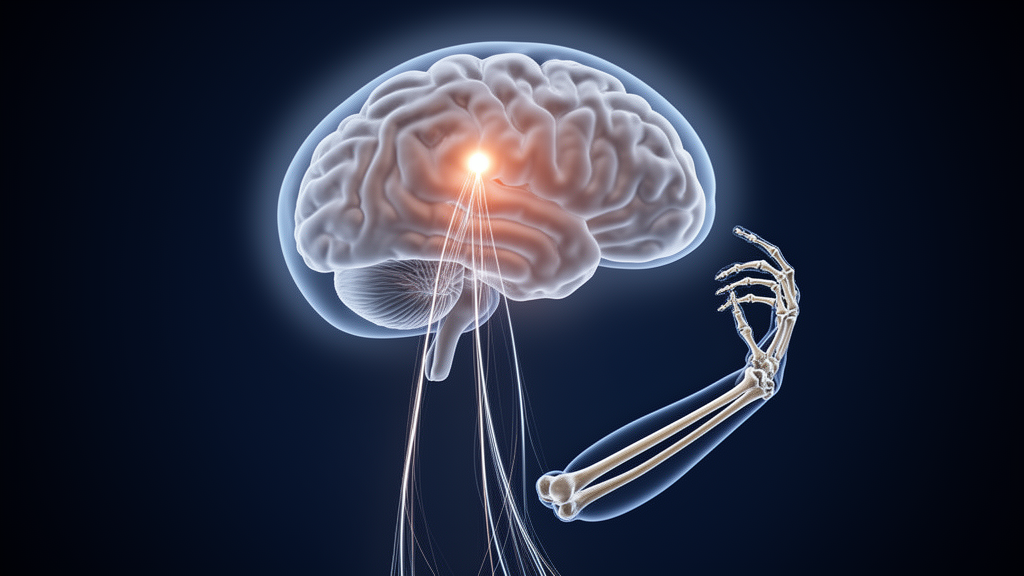
For decades, neuroscientists have debated whether the primary motor cortex (M1) merely relays movement commands from elsewhere in the brain or whether it actively generates the learned patterns of activity that underlie skilled movements. A new study published in Nature by Qiyu Chen, An Wu, Takaki Komiyama and colleagues at the University of California San Diego provides some of the most direct evidence yet that M1 plays an active, causal role. Using a sophisticated combination of in vivo two-photon calcium imaging and holographic optogenetic stimulation, the team showed that brief, precisely timed activation of a small ensemble of roughly 20 neurons in layer 2/3 of M1 can trigger movements that closely resemble a learned skilled action in mice.
The experimental system centered on a skilled lever-pressing task. Mice were trained to press a lever in response to a cue, and over weeks of practice they developed a highly stereotyped movement pattern. Previous work from the Komiyama lab had established that during the execution of learned motor skills, the neural population in layer 2/3 of M1 expresses a reproducible spatiotemporal activity pattern — a reliable sequence of activations across specific neurons that unfolds in a consistent order before and during the movement. What remained contested was whether this learned pattern is causally responsible for driving the learned movement or whether it is simply a byproduct, a cortical echo of commands generated by subcortical structures such as the cerebellum and thalamus.
To resolve this question, the researchers employed an all-optical approach that allowed them to both record and manipulate neural activity with cellular resolution. Two-photon calcium imaging captured the activity of thousands of individual neurons in M1 layer 2/3 while mice performed the task. Holographic optogenetic stimulation then used tightly focused patterns of light to activate functionally defined subsets of those same neurons — specifically, about 20 neurons whose activity onset reliably precedes voluntary movement onset. These are the so-called early-onset neurons, the members of the ensemble that appear to lead the learned sequence.
The results were striking. When the researchers briefly and synchronously stimulated the early-onset ensemble in task-engaged mice, the animals produced movements resembling the learned lever press. Moreover, the stimulation induced activity patterns in other M1 neurons that resembled the learned activity pattern. In other words, activating the leading edge of the sequence was sufficient to recruit the rest of the learned cortical pattern and to launch the learned movement. This finding supports the idea that M1 actively participates in generating the learned spatiotemporal activity pattern rather than passively reflecting it.
Critical control experiments sharpened the interpretation. When the researchers stimulated neurons whose activity followed movement onsets — the late-onset ensemble — the stimulation failed to induce the learned movement in task-engaged mice. This temporal specificity demonstrates that it is not simply the number of stimulated neurons or the location within M1 that matters, but the precise identity and timing of the neurons within the learned sequence. Extended data analyses confirmed that early- and late-onset target neurons did not differ in their general properties, including their spatial distribution, peak activity amplitudes, or response consistency during voluntary movements, ruling out trivial explanations for the distinct stimulation outcomes.
The study also revealed a deep relationship between cortical state and movement variability. Trial-by-trial variability of the optogenetically triggered population activity correlated with variability in the induced movements. Remarkably, these variabilities were predicted by the initial state of M1 activity preceding stimulation. When the pre-stimulation population activity was closer to the learned activity pattern, the subsequent movements were more similar to the learned movement. This finding aligns with a dynamical systems perspective on motor cortex function, in which preparatory activity sets the initial conditions of the cortical circuit, and a triggering input then launches the circuit along a reproducible trajectory. The initial state effectively determines how the circuit will respond to the same trigger.
Perhaps the most intriguing result emerged from trials in which stimulation induced the learned cortical activity pattern without inducing any movement. In these trials, the learned activity arose internally in M1 even though no movement followed. This indicates that the learned cortical pattern is not simply a reflection of movements — it can be generated internally by the cortical circuit itself. The dissociation between cortical activity and movement in these trials provides strong evidence that M1 can autonomously generate the learned pattern, consistent with theoretical models in which recurrent cortical dynamics produce reproducible sequences once the circuit is in the right state and receives a precise trigger.
Context dependence proved essential. When the researchers applied the same stimulation protocol to task-disengaged mice — animals that were not attending to the task — the stimulation failed to generate either movements or the learned activity pattern. This failure in disengaged states suggests that the cortical circuit must be prepared at an optimal initial state for the trigger to be effective. The learned pattern cannot be launched by the trigger alone; the circuit must be in a receptive configuration. This finding resonates with a broader literature on preparatory activity in motor cortex, including work by Churchland, Shenoy and colleagues showing that cortical preparatory activity predicts movement performance and variability.
The technical achievement underlying these findings is considerable. Holographic optogenetics allows researchers to stimulate multiple individually selected neurons simultaneously with micron-scale spatial precision, while two-photon calcium imaging records the activity of the surrounding network. The combination — sometimes called all-optical interrogation — enables causal tests of neural function at the resolution of individual neurons within intact circuits in behaving animals. The spatial accuracy of the stimulation was verified by positioning stimulation patterns at increasing distances from target neurons and confirming that target neuron activity was elicited only when the stimulation pattern was centered on the target.
The implications extend beyond basic neuroscience. Understanding how learned movement patterns are generated in motor cortex — and how cortical state, triggering inputs, and recurrent dynamics interact — has direct relevance for brain-machine interfaces, which aim to decode movement intentions from cortical activity, and for therapeutic approaches to motor disorders. The study also connects to recent work from the Komiyama lab showing that motor learning refines thalamic influence on motor cortex, suggesting that the triggering inputs that launch learned cortical patterns may arise from thalamocortical circuits refined by learning. Together, the findings support a model in which learned movements emerge when M1 is prepared at the optimal initial state and receives precise triggering inputs — a convergent mechanism that resolves a long-standing debate about the active role of motor cortex in skilled movement.
Subject of Research: Targeted stimulation of motor cortex ensembles drives learned movements
Article Title: Targeted stimulation of motor cortex ensembles drives learned movements
Article References: Targeted stimulation of motor cortex ensembles drives learned movements. (n.d.). https://doi.org/10.1038/s41586-026-11174-3
Image Credits: AI Generated
DOI: 10.1038/s41586-026-11174-3
Keywords: Targeted, stimulation, motor, cortex, ensembles, drives, learned, movements, scientific research
Cite Scienmag News
Cassandra Pierce. (October 16, 2026). Precise triggers in motor cortex can launch learned movements. Scienmag. https://scienmag.com/precise-triggers-in-motor-cortex-can-launch-learned-movements/
Cassandra Pierce. "Precise triggers in motor cortex can launch learned movements." Scienmag, 16 October 2026, https://scienmag.com/precise-triggers-in-motor-cortex-can-launch-learned-movements/. Accessed 16 October 2026.
Cassandra Pierce. "Precise triggers in motor cortex can launch learned movements." Scienmag. October 16, 2026. https://scienmag.com/precise-triggers-in-motor-cortex-can-launch-learned-movements/


