


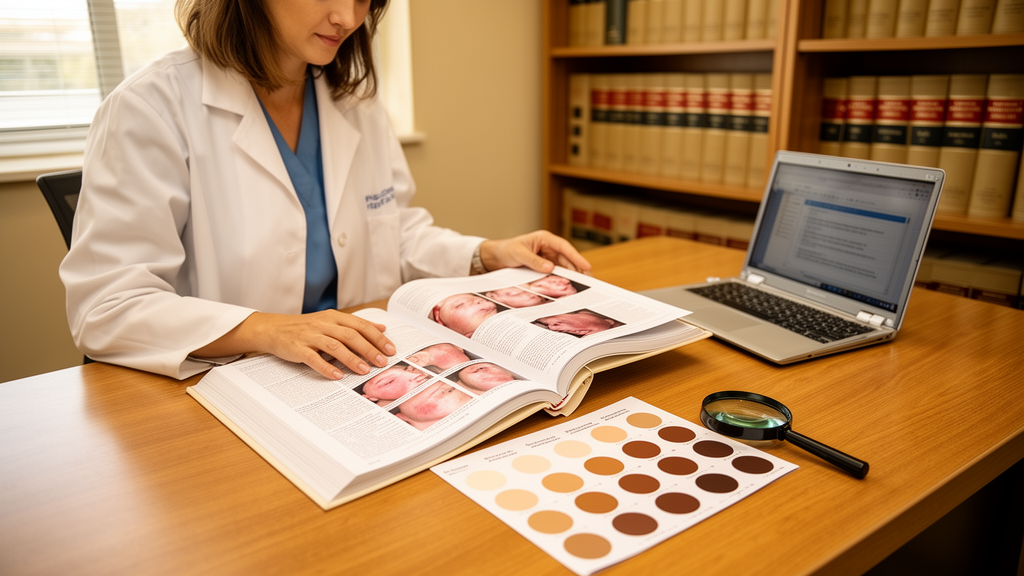
A systematic image analysis of seven widely adopted dermatologic surgery textbooks has found that fewer than one in ten clinical images depict skin of colour, a gap that researchers say may reinforce diagnostic blind spots and perpetuate disparities in surgical outcomes for patients with richly pigmented skin. The study, published in Archives of Dermatological Research, examined 3,334 figures and found that only 8.7 percent showed skin classified as Fitzpatrick skin types IV through VI, the range encompassing moderately brown to deeply pigmented skin. One textbook contained just 0.5 percent such images, effectively erasing the majority of the world’s population from its visual record.
The research, led by Ou Jia Emilie Wang and Quinn Stewart of the Faculty of Medicine at the University of British Columbia together with Jincheng Shi of the Division of Dermatology at The Ottawa Hospital and the University of Ottawa, was structured as a research letter but carries the weight of a large-scale audit. Two independent reviewers went through the figure collections of seven textbooks that are widely used in dermatologic surgery training, classifying every image by Fitzpatrick skin type and recording the associated diagnoses, procedures, and pigmentation findings. The Fitzpatrick scale, originally developed in 1975 to standardize responses to ultraviolet light, remains the dominant classification framework in dermatology despite well-documented limitations, and its six-category spectrum from type I, pale skin that always burns, to type VI, deeply pigmented skin that never burns, provided the study’s core metric.
The aggregate figure of 8.7 percent conceals a steeper drop-off in the subspecialties where visual pattern recognition matters most. Images depicting skin of colour were scarcest in Mohs micrographic surgery, the tissue-sparing technique for skin cancer removal, where they accounted for just 1.5 percent of figures. Facial reconstruction fared worst of all at 0.6 percent, followed by tumour imagery at 2.4 percent and wound care at 3.2 percent. These are precisely the domains in which surgeons must judge erythema, margins of inflammation, postoperative pigmentary change, and scarring patterns against a baseline that differs fundamentally from the pale skin that dominates the literature.
The clinical stakes of this visual deficit are not abstract. In highly pigmented skin, erythema may appear subtle or violaceous rather than bright red, making the early recognition of infection, flap ischemia, or allergic contact reactions considerably harder for a trainee who has never seen these presentations. Post-inflammatory hyperpigmentation and hypopigmentation, both common sequelae of surgical trauma in skin of colour, follow different courses and respond to different interventions than in lighter skin. Keloidal scarring, which occurs disproportionately in genetically darker skin, demands different surgical planning and adjunctive therapy. A recent systematic review of post-inflammatory hyperpigmentation treatment in skin of colour, cited by the authors, underscores how much of the evidence base itself is built on studies that under-recruit darker-skinned patients, compounding the textbook gap at every level of the educational pipeline.
The consequences extend into oncology. Acral lentiginous melanoma, the subtype that arises on the palms, soles, and nail apparatus, occurs at similar rates across populations but is disproportionately represented among people with darker skin, precisely because ultraviolet-driven melanomas are rarer there. Yet because educational imagery overwhelmingly shows melanoma on light skin, delayed diagnosis of acral lesions remains a documented driver of the survival gap, with population-level analyses from the United States showing worse outcomes for this subtype dating back decades. When a surgical textbook shows a trainee one hundred examples of melanoma and only a handful on brown or Black skin, the pattern-matching machinery of clinical judgment is calibrated accordingly.
The authors also flagged a structural problem that goes beyond simple counts: the near-total absence of standardized Fitzpatrick skin type labelling in the figures themselves. Without explicit labelling, readers cannot reliably identify which images depict which skin types, cannot gauge representation in any given chapter, and cannot use the images for calibrated self-testing. The lack of standardized annotation limits the educational value of whatever diverse imagery does exist and makes it difficult for publishers to track progress over time. In effect, the audit found both a quantitative shortfall and a qualitative infrastructure problem, since even the minority of skin-of-colour images are not systematically curated, tagged, or indexed for teaching purposes.
The new study builds on and extends a growing body of audit literature. A widely cited 2021 cross-sectional analysis published in the Journal of the American Academy of Dermatology by Alvarado and Feng found similar underrepresentation of dark skin in educational resources for common dermatologic conditions, helping to catalyze a wave of similar audits across journals, board review materials, and medical school curricula. The present analysis is notable for focusing specifically on dermatologic surgery, a procedural discipline in which the visual baseline matters not only for diagnosis but for intraoperative decision-making, and for its sheer scale, with more than three thousand figures classified by two independent reviewers rather than sampled or estimated.
The disparities documented in the textbooks mirror documented inequities in care. A 2025 comprehensive review of disparities in surgical site infection diagnosis and management in highly pigmented skin tones, cited in the study, describes how delayed recognition of infection in darker skin contributes to worse outcomes, while work on Mohs micrographic surgery in skin of colour has highlighted both the technical adaptations required and the scarcity of guidance available to surgeons. Educational materials are not the sole cause of such disparities, but they are a modifiable upstream factor: a resident who trains exclusively on images of light skin enters practice with a systematically skewed prior, and no amount of individual goodwill fully compensates for a curriculum that never showed them the relevant presentations.
The authors argue that deliberate, structured inclusion of skin of colour in surgical dermatology resources is necessary to support diagnostic accuracy and promote more equitable care. In practice, that means commissioning and licensing clinical photography that represents the full Fitzpatrick spectrum, standardizing skin type labelling across figures, and prioritizing the subspecialty areas where the deficit is most acute, particularly facial reconstruction and Mohs surgery. Some publishers and educational platforms have begun such initiatives in response to earlier audits, but the new data suggest that the field’s foundational textbooks, the reference works against which trainees are examined, have not yet caught up. The study’s authors received no external funding for the analysis and declare no competing interests.
As dermatology confronts a demographic reality in which the majority of the global population has pigmented skin, and as populations in North America and Europe grow increasingly diverse, the visual canon of the specialty is under pressure to change. The message of this audit is quantitative and unambiguous: out of 3,334 images across seven authoritative textbooks, fewer than three hundred showed the skin types carried by most of humanity. Closing that gap will require more than good intentions; it will require the same systematic curation, labelling, and editorial accountability that the field applies to its evidence base, so that the next generation of surgeons learns to read every skin the way it has long been trained to read one.
Subject of Research: Representation of skin of colour in dermatologic surgery textbook imagery
Article Title: Skin of colour representation in dermatologic surgery textbooks: an image analysis
Article References: Wang, O. J. E., Stewart, Q., & Shi, J. (2026). Skin of colour representation in dermatologic surgery textbooks: an image analysis. Archives of Dermatological Research, 318(1), Article 385. https://doi.org/10.1007/s00403-026-04853-8
Image Credits: AI Generated
DOI: 10.1007/s00403-026-04853-8
Keywords: dermatologic surgery, skin of colour, Fitzpatrick skin type, medical education, health equity, Mohs surgery, textbook imagery, facial reconstruction, post-inflammatory hyperpigmentation, diagnostic disparity, dermatology training, wound care
Cite Scienmag News
Ophelia Keating. (October 16, 2026). Dermatologic Surgery Textbooks Show Skin of Colour in Under 9 Percent of Images. Scienmag. https://scienmag.com/dermatologic-surgery-textbooks-show-skin-of-colour-in-under-9-percent-of-images/
Ophelia Keating. "Dermatologic Surgery Textbooks Show Skin of Colour in Under 9 Percent of Images." Scienmag, 16 October 2026, https://scienmag.com/dermatologic-surgery-textbooks-show-skin-of-colour-in-under-9-percent-of-images/. Accessed 16 October 2026.
Ophelia Keating. "Dermatologic Surgery Textbooks Show Skin of Colour in Under 9 Percent of Images." Scienmag. October 16, 2026. https://scienmag.com/dermatologic-surgery-textbooks-show-skin-of-colour-in-under-9-percent-of-images/


