


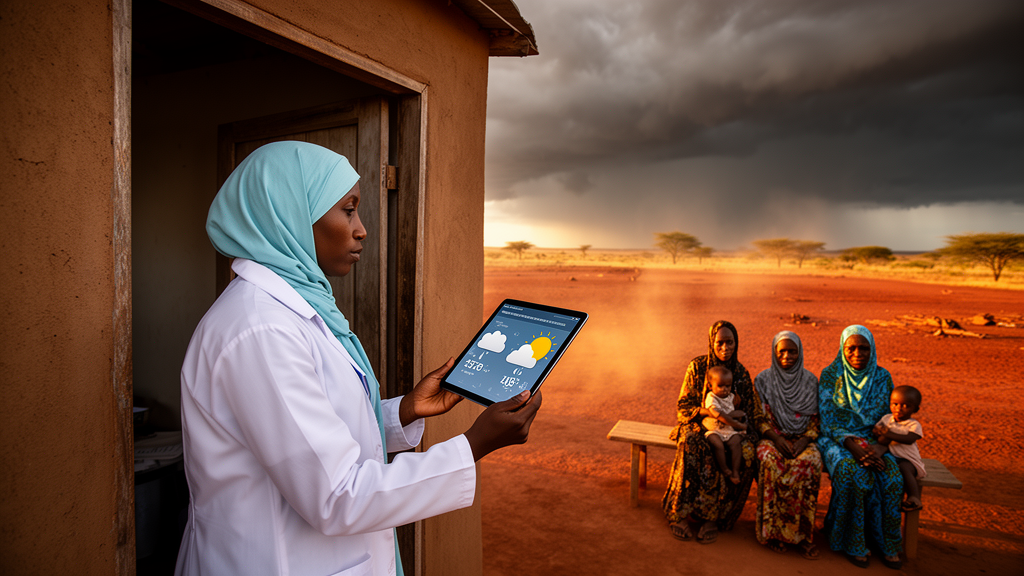
Somalia sits at one of the starkest intersections of climate stress and infectious disease risk anywhere in the world. Recurrent droughts and floods collide with mass displacement, acute food insecurity, fragile water and sanitation infrastructure, disrupted immunisation campaigns, and a health system stretched thin by conflict and workforce shortages. A new narrative review led by researchers at Somali National University and Salaam University, published in Frontiers in Epidemiology, argues that the country’s central problem is not a lack of early warning signals but a persistent failure to convert those signals into timely, funded, and disease-specific public health action. The authors call this the warning-to-action gap, and they propose a framework for closing it.
The review, which synthesised peer-reviewed literature and authoritative institutional sources published between January 2000 and June 2026, draws a technically important distinction between two categories of disease. Directly climate-sensitive infections, including cholera, malaria, dengue, and Rift Valley fever, are influenced by climatic and environmental conditions through water, vector, and ecological pathways. Indirectly climate-amplified vaccine-preventable diseases, including measles, diphtheria, and polio, are driven primarily by displacement, malnutrition, overcrowding, and interrupted immunisation, all of which intensify when climate shocks strike. The authors stress that preserving this distinction matters because each category demands different surveillance triggers and different preparedness responses.
The cholera pathway illustrates the mechanics. Flooding can contaminate water sources and overwhelm sanitation systems, while drought pushes households and internally displaced person communities toward unsafe water points and erodes hygiene capacity. World Health Organization Regional Office for the Eastern Mediterranean situation reports have documented continued cholera and acute watery diarrhoea transmission following the 2023 outbreak wave, including spread into flood-affected districts, with inadequate safe water and sanitation among displaced populations identified as a major risk. In a climate-informed system, rainfall and flood alerts, WASH breakdown reports, displacement density, and diarrhoeal clusters would be monitored together so that water treatment, case management, and community response could be triggered earlier.
Vector-borne diseases require a different surveillance lens. Malaria risk in Somalia is mediated by seasonal rainfall, flooding, standing water, and temperature, which shape Anopheles mosquito breeding, particularly where displacement and disrupted access to prevention and treatment increase vulnerability. Dengue has been confirmed in Puntland and Banadir, and outbreak investigations have identified stagnant water, containers, and other household breeding sites as important local risks. The review notes that modelling from Ethiopia and broader African evidence suggesting climate change could shift disease burden from malaria toward arboviruses should be treated as contextual rather than Somalia-specific. For these diseases, the authors argue, surveillance should combine climate data, fever syndromic reporting, entomological monitoring, diagnostic readiness, and district risk mapping.
Rift Valley fever stands out as the country’s most significant zoonotic climate-sensitive threat. In Somalia’s 2023 zoonoses prioritisation exercise, RVF was ranked first among seven priority zoonoses, reflecting the country’s deep dependence on livestock. Serological evidence of the virus in ruminants from Afgoye and Jowhar indicates exposure at the animal interface, although the human burden remains poorly characterised. Because risk rises with heavy rainfall, flooding, livestock movement, and mosquito proliferation, the review argues that surveillance must connect animal abortion events, unexplained livestock mortality, vector signals, and human febrile alerts before human cases appear, a quintessentially One Health requirement spanning human, animal, and environmental sectors.
On the vaccine-preventable side, Somali studies show that vaccination uptake among internally displaced populations is shaped by household, service, and policy barriers, while zero-dose children are concentrated in nomadic, remote, and conflict-affected communities. Climate shocks amplify risk through displacement, malnutrition, overcrowding in settlements, cold-chain disruption, and reduced healthcare access. The corresponding warning signals are therefore not meteorological but social: internal displacement influxes, Integrated Food Security Phase Classification acute malnutrition classifications of Phase 3 or higher, low immunisation coverage, and the identification of zero-dose clusters. Preparedness actions include mobile vaccination outreach, zero-dose child mapping, cold-chain monitoring, and community health worker deployment.
Somalia is far from devoid of surveillance assets. The Early Warning Alert and Response Network, built incrementally since 2008, and the Integrated Disease Surveillance and Response System with its DHIS2 platform, operational since 2016, form the health surveillance core. A formal evaluation of EWARN from 2017 to 2020 documented meaningful progress: the proportion of timely reports rose from 24.6 percent in 2017 to 96.8 percent by 2020, and alert verification improved from 2.0 percent to 52.6 percent over the same period. Yet data completeness averaged below 60 percent across all four evaluation years, and the system remains insufficiently integrated with non-health warning platforms. Beyond the health sector, the Famine Early Warning Systems Network, the Food Security and Nutrition Analysis Unit, WASH cluster monitoring, displacement tracking, nutrition surveillance, and livestock reporting all generate relevant intelligence. An ecological study of displacement in Somalia found strong associations between failed rains and population movement at a three-month lag and food insecurity at a one-month lag, temporal patterns with direct implications for outbreak preparedness. None of these streams are routinely fused with disease surveillance at the district level or with each other.
The governance and financing barriers the review identifies are structural rather than technological. A global analysis of 64 infectious disease warning and response systems found that 80 percent were reactive, designed to respond after case counts rise, and only 6 percent were prevention-centred, linking upstream risk signals to strategies addressing the drivers of disease emergence. Somalia exemplifies this pattern. Disease surveillance, food security monitoring, WASH assessment, displacement tracking, livestock health reporting, and hydrometeorological forecasting each operate through separate mandates, funding lines, and reporting hierarchies. Somalia’s 2023 IHR-PVS National Bridging Workshop identified joint surveillance systems, high-level ministerial coordination, and emergency funding structures as priority unmet needs. At the district level, many health teams lack trained personnel, diagnostic equipment, reliable connectivity, and logistics for timely alert verification, while insecurity restricts access to conflict-affected areas and laboratory capacity remains concentrated in a small number of facilities.
Financing emerges as perhaps the most binding constraint. Somalia’s IDSRS implementation progress stands at only 15 percent for the financing domain, the lowest across all assessed dimensions, reflecting prolonged over-reliance on short-term, project-cycle humanitarian funding. This structure impedes sustained investment in surveillance staffing, supply pre-positioning, routine supervision, and the flexible pre-allocated budgets that anticipatory preparedness requires. One Health coordination, meanwhile, remains nascent and dependent on external donor support, not yet embedded in government planning or budgeting at federal, state, or district levels. These deficits fall hardest on the populations bearing the greatest risk: internally displaced persons, nomadic and agropastoral communities, malnourished children, zero-dose children, and people in insecure or hard-to-reach areas, all of whom are less visible in routine surveillance and less likely to be reached by early response.
The framework the authors propose does not require new institutions. It builds on existing assets and operates in five linked stages: multisource signal detection combining climate forecasts, WASH conditions, displacement movements, nutrition intelligence, livestock reports, laboratory information, and community signals; integrated district risk assessment that interprets these signals jointly with EWARN and IDSRS data; a disease-specific trigger decision against pre-agreed criteria; early preparedness action such as commodity pre-positioning, rapid-response team mobilisation, and targeted outreach; and feedback, accountability, and learning to refine triggers over time. An illustrative composite trigger for a flood-prone district along the Jubba or Shabelle rivers could activate when an official flood warning coincides with documented deterioration in safe water or sanitation and an increase in acute watery diarrhoea alerts, though the authors emphasise that exact thresholds would require local calibration and prospective validation. The deeper reframe is conceptual: climate-informed surveillance should be understood not as better data collection but as an anticipatory public health function designed to act before climate shocks converge with vulnerability and become infectious disease emergencies. The lessons, the authors argue, extend well beyond Somalia to any fragile, conflict-affected, and climate-vulnerable setting where warnings already exist but action does not follow.
Subject of Research: Climate-informed surveillance and early warning systems for climate-sensitive infectious diseases in Somalia
Article Title: Climate-informed surveillance for climate-sensitive infectious diseases in Somalia: early warning systems, policy gaps, and preparedness priorities
Article References: Hassan, A. A., Sudi, L. A., Mohamed, M. D., Ibrahim, I. O., & Abdullahi, Y. B. (2026). Climate-informed surveillance for climate-sensitive infectious diseases in Somalia: early warning systems, policy gaps, and preparedness priorities. Frontiers in Epidemiology, 6, Article 1907542. https://doi.org/10.3389/fepid.2026.1907542
Image Credits: AI Generated
DOI: 10.3389/fepid.2026.1907542
Keywords: Somalia, climate change, infectious disease surveillance, early warning systems, cholera, malaria, dengue, Rift Valley fever, measles, One Health, anticipatory action, fragile health systems
Cite Scienmag News
Kristina Jarvis. (October 16, 2026). Somalia Has the Warnings but Not the Action: Closing the Climate-Disease Gap. Scienmag. https://scienmag.com/somalia-has-the-warnings-but-not-the-action-closing-the-climate-disease-gap/
Kristina Jarvis. "Somalia Has the Warnings but Not the Action: Closing the Climate-Disease Gap." Scienmag, 16 October 2026, https://scienmag.com/somalia-has-the-warnings-but-not-the-action-closing-the-climate-disease-gap/. Accessed 16 October 2026.
Kristina Jarvis. "Somalia Has the Warnings but Not the Action: Closing the Climate-Disease Gap." Scienmag. October 16, 2026. https://scienmag.com/somalia-has-the-warnings-but-not-the-action-closing-the-climate-disease-gap/


