


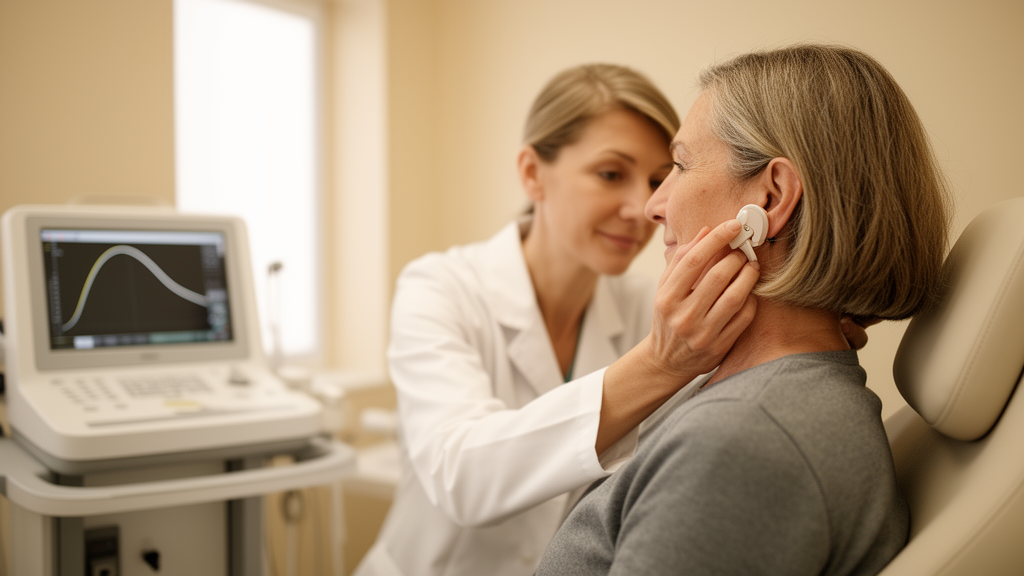
Sudden sensorineural hearing loss is one of the most alarming events in medicine: a person goes to bed with normal hearing and wakes to find that one ear has gone quiet, sometimes within a matter of hours. Yet for all its drama, the condition remains stubbornly unpredictable. Two patients with nearly identical audiograms, similar ages, and the same treatment can follow radically different paths, with one recovering most of their hearing and the other losing it permanently. A new retrospective cohort study published in Frontiers in Neurology has now tested an overlooked candidate for explaining that variation: the air pressure inside the middle ear, a number that audiologists measure every day and then, for the most part, throw away.
The measurement in question is the tympanometric peak pressure, or TPP, obtained during tympanometry, the quick puff-of-air test performed on virtually every patient who walks into a hearing clinic with sudden hearing loss. Tympanometry’s job in this setting is narrow and binary: it confirms that the eardrum moves normally, ruling out fluid, perforation, or other conductive problems that would change the diagnosis entirely. Once that box is ticked, the actual numeric pressure value recorded by the device typically vanishes from clinical reasoning. The researchers behind the new study, led by Tianyu Zhang of Xiong’an Xuanwu Hospital in China, argue that this habit may be discarding physiological information that is already available at no additional cost, and they designed their investigation to find out whether that discarded number actually matters.
Their approach was elegantly simple. Instead of asking whether the pressure in an affected ear falls within some population-wide normal range, they compared each patient’s affected ear against their own healthy contralateral ear. This paired-ear design is statistically powerful because both ears share the same age, the same systemic conditions, the same testing environment, and the same short-term physiological influences. Any difference between the two ears is therefore far more likely to reflect something real about the diseased side than background noise between unrelated patients. It is the auditory equivalent of a matched-pairs experiment, and it requires no new equipment, no biomarker assay, and no imaging sequence.
The study included 203 adults with unilateral sudden sensorineural hearing loss, defined as a sensorineural loss of at least 30 decibels across three consecutive frequencies developing within 72 hours, all of whom had bilateral TPP measurements taken before any corticosteroid treatment began. The team went beyond a single abnormality threshold. They calculated the signed difference in pressure between ears, the absolute magnitude of any asymmetry, a four-category laterality-aware classification of bilateral pressure patterns, and a series of sensitivity analyses using alternative cutoffs ranging from minus 50 to minus 150 decapascals. Hearing recovery, assessed in the 162 patients who returned for follow-up audiometry, was quantified both as a continuous hearing gain and as a clinically meaningful improvement of at least 15 decibels.
The headline result was, in a sense, a negative one. At the population level, middle-ear pressure was remarkably symmetric between ears. Median TPP was minus 9.1 decapascals on the affected side and minus 8.1 decapascals on the healthy side, with a median signed difference of just minus 1.2 decapascals, a difference that did not reach statistical significance. In other words, sudden sensorineural hearing loss is not accompanied by a consistent pressure shift in the affected ear. This finding matters because it argues against the idea that altered middle-ear ventilation, driven for instance by Eustachian tube dysfunction, is a common feature of the disease itself. The condition remains what modern otology believes it to be: a heterogeneous disorder of the inner ear, involving vascular, inflammatory, immune, or membrane-related mechanisms, not a problem of the air-filled middle-ear cavity.
But the paired-ear framework also surfaced something that conventional single-ear classification would have missed entirely. Using the standard threshold of minus 100 decapascals to define negative middle-ear pressure, the researchers found that 14 patients, or 6.9 percent, had negative pressure only in the affected ear, while 11 patients, or 5.4 percent, had negative pressure only in the healthy ear, and just 4 patients had it in both. Because these laterality-specific patterns only become visible when both ears are compared within the same person, they would be largely invisible to a clinician reading each tympanogram in isolation. A minority of patients also showed substantially larger interaural pressure differences than the cohort median absolute asymmetry of 11.9 decapascals, hinting at genuine individual heterogeneity in Eustachian tube function or middle-ear mechanics.
The crucial prognostic question, however, yielded a clear answer: baseline middle-ear pressure did not predict who recovered. Among patients with follow-up audiometry, mean hearing gain was 19.8 decibels in those with affected-ear negative pressure versus 23.2 decibels in those without, a difference that was not statistically significant. Clinically meaningful recovery of at least 15 decibels occurred in 71.4 percent of the negative-pressure group and 70.3 percent of the rest, an essentially identical proportion. Even after adjusting for the established prognostic factors of baseline hearing, age, treatment delay, and vertigo using robust regression, affected-ear negative pressure showed no reliable association with hearing gain. Continuous analyses of both the direction and the magnitude of interaural pressure differences, visualized with locally weighted scatterplot smoothing, likewise revealed no discernible relationship with recovery.
The researchers stress-tested this null result. They repeated the classification at thresholds of minus 50, minus 75, minus 125, and minus 150 decapascals, and the overall pattern of findings remained stable, with confidence intervals spanning the null at nearly every cutoff. The single exception came at the most stringent threshold of minus 150 decapascals, where six patients with extreme negative pressure appeared to have lower hearing gain, an adjusted difference of 11.6 decibels. The authors are appropriately cautious here: with only six exposed patients, the confidence interval was wide, the finding was exploratory, and it cannot support defining such an extreme cutoff as prognostic. Bootstrap resampling of the primary model confirmed that the main estimates were stable, though precision remained limited by the small number of patients with negative pressure overall.
The clinical implications are refreshingly concrete. The findings do not support using a single tympanometric pressure threshold to guide corticosteroid treatment or to counsel patients about their prognosis, and they suggest that routine middle-ear pressure abnormalities should not be interpreted as a common feature of sudden hearing loss or as an independent marker of poor recovery. At the same time, the study makes a compelling case for a change in record-keeping rather than testing: retaining the bilateral numeric pressure values that clinics already collect could enable a low-cost refinement of how patients are phenotyped, capturing interaural pressure patterns that a binary normal-or-abnormal label erases. Whether the magnitude and persistence of pressure asymmetry, tracked serially over time, carries biological or therapeutic significance, particularly for intratympanic steroid delivery, remains an open question for prospective multicenter studies.
The study has the usual caveats of retrospective, single-center research: selection bias is possible, records depend on the completeness of routine documentation, 41 patients lacked follow-up audiometry, and potentially relevant factors such as recent upper respiratory infections, allergic rhinitis, or Eustachian tube symptoms were not systematically recorded. Still, the work exemplifies a growing trend in clinical science: squeezing new insight out of data that medicine already generates but routinely ignores. For the hundreds of thousands of people worldwide who each year experience the terror of sudden hearing loss, the message is sobering but clarifying. The pressure in your middle ear, it turns out, does not seal your fate. The search for better predictors must look elsewhere, most likely within the inner ear itself, where the real damage begins.
Subject of Research: Middle-ear pressure patterns and hearing recovery in unilateral sudden sensorineural hearing loss
Article Title: Paired-ear tympanometric pressure patterns and hearing recovery in unilateral sudden sensorineural hearing loss: a retrospective cohort study
Article References: Zhang, T., Xie, Y., Li, Y., Zhang, H., Tian, H., Zhu, Z., Yang, Z., Wang, Z., Duan, J., & Zhang, T. (2026). Paired-ear tympanometric pressure patterns and hearing recovery in unilateral sudden sensorineural hearing loss: a retrospective cohort study. Frontiers in Neurology, 17, Article 1982019. https://doi.org/10.3389/fneur.2026.1982019
Image Credits: AI Generated
DOI: 10.3389/fneur.2026.1982019
Keywords: sudden sensorineural hearing loss, tympanometry, tympanometric peak pressure, middle-ear pressure, Eustachian tube dysfunction, hearing recovery, paired-ear analysis, audiology, prognostic factors, retrospective cohort study, neuro-otology, pure-tone audiometry
Cite Scienmag News
Ophelia Keating. (October 16, 2026). Sudden Hearing Loss Study Finds Ear Pressure Test Fails to Predict Recovery. Scienmag. https://scienmag.com/sudden-hearing-loss-study-finds-ear-pressure-test-fails-to-predict-recovery/
Ophelia Keating. "Sudden Hearing Loss Study Finds Ear Pressure Test Fails to Predict Recovery." Scienmag, 16 October 2026, https://scienmag.com/sudden-hearing-loss-study-finds-ear-pressure-test-fails-to-predict-recovery/. Accessed 16 October 2026.
Ophelia Keating. "Sudden Hearing Loss Study Finds Ear Pressure Test Fails to Predict Recovery." Scienmag. October 16, 2026. https://scienmag.com/sudden-hearing-loss-study-finds-ear-pressure-test-fails-to-predict-recovery/


