


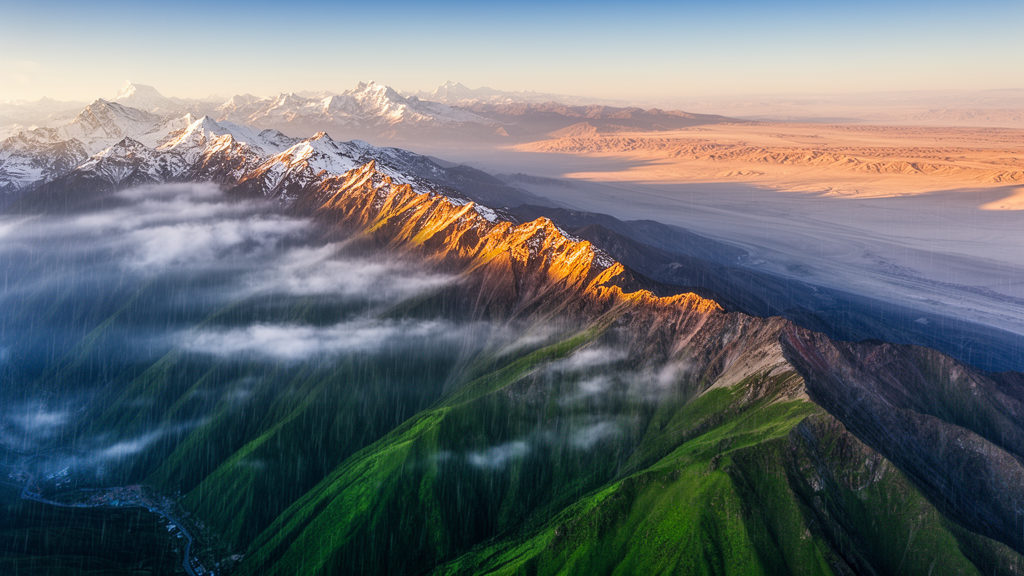
The Northwest Himalaya, one of the most hazard-prone mountain belts on Earth, is quietly undergoing a profound reorganization of its rainfall regime, according to a new 40-year observational analysis published in Discover Geoscience. Using a high-resolution dynamically downscaled dataset spanning 1981 to 2020, researchers led by Kritika Nag of Indira Gandhi National Open University found that the three Indian Himalayan states behave as climatically distinct units: Jammu & Kashmir is drying out with statistically significant declines across multiple extreme precipitation indices, Himachal Pradesh shows a persistent lengthening of dry spells, and Uttarakhand exhibits no significant trends at all, its precipitation regime still dominated by the raw power of orographic uplift.
The study is notable for the dataset it relies on. The team employed the High Asia Refined Analysis version 2, or HARv2, a 10-kilometer-resolution atmospheric product generated by dynamically downscaling the global ERA5 reanalysis with the Weather Research and Forecasting model. Because the Himalayan terrain is notoriously under-observed, with sparse gauge networks at high elevations, the researchers validated HARv2 against two independent benchmarks: the India Meteorological Department gridded precipitation dataset at 25 kilometers, the only ground-based observational reference available for the region, and the 12-kilometer IMDAA reanalysis developed by the National Centre for Medium Range Weather Forecasting. Five statistical metrics, including correlation coefficient, root mean square error, and Kling-Gupta efficiency, confirmed reasonable agreement across all three sub-regions, with correlations rising from 0.73 in Jammu & Kashmir to 0.91 in Uttarakhand against IMD.
That north-to-south improvement in model performance is itself physically meaningful. The Indian Summer Monsoon is a large-scale, organized circulation system that a WRF-based downscaling captures well, whereas Jammu & Kashmir depends heavily on western disturbances, the eastward-moving synoptic weather systems that deliver most winter and spring precipitation to the western Himalaya. These systems are far more variable and harder to simulate accurately, which explains the lower correlation values in the northernmost sub-region.
To quantify precipitation extremes, the team applied ten indices defined by the Expert Team on Climate Change Detection and Indices, a standardized framework of the World Meteorological Organization used worldwide for detecting climate extremes. Trends were assessed with the Mann-Kendall non-parametric test and Sen’s slope estimator, the most robust statistical tools for climatological trend detection. The results for Jammu & Kashmir were striking. Total annual wet-day precipitation, PRCPTOT, declined by 95.41 millimeters per decade in the IMD dataset and 74.27 millimeters per decade in HARv2, both statistically significant. The Simple Daily Intensity Index fell by roughly 0.35 millimeters per day per decade in both datasets, and the number of days exceeding 10 millimeters and 20 millimeters dropped by about 3 to 4 days and 1 day per decade respectively. The contribution of very heavy rainfall days, R95p, also declined significantly.
Equally concerning is the behavior of dry spells. The consecutive dry days index, CDD, showed a significant annual increase of 4.1 days per decade over Himachal Pradesh, supported by significant pentadal trends, while Jammu & Kashmir exhibited significant CDD increases at the five-year averaging scale even though the annual trend remained non-significant. Taken together, the declining totals, falling rainfall intensity, fewer moderate-to-heavy events, and lengthening dry spells point toward a transition to a drier and more intermittent precipitation regime across the northern Northwest Himalaya, with direct implications for snowpack accumulation, glacier mass balance, agriculture, and water security for the millions of people downstream who depend on Himalayan freshwater.
Uttarakhand tells a completely different story. None of the ten indices showed statistically significant trends over the 40-year record, though several, including R95p, R99p, and consecutive wet days, displayed weak increasing tendencies. The researchers attribute this to the dominant role of orographic processes: the region’s steep terrain efficiently converts even modest variations in incoming moisture into precipitation through strong terrain forcing, buffering the local climate against large-scale circulation changes.
The most technically ambitious part of the study involved atmospheric diagnostics designed to answer a deceptively simple question: is moisture supply the controlling factor behind Himalayan precipitation extremes? The team computed vertically integrated moisture transport, VIMT, by integrating the product of specific humidity and horizontal wind components from 1000 to 300 hectopascals in both HARv2 and ERA5. Over Jammu & Kashmir, the two datasets agreed moderately, with a correlation of 0.58 and a mean bias of only 15.67 kilograms per meter per second. But the agreement deteriorated progressively southward, falling to 0.29 over Himachal Pradesh and 0.22 over Uttarakhand, while the mean bias ballooned to 57.52 and 92.52 kilograms per meter per second respectively. This divergence reveals the growing importance of terrain channelling, localized moisture convergence, and precipitation-driven moisture depletion, processes that the fine-resolution HARv2 resolves but the coarser ERA5 smooths away.
Correlations between HARv2 diagnostic variables, including precipitable water, cloud liquid water, cloud ice water, cloud cover, and vertical velocity at 500 and 300 hectopascals, and the ETCCDI indices exposed a clear regional gradient in precipitation-generating mechanisms. Over Jammu & Kashmir, significant correlations were limited and mostly confined to wet spell duration, suggesting extremes there depend more on synoptic disturbances and terrain-triggered uplift than on moisture availability alone. Over Himachal Pradesh, a transitional regime, the relationships broadened to include total precipitation, intensity, and multi-day extremes linked with cloud hydrometeors and vertical motion. Over Uttarakhand, the coupling was strongest of all, with the highest correlation observed between PRCPTOT and vertical motion at 500 hectopascals, at 0.71. The conclusion is unambiguous: moisture alone does not explain precipitation extremes in the Northwest Himalaya, and orographic uplift and synoptic-scale disturbances are equally important drivers.
The El Niño-Southern Oscillation adds another layer of complexity. Classifying years by the Niño 3.4 sea surface temperature anomaly index, the team found that over Jammu & Kashmir the index correlated significantly and negatively with VIMT from both HARv2 and ERA5, confirming that El Niño phases weaken the Walker circulation and suppress moisture inflow while La Niña phases enhance it. This teleconnection weakened over Himachal Pradesh and Uttarakhand, where local terrain-driven processes increasingly modulate the moisture field. ENSO composites showed stronger and more widespread moisture penetration into higher elevations during La Niña years, with significant positive departures across nearly all diagnostic variables over Uttarakhand.
The authors acknowledge limitations, including the known wet bias of HARv2 over complex terrain, which affects magnitude-sensitive indices such as R95p and R99p, and the sparse high-elevation gauge coverage in the IMD benchmark. The 20-year sub-period split, chosen to separate the pre-satellite and satellite eras, was not formally tested with a changepoint algorithm, so inter-period differences should be read as multi-decadal variability rather than definitive regime shifts. Still, the central message stands: the Northwest Himalaya must be treated as a mosaic of climatically distinct sub-regions, each demanding targeted adaptation strategies, improved observational coverage, and continued high-resolution process-based monitoring to protect a region where drying in the north and terrain-amplified extremes in the south will shape hydrological risk for decades to come.
Subject of Research: Climate Sciences
Article Title: An observational perspective on extreme precipitation indices over the mountainous regions of Northwest Himalaya
Article References: Nag, K., Pattanayak, S., Venkatramanan, V., Sharma, V., & Shekhar, M. S. (2026). An observational perspective on extreme precipitation indices over the mountainous regions of Northwest Himalaya. Discover Geoscience, 4(1), Article 404. https://doi.org/10.1007/s44288-026-00775-0
Image Credits: AI Generated
DOI: 10.1007/s44288-026-00775-0
Keywords: Northwest Himalaya, extreme precipitation, ETCCDI, HARv2, climate change, ENSO, moisture transport, drought, Jammu & Kashmir, Himachal Pradesh, Uttarakhand, observational
Cite Scienmag News
Violet Maxwell. (October 16, 2026). Himalayan Precipitation Extremes Reveal a Stark North-South Divide, 40-Year Study Finds. Scienmag. https://scienmag.com/himalayan-precipitation-extremes-reveal-a-stark-north-south-divide-40-year-study-finds/
Violet Maxwell. "Himalayan Precipitation Extremes Reveal a Stark North-South Divide, 40-Year Study Finds." Scienmag, 16 October 2026, https://scienmag.com/himalayan-precipitation-extremes-reveal-a-stark-north-south-divide-40-year-study-finds/. Accessed 16 October 2026.
Violet Maxwell. "Himalayan Precipitation Extremes Reveal a Stark North-South Divide, 40-Year Study Finds." Scienmag. October 16, 2026. https://scienmag.com/himalayan-precipitation-extremes-reveal-a-stark-north-south-divide-40-year-study-finds/


