


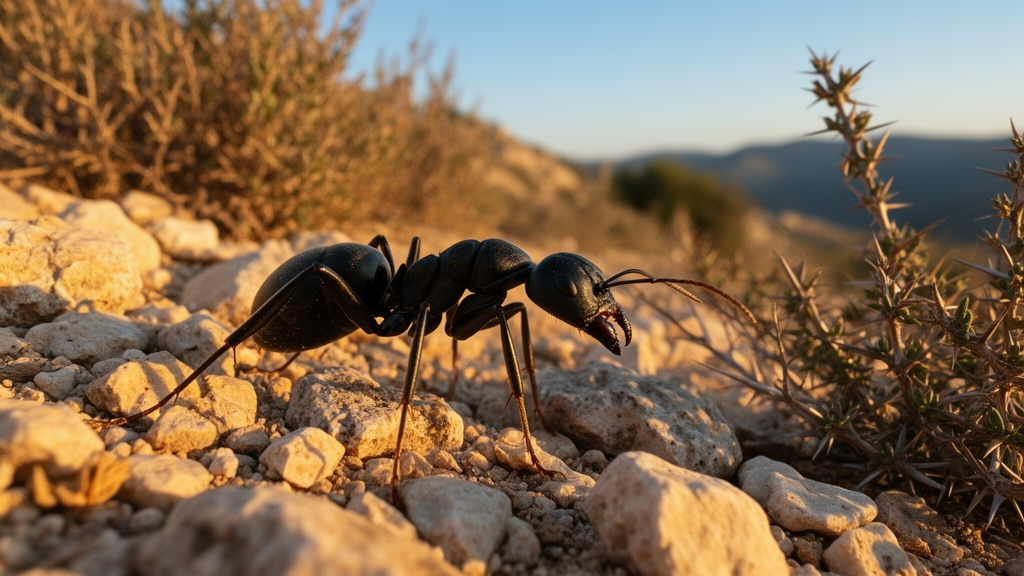
On the Mediterranean island of Cyprus, an ant long suspected of being an unwanted invader has turned out to be something far more remarkable: a species new to science, found nowhere else on Earth. Researchers re-examined specimens previously labelled Camponotus cf. vitiosus, a taxon flagged as a potential non-native species, and discovered through combined morphological and genetic analysis that the Cypriot ants represent a distinct endemic species, now formally described as Camponotus (Myrmentoma) limbouros sp. nov. in the journal ZooKeys. The finding removes a suspected invader from the island’s list of non-native ants while simultaneously adding a new endemic species to it, a rare double shift in the accounting of an island’s biodiversity.
The story began with uncertainty. In 2012, a single gyne and one minor worker of the puzzling taxon were collected on Cyprus, and researchers identified them as members of the subgenus Myrmamblys, with the East Asian species Camponotus vitiosus as the most probable candidate. That identification seemed plausible for a reason rooted in regional history: Ionescu-Hirsch had reported specimens identified as Camponotus (Myrmamblys) sp. near vitiosus introduced to Israel through bamboo from China in 2006 and 2009, the only record of a potential Mediterranean introduction of the species. Cyprus, hosting a high percentage of both endemic and non-native ant taxa, was considered a likely point of establishment for another invader.
The stakes of such identifications are considerable. Invasive non-native species are a major driver of global biodiversity loss, and ants are among the most consequential of these translocated organisms, with around 520 species transported around the world. Within the last few years, several novel non-native ant species have established viable self-sustaining populations in Europe and the Mediterranean, including the Red Imported Fire Ant Solenopsis invicta, the Asian Needle Ant Brachyponera chinensis, and Pheidole parva. Early warning, rapid detection and response are crucial steps to assess and manage biological invasions, which makes accurate species identification the foundation of the entire enterprise.
Cyprus itself sits in the heart of the Eastern Mediterranean, bordered by Europe, Asia and Africa, and its ant fauna reflects that crossroads position. The latest published checklist synthesizes 88 species, including 18 endemic and 18 non-native taxa, each accounting for 20.5 percent of all species, and the island’s myrmecofauna is steadily approaching 100 species as more taxa are uncovered. The high percentage of endemic species highlights the importance of Cyprus as a biodiversity hotspot and rarity center for Mediterranean ants, but the large portion of non-native species poses a threat to native biodiversity, society and the economy. Compounding the challenge, the ant fauna of Western Asia and the Middle East is especially poorly known, and the lack of up-to-date taxonomic revisions for many genera makes identification of some taxa difficult.
To resolve the mystery, the research team compared material of all castes collected on Cyprus in 2012 by L. Borowiec and S. Salata and in 2024 by S. Salata, C. Georgiadis and J. Demetriou with specimens of the nominal species provided by B. Guénard from Hong Kong in China and from Japan. They then assembled a genetic dataset of cytochrome oxidase I (COI) barcodes, generating new sequences for one Cypriot sample and one Japanese sample of C. vitiosus, and downloading 189 sequences from the Barcode of Life Data Systems (BOLD). The dataset comprised all Camponotus (Myrmentoma) species for which sequence data were available, sequences from other Camponotus species and subgenera occurring in Cyprus and adjacent Eastern Mediterranean regions, and outgroup sequences of Colobopsis for rooting the analysis.
The laboratory work followed the NGS species discovery pipeline at the Museum für Naturkunde in Berlin, based on established Oxford Nanopore Technologies amplicon barcoding workflows. DNA was extracted from individual specimens using a modified HotSHOT protocol, and the 658 bp barcode region of the mitochondrial COI gene was amplified by PCR using uniquely indexed primers that enable specimen-specific assignment of the resulting amplicons after sequencing. Sequencing was performed on a PromethION platform, and specimen-specific barcode sequences were recovered after demultiplexing and consensus generation using ONTbarcoder 2.0, with only barcodes passing stringent filtering criteria used for analysis. All 195 sequences were aligned with Muscle, partitioned into two subsets by codon position, and analyzed in a joint Maximum Likelihood best tree and bootstrap analysis in IQ-TREE, with genetic distances calculated in MEGA12 using the Kimura 2-parameter model and a hypothetical barcode gap of 5 percent applied to distinguish intra- from interspecific variation.
The molecular results were unambiguous on the key question. Genetic distances between the new species and other Camponotus (Myrmentoma) species range from 0.13 to 0.19 base pair sequence divergence, and from 0.16 to 0.24 to other Camponotus species included in the analysis. Most tellingly, the sequence divergence of the Cypriot ants to the nominal C. vitiosus is between 0.21 and 0.22, far beyond the 5 percent barcode gap threshold, confirming that the two are not conspecific. The COI gene tree shows the new species clustering within a clade of Palearctic and Nearctic Camponotus (Myrmentoma) species, although the branch support for this grouping is low and the precise phylogenetic position of the species will require further investigation using nuclear genetic markers.
The morphological evidence proved equally decisive. Camponotus limbouros differs from all known Eastern Mediterranean Camponotus in the presence of a distinctly concave dorsal propodeum, a character observed only slightly in some specimens of C. fallax and the C. aethiops-oertzeni complex. Historically confused with C. vitiosus, the new species differs from that East Asian relative in the presence of a deep median emargination in the clypeus of major workers and gynes, a head in major workers that is never truncate anteriorly, long and erect setae on the frons and the ventral surface of the head, a densely imbricate mesosoma, and erect setae on the propodeum present only on the posterior part of its dorsum. Based on pronounced caste dimorphism, a medium-sized body, a subrectangular head with slightly convex lateral sides, an arched mesosoma, and an anterior clypeal margin regularly arched and lacking protrusion, the species is assigned to the subgenus Myrmentoma.
Knowledge of the ecology of the new species remains limited. Specimens were collected in 2012 and 2024 in mixed cedar and pine forest in Cedar Valley, the famous refuge of the endemic Cypriot cedar Cedrus brevifolia, at altitudes of 1130 and 1196 meters. In 2024, a nest series was collected inside dry twigs on living trees of the endemic golden oak Quercus alnifolia, the national tree of Cyprus, which is protected under the Forest Law and the EU Habitats Directive. The detected colony was small, with fewer than 20 workers, and monogynous. Lone specimens collected with pitfall traps in 2013 in phrygana with Ceratonia siliqua and in 2007 from Laneia village suggest the species may utilize various Quercus species or other unrelated plants as nesting sites. Given its arboreal lifestyle, nesting inside twigs of standing trees, the species may be threatened by forest fires and land-use changes affecting the quality and extent of its habitats.
The discovery elevates the number of endemic Camponotus species on Cyprus to two, alongside C. troodosensis, and raises the total number of endemic ant species on the island to 19 while reducing the number of non-native ant species to 17. The initial mistake stemmed from the collection of only a single gyne and minor worker, together with the report of the taxon from neighboring Israel, which had been identified as a source of other non-native ants in Cyprus. Only collecting the full nest sample and obtaining COI data revealed that the Cypriot populations represent a distinct and endemic species with unique morphological characters. The authors highlight DNA barcoding as an important tool for resolving the taxonomic status of species-level taxa and call for the development of a comprehensive DNA barcode reference library for the Cypriot ant fauna, which could support eDNA- and metabarcoding-based monitoring of both native and non-native species in the future.
Subject of Research: Taxonomic description of a new endemic carpenter ant species from Cyprus, resolved from a suspected non-native invader using morphology and COI DNA barcoding
Article Title: Losing a non-native, gaining an endemic: Description of Camponotus ( Myrmentoma ) limbouros sp. nov. ( Hymenoptera , Formicidae ) from Cyprus
Article References: Demetriou, J., Blaimer, B. B., Georgiadis, C., Voges, J. H., Guénard, B., Borowiec, L., & Salata, S. (2026). Losing a non-native, gaining an endemic: Description of Camponotus (Myrmentoma) limbouros sp. nov. (Hymenoptera, Formicidae) from Cyprus. ZooKeys, 1294, 151-174. https://doi.org/10.3897/zookeys.1294.205360
Image Credits: AI Generated
DOI: 10.3897/zookeys.1294.205360
Keywords: Camponotus limbouros, Cyprus, endemic species, DNA barcoding, invasive ants, taxonomy, Myrmentoma, COI barcode, Mediterranean biodiversity, ZooKeys, Losing, non-native
Cite Scienmag News
Margaret Porter. (October 16, 2026). A suspected invader in Cyprus turns out to be a brand-new endemic carpenter ant species. Scienmag. https://scienmag.com/a-suspected-invader-in-cyprus-turns-out-to-be-a-brand-new-endemic-carpenter-ant-species/
Margaret Porter. "A suspected invader in Cyprus turns out to be a brand-new endemic carpenter ant species." Scienmag, 16 October 2026, https://scienmag.com/a-suspected-invader-in-cyprus-turns-out-to-be-a-brand-new-endemic-carpenter-ant-species/. Accessed 16 October 2026.
Margaret Porter. "A suspected invader in Cyprus turns out to be a brand-new endemic carpenter ant species." Scienmag. October 16, 2026. https://scienmag.com/a-suspected-invader-in-cyprus-turns-out-to-be-a-brand-new-endemic-carpenter-ant-species/


