


Deep in the limestone mountains of western Guangxi, China, botanists have identified a tree species new to science, one that had been growing unnoticed in a nature reserve until a two-year survey effort finally brought it to light. The species, named Casearia napoensis after Napo County where it was found, belongs to the pantropical woody genus Casearia, which comprises roughly 200 species distributed across the tropics, with its greatest diversity in the Neotropics. The discovery, published in the journal PhytoKeys, marks the first new Casearia species described from China in more than two decades, breaking a long taxonomic silence in a genus whose Chinese representatives had remained static since the Flora of China was published in 2007.
The research team, led by T. Xu, L. Gong, Z. L. Ouyang and Z. Y. Su, conducted thirteen field surveys at the type locality between 2024 and 2026, observing living plants in the forest and measuring herbarium specimens collected from the site. Comparisons with other Casearia species known from China were made using relevant literature and digital images of specimens housed at numerous herbaria across China and abroad, supplemented by type specimen images consulted through the JSTOR Global Plants database and the Chinese Virtual Herbarium. Voucher specimens are deposited in the herbaria of Nanning Botanical Garden, Chenshan Botanical Garden and the Guangxi Institute of Chinese Medicine and Pharmaceutical Sciences, ensuring that the physical evidence underpinning the description remains accessible for future study.
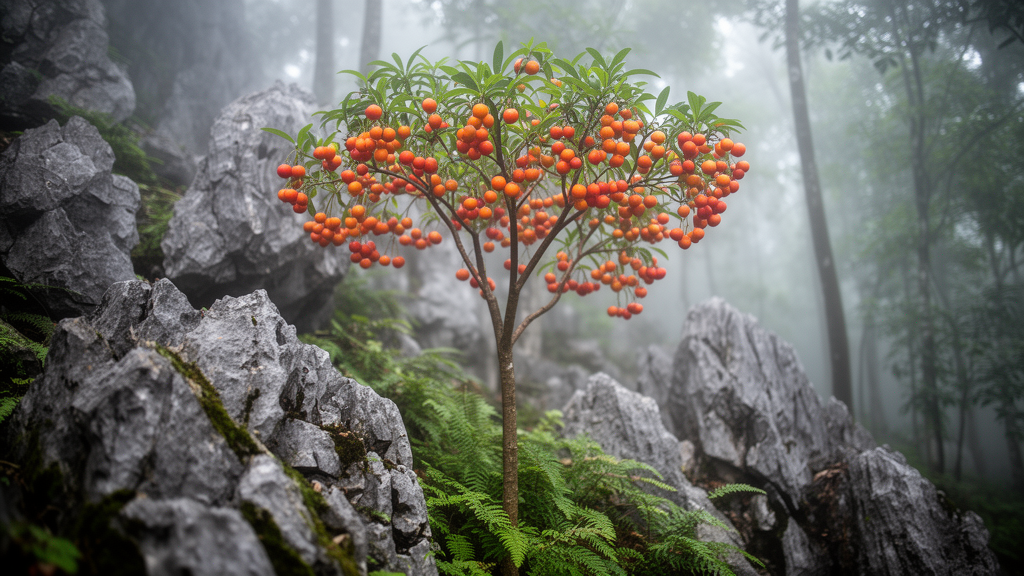
What makes Casearia napoensis immediately striking is its fruit. The capsule measures 2.2 to 3 centimeters across, spherical in shape and leathery in texture, turning a vivid orange-red when ripe. At maturity it splits into four or five valves, each valve fleshy and roughly half a centimeter thick, and a single fruit can carry up to fifteen or sixteen seeds. Among the recorded species of Casearia, this combination of characters sets the new species apart from its closest relatives, Casearia membranacea and Casearia tardieuae, both of which produce three-valved capsules. The number of valves in the dehiscent fruit thus serves as a key diagnostic feature separating the new species from its morphological neighbors.
The tree itself stands four to eight meters tall with a straight trunk and grayish-white bark. Its young branches are longitudinally ridged and exfoliate in flakes, while the alternate leaves are thinly leathery, obovate-oblong, and measure eleven to fifteen centimeters long by three and a half to five and a half centimeters wide, with an acuminate apex and eight to ten pairs of arching lateral veins. The flowers are small, green and bisexual, clustered in groups of three or four in the leaf axils without peduncles, each roughly four millimeters across with five ovate sepals, no petals, and six to nine stamens whose filaments are sparsely pubescent. The disk lobes are oblong, flattened and densely pubescent. Flowering occurs from April to June, with fruiting from August to November.
Beyond the fruit valves, a suite of finer characters distinguishes Casearia napoensis from its relatives. The stipules are narrowly triangular and about three millimeters long, compared with the ovate, one-millimeter stipules of Casearia membranacea and the triangular, two-millimeter stipules of Casearia tardieuae. The leaf blades of the new species are thinly leathery, whereas those of Casearia membranacea are papery to slightly leathery and those of Casearia tardieuae are leathery to thickly leathery. The stamens number six to nine in the new species, against eight to ten in Casearia membranacea and eight in Casearia tardieuae, and the filament pubescence pattern differs among the three. The disk lobes of the new species are densely pubescent throughout, while those of its relatives carry hairs mainly at the apex.
The authors also raise an intriguing taxonomic puzzle surrounding Casearia tardieuae. In the original 1970 description by Lescot and Sleumer, the fruit is recorded as measuring 3.5 by 2.5 millimeters, which the new paper suggests is likely a typographical error and should probably read 3.5 by 2.5 centimeters. The two species can nonetheless be separated by whether the pericarp is verrucose, meaning warty, a texture absent in the smooth-capsuled Casearia napoensis. A further complication involves Casearia calciphila, described as a new species by Bao in 1983 and later synonymized under Casearia tardieuae in the Flora of China, though the authors of that flora had not seen material of Casearia tardieuae. According to the earlier Flora Reipublicae Popularis Sinicae, the capsule of Casearia calciphila is ellipsoid and about 1.2 centimeters long, a size that also distinguishes it from the new species.
The discovery carries significant conservation weight. Casearia napoensis is known only from the type location in the Guangxi Laohutiao Nature Reserve, growing in limestone mountainous forest at an altitude of 1200 meters. Thirteen field surveys conducted between May 2024 and May 2026 failed to uncover any additional localities, suggesting that the distribution of the species is extremely limited. In total, seventeen individuals have been found, of which only two are mature. Applying the Guidelines for Using the IUCN Red List Categories and Criteria, the authors assess the species as Critically Endangered under criterion D1, which addresses species with very few mature individuals. The restricted range and tiny population place the new tree among the most imperiled plant discoveries in the region.
The genus Casearia is generally placed in the family Salicaceae, following the APG IV classification, though a plausible alternative proposed by Alford in 2005 would segregate Casearia and about a dozen other genera into a separate family, Samydaceae. Chinese Casearia species share a set of characters including flowers arranged in axillary glomerules, disk lobes in the same row as the stamens, an entire style and fleshy capsules. The new species fits this framework while adding a distinctive combination of fruit and vegetative characters. The authors provide a revised key to the Casearia species of China, incorporating Casearia napoensis alongside the seven previously recorded species, which include Casearia graveolens, Casearia flexuosa, Casearia velutina, Casearia kurzii, Casearia glomerata, Casearia membranacea and Casearia tardieuae.
Recent years have seen a wave of new Casearia species described from other parts of the world, including Southeast Africa, Central America, South America and West Africa, reflecting renewed taxonomic attention to a genus whose species boundaries remain challenging. The Chinese discovery adds a new piece to this global picture and underscores how much remains to be learned about plant diversity in the limestone karst forests of southern China, habitats known for high endemism and severe conservation pressure. The specific epithet napoensis derives from Napo County, the site of the type locality, and the species carries a Chinese vernacular name, napo jiaogucui.
There is a modest note of hope amid the alarming conservation assessment. Nanning Botanical Garden has collected seeds from the wild population and successfully raised seedlings, establishing an ex-situ conservation collection that could safeguard the genetic material of the species should the wild population decline further. Whether additional individuals survive in unsurveyed pockets of the reserve remains unknown, and continued field work will be essential to refine the population estimate. For now, Casearia napoensis stands as both a taxonomic milestone, the first new Chinese Casearia in twenty years, and a stark reminder that species new to science can be Critically Endangered from the moment they are formally described.
Subject of Research: Botany
Article Title: Casearia napoensis ( Salicaceae ), a new species from Guangxi, China
Article References: Xu, T., Ouyang, Z., Su, Z., Yang, M., Jia, X., & Gong, L. (2026). Casearia napoensis (Salicaceae), a new species from Guangxi, China. PhytoKeys, 279, 267-272. https://doi.org/10.3897/phytokeys.279.206429
Image Credits: AI Generated
DOI: 10.3897/phytokeys.279.206429
Keywords: Casearia napoensis, new species, Guangxi, China, Salicaceae, PhytoKeys, Critically Endangered, limestone karst, taxonomy, plant conservation, Casearia, napoensis
Cite Scienmag News
Margaret Porter. (October 16, 2026). New Tree Species With Orange-Red Fruits Discovered in China’s Limestone Forests. Scienmag. https://scienmag.com/new-tree-species-with-orange-red-fruits-discovered-in-chinas-limestone-forests/
Margaret Porter. "New Tree Species With Orange-Red Fruits Discovered in China’s Limestone Forests." Scienmag, 16 October 2026, https://scienmag.com/new-tree-species-with-orange-red-fruits-discovered-in-chinas-limestone-forests/. Accessed 16 October 2026.
Margaret Porter. "New Tree Species With Orange-Red Fruits Discovered in China’s Limestone Forests." Scienmag. October 16, 2026. https://scienmag.com/new-tree-species-with-orange-red-fruits-discovered-in-chinas-limestone-forests/


