


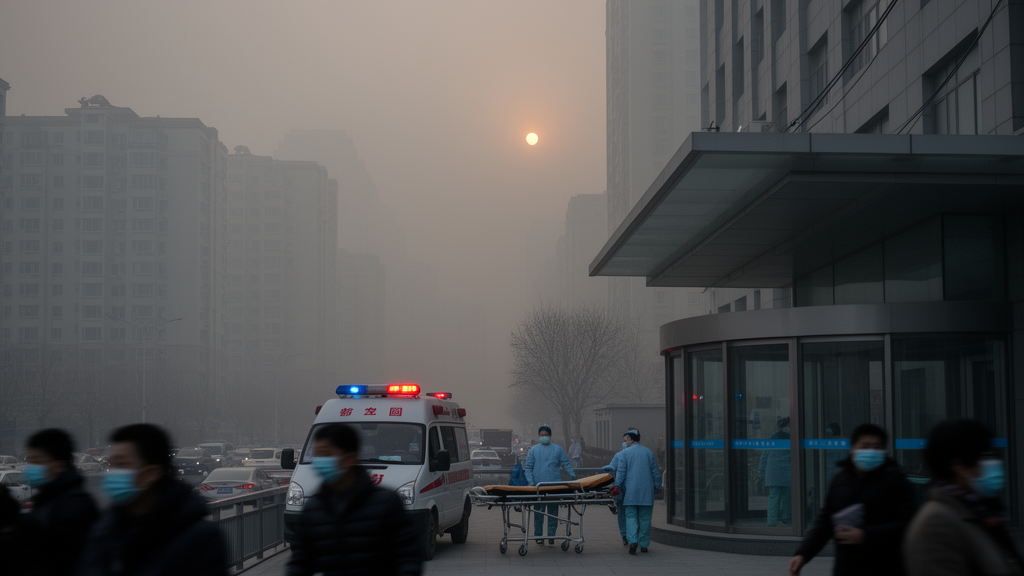
In the heavily polluted river valley city of Lanzhou in northwestern China, even a few days of elevated air pollution appears to raise the risk that residents will end up in a hospital bed with an ischemic stroke. That is the central finding of a new time-series study published in BMC Public Health, in which researchers led by Sixuan Chen of Baotou Medical College and Yongmei He and Yongcong Chen of Lanzhou University analyzed four years of hospital admission records alongside daily measurements of six major ambient air pollutants. Over the study period from January 1, 2016 to December 31, 2019, the city’s public hospitals recorded 53,489 ischemic stroke admissions, averaging roughly 37 cases every day, providing the statistical power needed to detect subtle pollution effects that smaller datasets often miss.
Lanzhou is a scientifically compelling setting for this kind of research because its geography traps pollution in ways that flat cities do not. The city sits in a narrow river valley, which means temperature inversions and stagnant air can hold industrial emissions, vehicle exhaust, and coal combustion products close to the ground for days at a time. Evidence from such heavily polluted valley cities has been limited, the authors note, even as ambient air pollution has become increasingly recognized as a modifiable risk factor for cerebrovascular disease. Ischemic stroke, the most common form of stroke, occurs when a clot blocks blood flow to part of the brain, and short-term spikes in air pollution are suspected of triggering such events through inflammatory and cardiovascular pathways.
The study’s methodology reflects the current state of the art in environmental epidemiology. The researchers obtained daily ischemic stroke hospital admissions from all public hospitals in Lanzhou, along with concurrent air pollutant concentrations and meteorological data, and coded the diagnoses using the International Classification of Diseases, 10th Revision. To disentangle the effect of pollution from other factors that drive daily admission counts, they used quasi-Poisson regression combined with a distributed lag non-linear model, or DLNM. This statistical framework allowed them to control for the long-term trend of time, meteorological confounders such as temperature and humidity, and day-of-week effects, while simultaneously quantifying how pollution effects accumulate and decay across multiple days of exposure.
The distributed lag component is technically important because pollution-related health effects rarely appear instantly or vanish immediately. Instead, a day of high particulate matter may push admission rates up over the following week, with the risk distributed across several lag days. By modeling this lag structure non-linearly, the team could compute cumulative relative risks at specific lag windows, such as lag07, which represents the accumulated effect over the first seven days after exposure. They also fitted exposure-response curves to test whether the relationship between pollutant levels and stroke risk was linear or whether it had thresholds, and they checked the stability of their results using two-pollutant models and by varying the degrees of freedom assigned to time in the models.
The headline results are striking. In single-pollutant models, each 10 microgram per cubic meter increment in fine particulate matter, PM2.5, at lag07 was associated with a cumulative relative risk of ischemic stroke admission of 1.038, with a 95 percent confidence interval of 1.016 to 1.062. Each 10 microgram per cubic meter increment in coarser particulate matter, PM10, at lag07 carried a relative risk of 1.005, with a confidence interval of 1.000 to 1.010. Sulfur dioxide showed a larger effect: each 10 microgram per cubic meter increment at lag05 was associated with a relative risk of 1.059, with a confidence interval of 1.004 to 1.117. Carbon monoxide, measured in milligrams per cubic meter, was the most potent of all, with each 1 milligram per cubic meter increment at lag06 associated with a relative risk of 1.136, and a confidence interval of 1.032 to 1.249.
Not every pollutant behaved as expected, however. Nitrogen dioxide at lag7 and the maximum daily 8-hour average ozone concentration at lag07 showed inverse associations, with relative risks of 0.986, confidence interval 0.974 to 0.998, and 0.968, confidence interval 0.948 to 0.988, respectively. The authors do not interpret these inverse findings as evidence that NO2 or ozone protects against stroke. Such inverse point estimates in time-series studies can arise from complex correlations among pollutants, from seasonal patterns in which ozone peaks in summer while pollution-related stroke admissions peak in winter, or from statistical artifacts of collinearity. The two-pollutant models were specifically designed to probe whether the positive associations for PM2.5, PM10, SO2, and CO held up when other pollutants were included, testing the robustness of the signal.
The exposure-response curves added another layer of technical insight. For PM2.5, PM10, and carbon monoxide, the fitted curves showed approximately linear associations with ischemic stroke admissions without apparent thresholds within the observed exposure range. In practical terms, this means there may be no safe level of exposure to these pollutants in Lanzhou: risk appears to rise steadily from the lowest observed concentrations upward, which supports the argument that even modest reductions in pollution could yield measurable public health benefits. This linearity is consistent with a growing body of evidence in cardiovascular epidemiology suggesting that particulate matter affects stroke risk through mechanisms such as systemic inflammation, blood coagulation changes, and autonomic nervous system disruption, pathways that operate across the full exposure spectrum.
Stratified analyses revealed that the pollution-stroke relationship is not uniform across the population. Higher point estimates for particulate matter were observed among individuals aged 75 years and older, suggesting that the elderly are particularly vulnerable to the cerebrovascular effects of short-term exposure to PM2.5 and PM10. Several pollutants showed higher point estimates among females, and the associations were generally stronger during the cold season. These seasonal patterns make sense in the context of Lanzhou’s climate and pollution profile: winter brings heating-related emissions, temperature inversions that trap pollutants in the valley, and colder temperatures that themselves stress the cardiovascular system. The authors suggest that these findings may inform local air quality interventions and early warning strategies to reduce pollution-related cerebrovascular risks, particularly during periods of high pollution.
The study extends previous evidence from Lanzhou by examining ischemic stroke-specific admissions during a later study period and by evaluating a broader range of air pollutants than earlier work. The researchers emphasize that their analysis covered six pollutants simultaneously, including PM2.5, PM10, sulfur dioxide, nitrogen dioxide, 8-hour ozone, and carbon monoxide, and that they tested the stability of the associations by adopting two-pollutant models and by changing the degrees of freedom in time within the models. This kind of sensitivity analysis is essential in time-series epidemiology, where the choice of how flexibly to model long-term trends can materially change effect estimates. The fact that the positive associations for particulate matter, sulfur dioxide, and carbon monoxide survived these checks strengthens confidence in the findings.
For a city of Lanzhou’s size and pollution burden, the public health implications are substantial. With an average of 37 ischemic stroke admissions per day and a relative risk increase of nearly 4 percent for each 10 microgram per cubic meter rise in PM2.5 over a week, even small improvements in air quality could translate into dozens of avoided hospitalizations over the course of a year. The authors suggest that their findings may guide early warning strategies that alert vulnerable residents, particularly the elderly and those with existing cardiovascular conditions, to stay indoors during pollution episodes. As heavily polluted valley cities across northwestern China and beyond continue to grapple with the health consequences of trapped industrial and heating emissions, this study offers both a warning and a roadmap: the risk is real, it is measurable, and it is modifiable.
Subject of Research: A four-year time-series study in Lanzhou, China links short-term exposure to PM2.5, PM10, SO2, and CO with increased ischemic stroke hospital admissions, with effects strongest in the elderly, females, and the cold season.
Article Title: Associations of short-term exposure to multiple air pollutants with hospital admissions for ischemic stroke in Lanzhou, China
Article References: Associations of short-term exposure to multiple air pollutants with hospital admissions for ischemic stroke in Lanzhou, China. (n.d.). https://doi.org/10.1186/s12889-026-29901-w
Image Credits: AI Generated
DOI: 10.1186/s12889-026-29901-w
Keywords: air pollution, ischemic stroke, PM2.5, hospital admissions, Lanzhou, distributed lag non-linear model, public health, environmental epidemiology, Associations, short-term, exposure, multiple
Cite Scienmag News
Cassandra Pierce. (October 16, 2026). Short-Term Exposure to Multiple Air Pollutants Tied to Ischemic Stroke Hospital Admissions in Lanzhou. Scienmag. https://scienmag.com/short-term-exposure-to-multiple-air-pollutants-tied-to-ischemic-stroke-hospital-admissions-in-lanzhou/
Cassandra Pierce. "Short-Term Exposure to Multiple Air Pollutants Tied to Ischemic Stroke Hospital Admissions in Lanzhou." Scienmag, 16 October 2026, https://scienmag.com/short-term-exposure-to-multiple-air-pollutants-tied-to-ischemic-stroke-hospital-admissions-in-lanzhou/. Accessed 16 October 2026.
Cassandra Pierce. "Short-Term Exposure to Multiple Air Pollutants Tied to Ischemic Stroke Hospital Admissions in Lanzhou." Scienmag. October 16, 2026. https://scienmag.com/short-term-exposure-to-multiple-air-pollutants-tied-to-ischemic-stroke-hospital-admissions-in-lanzhou/


