


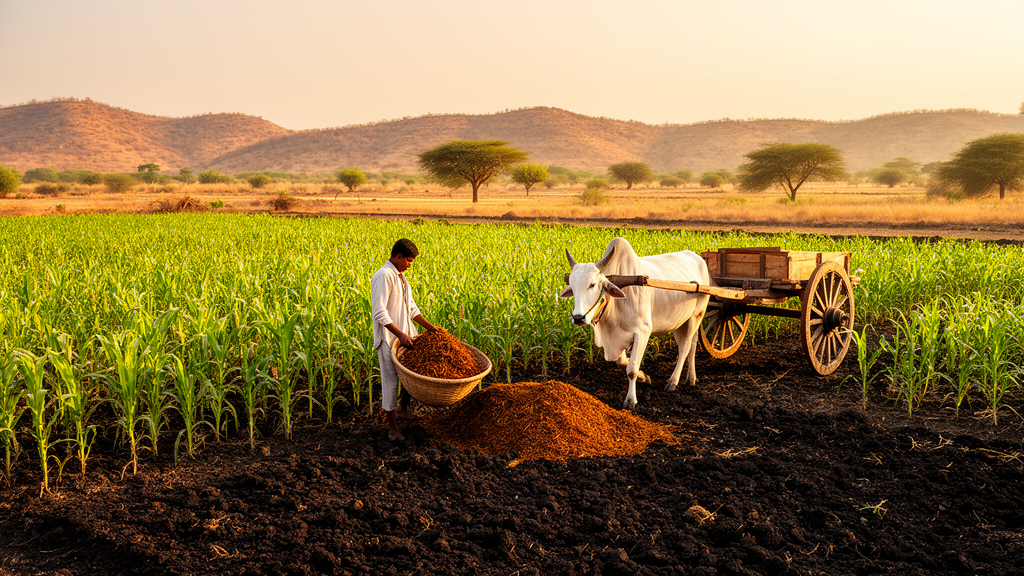
In the parched farmlands of semiarid India, where soils have been quietly losing their fertility for generations, one of the longest-running agricultural experiments ever conducted has delivered a striking verdict: farmyard manure, applied steadily over more than half a century, can rebuild degraded soils, sustain crop yields, and strengthen food security in some of the world’s most vulnerable farming regions.
The study, published in the journal Discover Sustainability, tracked the effects of farmyard manure and nitrogen fertilization across 56 years in an irrigated pearl millet-wheat cropping system. Researchers led by Pooja Rani and Sarvendra Kumar of the ICAR-Indian Agricultural Research Institute in New Delhi, working with colleagues at CCS Haryana Agricultural University and several other Indian institutions, examined four manure rates—0, 10, 20, and 30 megagrams per hectare—each split equally between the rabi and kharif growing seasons, and combined them with three nitrogen fertilization levels of 0, 60, and 120 kilograms per hectare.
The results, drawn from yield records spanning 2000 to 2023, revealed that plots receiving 20 megagrams of manure per hectare produced average pearl millet yields of 2.45 megagrams per hectare and wheat yields of 4.77 megagrams per hectare. Those figures were statistically comparable to the yields from plots receiving the heaviest manure dose of 30 megagrams per hectare, yet they represented gains of 25 percent for pearl millet and 43 percent for wheat relative to unfertilized control plots. The finding suggests that farmers may not need the maximum manure input to achieve near-maximum productivity, a conclusion with significant implications for the scalability of organic nutrient management.
Equally important was what happened when nitrogen fertilization was omitted. The researchers found that removing nitrogen from the system significantly diminished yield potential regardless of manure rate, emphasizing that organic inputs alone cannot substitute for this essential macronutrient in crop production. Manure and mineral nitrogen, the study indicates, work best in tandem: the organic fraction builds soil structure, carbon, and microbial life over decades, while mineral nitrogen supplies the readily available nutrient that crops need in the short term.
Beneath the yield statistics lies a deeper story about soil transformation. Continuous application of the heaviest manure dose increased soil organic carbon by 143 percent in surface soils and 183 percent in subsurface soils compared with control plots. Available phosphorus rose 4.1-fold in surface soils and 6.2-fold in subsurface soils, while available potassium increased 1.7-fold and 2.7-fold respectively. These are not marginal adjustments; they represent a fundamental reconstitution of the soil’s chemical and biological capacity to support plant life in a region where fertility has been declining for decades.
The biological dimension proved just as consequential. Manure-treated plots showed significantly higher microbial functions and enzyme activity, indicators of a living soil community actively cycling nutrients and supporting plant growth. Soil microbes and their enzymes mediate the decomposition of organic matter, the release of nitrogen and phosphorus, and the formation of stable soil aggregates—all processes that determine whether a soil can sustain productivity through drought years and climate variability.
To untangle which factors mattered most for crop yields, the team employed partial least squares path modeling, a statistical technique capable of quantifying the relative influence of multiple interacting variables. The analysis revealed that macronutrients were the principal drivers of crop yield, with a path coefficient of 1.18 and a p-value below 0.001. Macronutrients alone accounted for 72 percent of yield variability, highlighting the critical interplay between biotic factors such as microbial activity and abiotic factors such as nutrient availability in determining agricultural outcomes.
The researchers conclude that integrating 20 megagrams of farmyard manure per hectare with optimum nitrogen fertilization may provide a scalable, climate-resilient solution for sustaining yields, restoring degraded soils, and strengthening food security in semiarid regions and comparable soil types. The moderate manure rate, statistically indistinguishable in productivity from the highest rate, offers a practical compromise that avoids the logistical and economic burdens of applying excessive organic material while still delivering the long-term soil benefits that underpin resilience.
For a world grappling with soil degradation, climate volatility, and rising food demand, the study’s message is both simple and profound: patience pays. Five decades of steady organic inputs transformed exhausted semiarid soils into productive, carbon-rich, biologically active farmland. The experiment demonstrates that sustainable intensification is not a contradiction but an achievable reality, provided farmers and policymakers commit to nutrient cycling practices whose benefits compound over generations rather than seasons.
The 56-year experiment behind these findings belongs to a rare class of field trials. Long-term agricultural experiments spanning multiple decades are uncommon worldwide, and those conducted under uniform management in semiarid environments are rarer still. Their value lies in the ability to separate slow-acting processes—such as the gradual accumulation of soil organic matter and the slow build-up of nutrient reserves—from the year-to-year noise of weather and management. Because the manure treatments were split equally between the kharif (monsoon) and rabi (winter) seasons, the study captured how organic inputs behave across both of the contrasting growing windows that define cropping in much of semiarid South Asia.
The choice of cropping system matters as much as the duration. Pearl millet and wheat together form a staple rotation across large parts of the Indian subcontinent, with pearl millet grown during the hot, rain-fed-influenced monsoon season and wheat cultivated under irrigation in the cooler months. Yields averaging 2.45 megagrams per hectare for pearl millet and 4.77 megagrams per hectare for wheat in the moderately manured plots represent substantial productivity for semiarid conditions, where heat stress, erratic rainfall, and inherently low soil organic matter typically constrain output. The fact that these yields were achieved with manure as the primary nutrient foundation suggests that organic matter accumulation can buffer crops against the environmental stresses characteristic of dryland agriculture.
The differential response of surface and subsurface soils offers a window into how manure reshapes the soil profile over time. The larger relative gains in subsurface layers—183 percent for organic carbon, 6.2-fold for phosphorus, and 2.7-fold for potassium—indicate that decades of organic additions have moved nutrients and carbon below the topsoil. This matters because subsurface reserves influence root development, water-holding capacity, and the ability of crops to access moisture during dry spells. Surface enrichment alone can be washed away or volatilized; deep accumulation suggests a durable restructuring of the soil’s fertility architecture.
The statistical finding that the 20 megagram rate matched the 30 megagram rate carries practical weight for resource-constrained farming systems. Farmyard manure is bulky, labor-intensive to transport and apply, and often in limited supply at the farm scale. Halving the required dose without sacrificing yield means more farmers can adopt the practice, and more land can be covered with the same quantity of available manure. It also reduces the risk of nutrient oversaturation, which can occur when heavy organic applications exceed crop uptake capacity over many years.
The interdependence between manure and mineral nitrogen deserves emphasis. The finding that omitting nitrogen fertilization significantly diminished yield potential, regardless of manure rate, aligns with a broader principle in soil science: organic amendments release nutrients gradually as microbes decompose them, and this slow mineralization frequently cannot match the rapid nutrient demand of cereal crops during critical growth stages. Integrated nutrient management—combining organic matter building with judicious mineral fertilization—has emerged as a central strategy for reconciling productivity with soil conservation, and this experiment provides multi-decadal empirical support for that approach in a semiarid context.
The path modeling results add a quantitative dimension to understanding what drives yield in these systems. A path coefficient of 1.18 for macronutrients, with 72 percent of yield variability explained, indicates that while microbial activity and enzyme dynamics are essential mediators of nutrient cycling, the ultimate constraint on productivity remains the supply of essential plant nutrients. This does not diminish the biological story; rather, it clarifies the causal chain. Manure feeds the microbial community, microbes decompose organic matter and release nutrients, and those nutrients—nitrogen, phosphorus, potassium—directly fuel crop growth. The biotic and abiotic components are not competing explanations but sequential links in the same process.
Soil organic carbon itself deserves attention beyond its role in fertility. Carbon stored in agricultural soils represents one of the few widely available mechanisms for removing atmospheric carbon dioxide while simultaneously improving food production. The 143 percent surface and 183 percent subsurface increases observed here, achieved through a practice already familiar to farmers, suggest that semiarid croplands—often dismissed as having limited carbon sequestration potential—can accumulate substantial carbon when managed with sustained organic inputs over long horizons. The magnitude of these gains, accumulated over 56 years, also illustrates the patience required: carbon accrual in soils is slow, and short-term trials frequently underestimate the eventual benefits.
The enzyme activity and microbial function findings round out the picture of a soil transformed from a largely mineral substrate into a functioning biological system. Enzymes involved in carbon, nitrogen, phosphorus, and sulfur cycling serve as sensitive indicators of soil health, responding to management changes faster than bulk organic matter measurements. Their elevation in manure-treated plots confirms that the added organic material is not merely accumulating inertly but is being actively processed by soil organisms, sustaining the nutrient flows on which crop productivity depends.
Taken together, the study offers a template for dryland agriculture facing intensifying climate pressure. It demonstrates that the combination of moderate organic inputs and balanced mineral fertilization, maintained consistently over decades, can simultaneously address food production, soil restoration, and climate resilience in environments where these goals have often been treated as competing priorities.
Subject of Research: Long term manure driven nutrient cycling enhances productivity resilience and food security in semiarid agroecosystems
Article Title: Long term manure driven nutrient cycling enhances productivity resilience and food security in semiarid agroecosystems
Article References: Rani, P., Kumar, S., Raj, D., Purakayastha, T. J., Sinha, N. K., Mandal, D., Rosin, K. G., Govindasamy, V., Sharma, A., Sinha, S. K., Vishwanath, Jangir, A., Chowdhuri, A., & Kumar, A. (2026). Long term manure driven nutrient cycling enhances productivity resilience and food security in semiarid agroecosystems. Discover Sustainability. https://doi.org/10.1007/s43621-026-03974-4
Image Credits: AI Generated
DOI: 10.1007/s43621-026-03974-4
Keywords: Long, term, manure, driven, nutrient, cycling, enhances, productivity, resilience, food, security, semiarid
Cite Scienmag News
Alan Morgan. (October 16, 2026). Decades of Manure Build Climate-Resilient Farms in Semiarid India. Scienmag. https://scienmag.com/decades-of-manure-build-climate-resilient-farms-in-semiarid-india/
Alan Morgan. "Decades of Manure Build Climate-Resilient Farms in Semiarid India." Scienmag, 16 October 2026, https://scienmag.com/decades-of-manure-build-climate-resilient-farms-in-semiarid-india/. Accessed 16 October 2026.
Alan Morgan. "Decades of Manure Build Climate-Resilient Farms in Semiarid India." Scienmag. October 16, 2026. https://scienmag.com/decades-of-manure-build-climate-resilient-farms-in-semiarid-india/


