


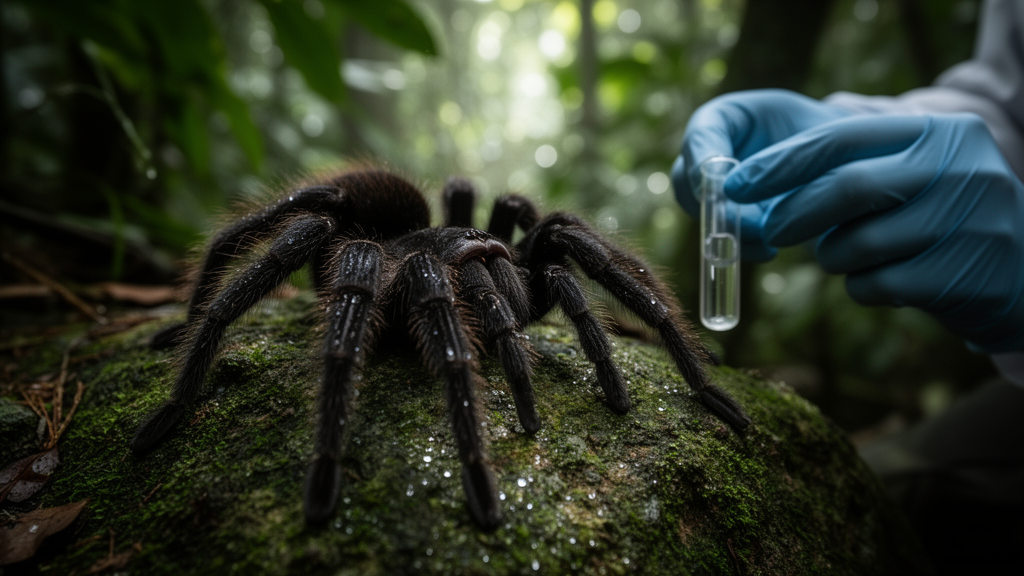
Deep in the humid rice paddies and lateritic soils of South and Southeast Asia, a large, dark, hairy spider waits at the mouth of a silk-lined burrow. To farmers, it is a familiar and feared neighbor. To scientists, it is Chilobrachys, a genus of Old-World tarantulas whose venomous bites have long been surrounded by rumor, folklore, and fragmentary clinical evidence. A new study published in Frontiers in Arachnid Science now delivers the most comprehensive picture yet of where these spiders live, what climates they prefer, and what actually happens to the humans they bite, combining bioclimatic modeling with fourteen years of verified bite documentation.
The research team, led by Ayan Mondal of Government General Degree College in Mohanpur, West Bengal, together with colleagues from Prafulla Chandra Sen Government Medical College and Hospital and The University of Burdwan, assembled an enormous dataset to map the genus across Asia. Starting from 940 occurrence points drawn from the Global Biodiversity Information Facility, social media platforms, and direct field observations, the researchers applied a spatial thinning technique using a 1.5-kilometer grid to eliminate geographical sampling bias. After removing points over marine environments and those lacking essential environmental data, 921 valid occurrence points remained for the final modeling process.
To predict where Chilobrachys species can thrive, the team employed maximum entropy modeling, or MaxEnt, a statistical framework widely used in ecological biogeography. Of the 19 bioclimatic variables initially considered, seven were retained after the researchers used the ENMTools package to strip out variables correlated at plus or minus 0.8 or higher, a step that prevents overfitting due to multicollinearity among raster layers. The model’s performance was assessed through 10-fold cross-validation, and the resulting habitat suitability map achieved an approximate AUC value of 0.887, indicating strong predictive power and relatively few false positives. The final map categorized Asian landscapes into four distribution classes, from unsuitable habitat to maximum suitability, with the red-highlighted maximum zones covering 734,216 square kilometers.
The modeling results reveal a genus with sharply defined climatic preferences. Chilobrachys species flourish where daily temperature ranges are moderate, spanning minus 7.9 degrees Celsius to 43.3 degrees Celsius across their range, and where precipitation is sufficient, from 0 millimeters to 2,325 millimeters. The response curves show a peak in suitability when the mean diurnal range sits near 10 degrees Celsius, after which it declines sharply. The maximum temperature of the warmest month, known as BIO5, emerges from the jackknife test as the single most important variable, with suitability peaking between 30 and 35 degrees Celsius and collapsing at higher extremes. Precipitation during both the warmest and coldest quarters, BIO18 and BIO19, also plays a decisive role, with the warmest-quarter rainfall peaking around 2,000 to 3,000 millimeters. The genus is strongly sensitive to arid conditions, with occurrence probability dropping steeply when precipitation of the driest month falls below 50 millimeters.
Geographically, the highest probability zones stretch across northeastern India into the Himalayan foothills and along the Western Ghats, regions home to species such as Chilobrachys assamensis and C. fimbriatus. India harbors 12 species, the greatest national diversity, followed by Myanmar with nine and China with seven. Central and southern Sri Lanka show maximum probability, corresponding to the island’s two endemic species, while northern Vietnam and western Thailand are marked as high-probability areas. Most of central and northern China, by contrast, is unsuitable due to colder winters and lower precipitation. The southern regions of peninsular Malaysia show minimal likelihood, possibly reflecting higher isothermality or reduced rainfall during certain months.
These climatic findings align closely with the genus’s natural history. Chilobrachys spiders prefer moist, humid environments near rivers and streams, constructing branched burrows in semiarid, lateritic soil where silk-lined tunnels serve as both shelter and hunting ground. They are ambush predators, remaining concealed until prey comes within reach, and their diet spans orthopterans, dipterans, dictyopterans, hymenopterans, and lepidopterans, along with small vertebrates including frogs, lizards, and rodents. They are strict carnivores that reject scavenging, and cannibalism is observed, particularly among females who may consume males after failed mating attempts. During the mating season from March to July in the subcontinent, males abandon their burrows and adopt a wandering, cursorial hunting style as they search for mates, dramatically increasing their mobility and their encounters with humans.
That seasonal wandering may explain a striking pattern in the bite data. Over fourteen years, from January 2010 to August 2024, the team documented 24 confirmed Chilobrachys bites in humans, verified under strict international protocols requiring direct observation, captured or photographed spiders, and typical symptoms. Most incidents occurred between April and July, with June alone accounting for seven bites, followed by April with five, May with four, and July with three. The researchers attribute this pre-monsoon and early-monsoon peak to the overlap of agricultural activity with the spiders’ active phase, as soil disturbance displaces tarantulas from their burrows and mating-season males roam openly.
The clinical picture that emerges is considerably more severe than the mild stings typically associated with tarantula bites. Pain intensity across all data sources ranged from 6 to 10 on a 10-point scale, with medical reports recording values between 8 and 10. Pain lasted from 3 to 7 days in medically followed cases, but spot surveys in remote areas revealed periodic pain lasting up to 30 days, a difference the researchers link to delayed treatment. Necrosis appeared in 50 to 72 percent of cases depending on the data source, and blister formation reached 91 percent in spot surveys. Fang marks, surprisingly, were visible in only 20 to 27 percent of cases. Systemic effects, though rarer, included fever, breathing difficulty from allergic reactions, generalized pruritus, and in rare instances hemoglobinuria, the presence of hemoglobin in urine caused by venom-induced hemolysis.
Three detailed case reports from West Bengal illustrate the venom’s cytotoxic potential. A 65-year-old farmer bitten on the left leg in a paddy field developed progressive swelling, blisters, and blackening of the skin; laboratory tests showed elevated creatinine and a leukocyte count of 18,700 per cubic millimeter, and surgical consultation led to debridement for suspected compartment syndrome. A 48-year-old housewife bitten on the left forearm while cooking required wound debridement and fasciotomy under general anesthesia, followed by negative-pressure wound therapy for five days. A 57-year-old farmer bitten on the right middle finger experienced a burning sensation radiating to his shoulder, managed conservatively with intravenous linezolid, levofloxacin, promethazine, and gabapentin. All three patients recovered fully on follow-up, but the cases demonstrate how delayed or inadequate care can escalate a localized bite into cellulitis, necrosis, and compartment syndrome, a limb-threatening condition caused by swelling within closed fascial compartments.
The venom’s biochemistry helps explain these outcomes. Chilobrachys venom, particularly that of the Chinese species C. jingzhao, is dominated by cystine-knot toxins, structurally stable peptides whose conserved disulfide bonds enhance binding precision. These toxins modulate voltage-gated sodium and potassium channels, acting as pore blockers or gating modifiers, shifting activation thresholds and trapping voltage sensors in resting states. Toxins such as Jingzhaotoxin-V and Jingzhaotoxin-XIII selectively alter ion channel dynamics, and transcriptomic studies continue to reveal novel peptides with significant pharmacological implications. Two human fatalities have been attributed to Chilobrachys bites in the literature, involving complications such as gangrene and severe allergic reactions, and multiple fatal bites in dogs have been reported, underscoring that while these spiders are rarely lethal to humans, their venom demands respect.
Treatment, the researchers emphasize, hinges on early intervention. The recommended first aid follows the RICE protocol of rest, ice, compression, and elevation, beginning with thorough washing of the bite area with soap and water, ice packs applied for 15 to 20 minutes on and off, limb elevation, and nonsteroidal anti-inflammatory drugs such as naproxen or ibuprofen for pain. Tetanus prophylaxis is advised when immunization status is unclear. Antihistamines such as pheniramine or levocetirizine control itching and mild allergic reactions, while severe anaphylaxis requires epinephrine and emergency protocols. Patients should be monitored for at least 24 hours because symptoms can be delayed up to 30 hours, with follow-up extending to a week. Laboratory investigations include complete blood counts, coagulation profiles, renal and liver function tests, and urine examination for hemoglobinuria. In severe cases, surgical debridement removes necrotic tissue, fasciotomy relieves compartment syndrome, and hemodialysis may be initiated for acute renal failure or hemolysis, with blood transfusion considered when hemoglobin drops significantly.
Beyond the clinic, the study carries implications for a changing climate. The sharp decline in habitat suitability beyond 35 degrees Celsius suggests that extreme heat acts as a barrier to the genus’s distribution, potentially limiting range expansion under global warming, while shifts in rainfall patterns could either expand or contract suitable habitats depending on their nature. The researchers argue that public awareness in endemic regions, healthcare worker training in tarantula bite identification and first aid, and early medical intervention are essential to mitigate morbidity. As agricultural zones in tropical and subtropical Asia continue to host the highest risk of human-spider interaction, the study provides a dual framework, ecological and clinical, for preventing and managing envenomation in a world where the boundaries between spider habitat and human activity grow ever thinner.
Subject of Research: Distribution, habitat suitability, natural history, bite report, and medical importance of the Asian tarantula Chilobrachys spp.
Article Title: Distribution, habitat suitability, natural history, bite report, and medical importance of the Asian tarantula Chilobrachys spp.
Article References: Mondal, A., Das, S., Mukherjee, S. S., & Saha, S. (2025). Distribution, habitat suitability, natural history, bite report, and medical importance of the Asian tarantula Chilobrachys spp.. Frontiers in Arachnid Science, 4, Article 1598438. https://doi.org/10.3389/frchs.2025.1598438
Image Credits: AI Generated
DOI: 10.3389/frchs.2025.1598438
Keywords: Distribution, habitat, suitability, natural, history, bite, report, medical, importance, Asian, tarantula, Chilobrachys
Cite Scienmag News
Alan Morgan. (October 16, 2026). Asian Tarantula Venom Revealed: Climate Maps and Clinical Cases Redefine Bite Risk. Scienmag. https://scienmag.com/asian-tarantula-venom-revealed-climate-maps-and-clinical-cases-redefine-bite-risk/
Alan Morgan. "Asian Tarantula Venom Revealed: Climate Maps and Clinical Cases Redefine Bite Risk." Scienmag, 16 October 2026, https://scienmag.com/asian-tarantula-venom-revealed-climate-maps-and-clinical-cases-redefine-bite-risk/. Accessed 16 October 2026.
Alan Morgan. "Asian Tarantula Venom Revealed: Climate Maps and Clinical Cases Redefine Bite Risk." Scienmag. October 16, 2026. https://scienmag.com/asian-tarantula-venom-revealed-climate-maps-and-clinical-cases-redefine-bite-risk/


