


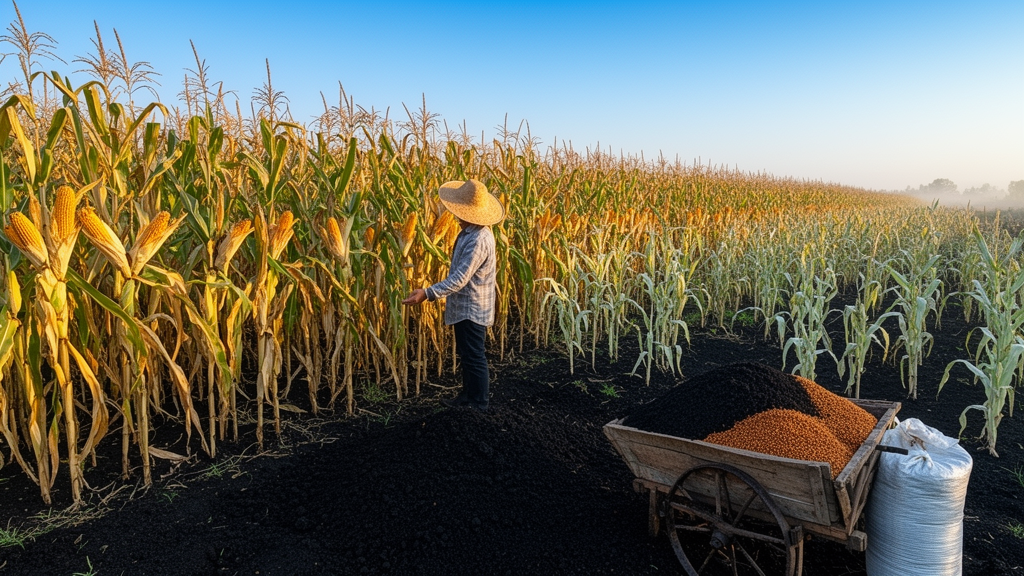
Five consecutive years of field trials on China’s Northeast Black Soil Region have delivered a striking result: when farmers added either humic acid or composted chicken manure to their standard chemical fertilizer regime, average maize yields climbed by roughly 46 percent compared with plots receiving mineral fertilizer alone. The study, conducted at the Anda Experimental Base of Heilongjiang Bayi Agricultural University between 2021 and 2025, offers one of the most detailed pictures yet of how organic amendments interact with alkaline soils, microbial communities, and long-term yield stability in one of the world’s most important grain-producing regions.
The research team, led by Yuzhou Jiang and colleagues from Heilongjiang Bayi Agricultural University and the Chinese Academy of Agricultural Sciences, set out to address a persistent problem. The black soils of Northeast China are naturally alkaline, with pH values around 8.2 that restrict the availability of phosphorus and micronutrients, impair microbial functions, and cause year-to-year yield fluctuations under conventional chemical fertilization. As grain demand continues to grow across China, understanding how to stabilize productivity in these soils has become a matter of national food security.
The experiment compared three treatments in a randomized block design: a chemical fertilizer control (CK) receiving urea, diammonium phosphate, and potassium sulfate at recommended rates; a humic acid treatment (HA) adding 3,000 kilograms per hectare of humic acid extracted from weathered lignite; and a chicken manure treatment (JF) adding 1,500 kilograms per hectare of commercially composted poultry manure. All plots grew the same maize variety, Xianyu 335, under identical agronomic management. Over five harvests, the average yields under HA and JF reached 12.47 and 12.50 tonnes per hectare respectively, representing increases of 45.90 and 46.27 percent relative to the fertilizer-only control.
Yet the two organic amendments told distinctly different stories over time. Linear regression of yield trends revealed that the humic acid treatment exhibited a significantly steeper positive slope of 1.47 tonnes per hectare per year, with an R-squared of 0.58 and a P value of 0.001, compared with 0.84 tonnes per hectare per year for chicken manure. This suggests humic acid possesses superior long-term yield-building potential. Chicken manure, by contrast, delivered the lowest coefficient of variation at 17.64 percent, indicating better inter-annual stability, while humic acid showed the highest variability at 22.7 percent. The yield sustainability index ranged narrowly from 0.727 to 0.742 across all treatments, and the corrected yield trend index was lowest for humic acid at minus 49.93 percent, confirming a strong yield acceleration from the early to the later phases of the trial.
The soil chemistry results were equally revealing. After five years, both organic-amended treatments showed slightly but consistently lower soil pH than the control, with HA and JF plots measuring 8.02 and 8.01 respectively against 8.26 for CK. This represents a modest shift of approximately 0.25 pH units within the alkaline range. However, bulk density, alkaline-hydrolyzable nitrogen, available phosphorus, available potassium, and multiple organic carbon fractions, including total soil organic carbon, particulate organic carbon, mineral-associated organic carbon, easily oxidizable organic carbon, and water-soluble organic carbon, showed no significant differences among treatments. The researchers note that this carbonate-buffered calcareous soil has limited intrinsic capacity for such a small pH change to substantially modify phosphorus or micronutrient bioavailability on its own.
Metagenomic sequencing of rhizosphere soil, performed on samples collected at the final 2025 harvest, revealed a more nuanced microbial picture. Alpha diversity indices, including the Simpson, Chao1, Sobs, and Coverage indices, were highly similar across all treatments, with the Simpson index consistently at 0.99. This suggests that five years of organic amendment did not substantially alter overall microbial richness or evenness. However, principal component analysis showed distinct separation patterns: PC1 explained 14.62 percent of community variation and PC2 explained 13.86 percent, together accounting for 28.48 percent of total variation. The most pronounced differences in community structure appeared between the control and humic acid treatments, with chicken manure showing intermediate characteristics.
Taxonomic analysis uncovered treatment-specific enrichment patterns that hint at different ecological strategies. The humic acid treatment was descriptively associated with higher relative abundance of Luteitalea and Nocardioides, actinomycete-associated taxa linked to complex organic matter decomposition and rhizosphere substrate utilization. The chicken manure treatment enriched Bradyrhizobium, a genus strongly associated with nitrogen cycling, and Lysobacter, known for its antagonistic effects against other microorganisms. The control treatment maintained high relative abundance of Rubrobacter, the most abundant annotated genus across all plots. A Kruskal-Wallis H-test detected significant differences among treatments for ten genera, and LEfSe analysis further revealed distinct archaeal community compositions, though the researchers caution that several archaeal annotations, including thermophilic taxa biologically unexpected in temperate agricultural topsoil, likely reflect database annotation bias rather than genuine in-situ enrichment.
Correlation and ordination analyses pointed to soil pH as the primary environmental driver of microbial community differentiation. Redundancy analysis showed that RDA1 and RDA2 together explained 87.6 percent of community variation, with the pH vector carrying the longest arrow length. An exploratory structural equation model suggested positive associations between organic amendment treatment, reduced soil pH, and maize yield, with model coefficients of 0.92 for Luteitalea and minus 0.73 for Rubrobacter in relation to pH. However, the researchers are careful to emphasize that these modeled associations do not constitute mechanistic causal proof, given the small sample size and the confounding of nutrient inputs with organic material addition.
Indeed, the study’s most important caveat is its experimental design. Because the organic materials were applied at locally recommended rates rather than balanced for total nutrient content, the HA and JF treatments received substantial additional nitrogen, phosphorus, and potassium from organic sources. No equal-nutrient mineral-fertilizer control was included, meaning yield differences cannot be definitively attributed to the intrinsic properties of the organic materials, the modest pH shifts, or the observed microbial community changes alone. Interestingly, HA and JF received markedly different total nitrogen and phosphorus inputs from organic sources yet produced statistically indistinguishable multi-year average yields, an observation inconsistent with a simple monotonic nutrient-supply-limited response. One plausible interpretation is that both amended treatments had already saturated the primary yield-limiting factor for maize at this site.
The practical implications remain significant for farmers across the Northeast Black Soil Region. Humic acid application should be prioritized when production goals emphasize long-term yield potential, while chicken manure proves more advantageous for achieving consistent annual yields and mitigating risk under climate variability. As the researchers conclude, both materials represent regionally adaptable organic soil enrichment practices, though their respective applications target different objectives. Future work with balanced nutrient controls and larger sample sets will be needed to disentangle the relative contributions of supplementary nutrients, pH modification, and microbial community restructuring to the remarkable yield gains documented over these five years.
Subject of Research: Long-term effects of combined chemical fertilizer and organic amendments on maize yield stability and soil microbial communities in alkaline black soils
Article Title: Long-term effects of combined application of chemical fertilizers and organic materials on maize yield stability and microbial functional potential and soil microbial community structure in alkaline soils
Article References: Jiang, Y., Zhang, Y., Zhang, H., & Li, Y. (2026). Long-term effects of combined application of chemical fertilizers and organic materials on maize yield stability and microbial functional potential and soil microbial community structure in alkaline soils. Frontiers in Agronomy, 8, Article 1948938. https://doi.org/10.3389/fagro.2026.1948938
Image Credits: AI Generated
DOI: 10.3389/fagro.2026.1948938
Keywords: maize yield, humic acid, chicken manure, alkaline soils, black soil region, soil microbiome, metagenomics, organic amendments, soil pH, yield stability, China agriculture, sustainable fertilization
Cite Scienmag News
Alan Morgan. (October 16, 2026). Humic Acid and Chicken Manure Lift Maize Yields Nearly 46 Percent in China’s Alkaline Black Soils. Scienmag. https://scienmag.com/humic-acid-and-chicken-manure-lift-maize-yields-nearly-46-percent-in-chinas-alkaline-black-soils/
Alan Morgan. "Humic Acid and Chicken Manure Lift Maize Yields Nearly 46 Percent in China’s Alkaline Black Soils." Scienmag, 16 October 2026, https://scienmag.com/humic-acid-and-chicken-manure-lift-maize-yields-nearly-46-percent-in-chinas-alkaline-black-soils/. Accessed 16 October 2026.
Alan Morgan. "Humic Acid and Chicken Manure Lift Maize Yields Nearly 46 Percent in China’s Alkaline Black Soils." Scienmag. October 16, 2026. https://scienmag.com/humic-acid-and-chicken-manure-lift-maize-yields-nearly-46-percent-in-chinas-alkaline-black-soils/


