


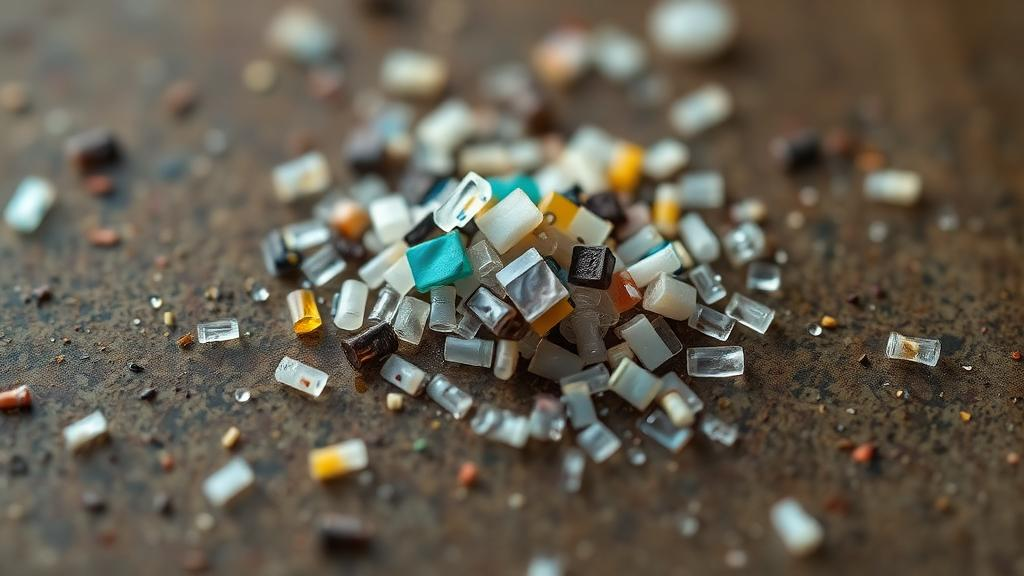
Every flush, laundry load, and laboratory rinse on a university campus eventually converges on a single destination: the sewage treatment plant. And according to a new study from India, what accumulates at the end of that journey is a startlingly rich archive of everyday plastic life. Researchers at BITS Pilani, Hyderabad campus, have documented microplastic contamination in sewage sludge from the institution’s own wastewater treatment system, finding plastic particles in every single sample collected over a seven-month monitoring campaign.
The study, published in the journal Environmental Monitoring and Assessment, focused on an academic facility operating a hybrid Moving Bed Biofilm Reactor combined with Zero Liquid Discharge technology, a configuration known as MBBR-ZLD. Between January and July, the team collected sludge samples fortnightly and subjected them to a battery of analytical techniques, including wet peroxide oxidation, density separation, stereomicroscopy, ATR-FTIR spectroscopy, scanning electron microscopy with energy dispersive X-ray analysis, and Nile Red fluorescence microscopy. The result was one of the most comprehensive portraits yet of microplastic pollution in an institutional treatment system in a developing country.
The numbers are striking. Microplastic concentrations in the sludge ranged from 120 to 1,145 particles per kilogram of dry weight, with considerable variation across the sampling period. Particle sizes spanned an enormous range, from just 7.02 micrometers to 4,592 micrometers, roughly the difference between a bacterium and a grain of rice. The 500 to 1,000 micrometer fraction emerged as the most prevalent size class, suggesting that mid-sized fragments and fibres survive the treatment process most effectively and become concentrated in the sludge matrix.
When the researchers examined particle morphology, a clear hierarchy emerged. Fibres dominated the assemblage, accounting for 43.3 percent of all microplastics identified. Fragments followed closely at 39.5 percent, while films made up 11.5 percent. This distribution tells a story about the sources of contamination on campus. Fibres typically originate from synthetic textiles shed during laundry, fragments from the mechanical breakdown of larger plastic items, and films from packaging materials. The near-even split between fibres and fragments suggests that both domestic activities and disposable plastic consumption contribute substantially to the pollution load.
Polymer identification using infrared spectroscopy revealed eight distinct plastic types in the sludge. Nylon-PA6 was the most abundant polymer at 37.7 percent, followed by low-density polyethylene at 16.0 percent. The remaining polymers included polyethylene terephthalate, polypropylene, polystyrene, polycarbonate, polymethyl methacrylate, and acrylonitrile butadiene styrene. Each of these materials points to a specific origin. Nylon fibres are shed from synthetic clothing during washing, LDPE is ubiquitous in packaging and plastic bags, PET appears in beverage bottles, and polycarbonate and PMMA are common in laboratory equipment and consumer electronics. The diversity of polymers reflects the diversity of plastic use across a residential and academic campus.
One of the most methodologically important aspects of the study was its rigorous validation approach. The researchers used co-spiked reference materials to assess recovery efficiency, finding an overall recovery of 81.66 percent with a standard deviation of 2.51 percent. Crucially, recovery varied depending on particle type and size, meaning that some categories of microplastics were systematically undercounted or overcounted by the extraction procedure. To address this, the team applied correction factors to their raw data, improving the accuracy of their concentration estimates. This kind of methodological transparency is increasingly recognized as essential in microplastic research, where extraction losses can dramatically skew reported abundances.
Perhaps the most intriguing finding came from the temporal analysis. The researchers observed a strong positive Spearman rank correlation between campus occupancy and monthly mean microplastic concentration, with a correlation coefficient of 0.756 and a p-value of 0.049. In practical terms, this means that when more people were on campus, more microplastics ended up in the sludge. The relationship, while statistically significant at the conventional threshold, sits right at the boundary of the p-value cutoff, suggesting a real but not overwhelming signal. Still, the implication is clear: human activity is a primary driver of microplastic loading in institutional wastewater systems.
This finding has implications that extend far beyond a single university. Campuses, office complexes, hospitals, and other institutional facilities generate concentrated, predictable patterns of plastic consumption tied directly to occupancy. Laundry from hostels, cosmetics and personal care products washed off in showers, hygiene products, food packaging from canteens, and laboratory plastics all converge on the treatment plant. The study’s authors note that these diverse daily emissions from laundry, cosmetics, hygiene, packaging, and laboratories collectively shape the polymer profile found in the resulting sludge.
The broader context makes these findings particularly significant. Sewage sludge is increasingly recognized as a major reservoir and environmental pathway for microplastics. When sludge is applied to agricultural land as fertilizer or disposed of in landfills, the embedded microplastics can migrate into soils, waterways, and ultimately the food chain. Recent research has documented microplastic contamination in soils amended with treated sludge, raising concerns about long-term ecological and human health effects. Understanding the concentration, composition, and temporal dynamics of microplastics in sludge is therefore a critical step toward designing effective mitigation strategies.
The choice of an MBBR-ZLD system as the study site adds another layer of relevance. Moving Bed Biofilm Reactors are widely deployed in India and other developing countries as compact, efficient treatment solutions, while Zero Liquid Discharge systems are designed to eliminate liquid effluent entirely by recovering water and concentrating waste into solid form. If microplastics accumulate in the sludge of such advanced systems, it suggests that even sophisticated treatment infrastructure cannot fully prevent plastic particles from concentrating in residual waste streams. The researchers argue that institutional usage patterns play a decisive role in microplastic accumulation within these systems, a conclusion that could inform both facility management and future regulatory frameworks. As plastic production continues to grow globally, studies like this one provide the granular, site-specific data needed to understand where microplastics come from, where they go, and how human behavior shapes their environmental trajectory.
Subject of Research: Microplastic contamination in sewage sludge from a university wastewater treatment system in India
Article Title: Occurrence, quantification, and characterization of microplastics in sewage sludge from a university wastewater treatment system
Article References: Occurrence, quantification, and characterization of microplastics in sewage sludge from a university wastewater treatment system. (n.d.). https://doi.org/10.1007/s10661-026-15866-1
Image Credits: AI Generated
DOI: 10.1007/s10661-026-15866-1
Keywords: microplastics, sewage sludge, wastewater treatment, MBBR, zero liquid discharge, ATR-FTIR spectroscopy, Nile Red staining, polymer identification, campus occupancy, India, environmental monitoring, fibres
Cite Scienmag News
Violet Maxwell. (October 16, 2026). Microplastics Pile Up in University Sewage Sludge as Campus Life Leaves a Measurable Plastic Fingerprint. Scienmag. https://scienmag.com/microplastics-pile-up-in-university-sewage-sludge-as-campus-life-leaves-a-measurable-plastic-fingerprint/
Violet Maxwell. "Microplastics Pile Up in University Sewage Sludge as Campus Life Leaves a Measurable Plastic Fingerprint." Scienmag, 16 October 2026, https://scienmag.com/microplastics-pile-up-in-university-sewage-sludge-as-campus-life-leaves-a-measurable-plastic-fingerprint/. Accessed 16 October 2026.
Violet Maxwell. "Microplastics Pile Up in University Sewage Sludge as Campus Life Leaves a Measurable Plastic Fingerprint." Scienmag. October 16, 2026. https://scienmag.com/microplastics-pile-up-in-university-sewage-sludge-as-campus-life-leaves-a-measurable-plastic-fingerprint/


