


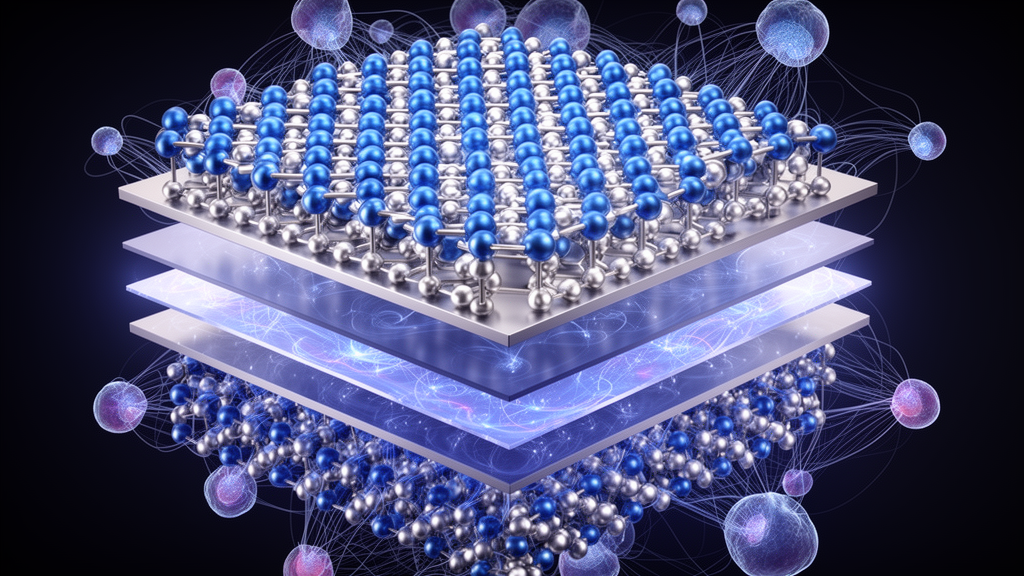
Deep inside the sintered pellets of an otherwise unremarkable metal alloy, a quiet revolution in materials prediction is taking shape. Indium-lead heterostructures, fabricated by the industrial workhorse technique of hot pressing, sit at the intersection of superconducting quantum devices, spintronic circuits, and flexible electromagnetic functional materials. Their usefulness hinges on a property that has stubbornly resisted prediction: electromagnetic coupling, the way electric and magnetic responses intertwine across scales ranging from individual atomic layers to centimeter-scale pressed compacts. A new study published in Frontiers in Chemistry introduces an artificial intelligence framework that finally tames this multiscale complexity, achieving accuracy improvements of more than forty percent over the strongest existing baselines while keeping the predictions physically honest.
The central difficulty is that electromagnetic coupling in these low dimensional systems is not governed by any single mechanism. At the smallest scale, atomic layer spin-orbit coupling dictates how electron spins respond to electric fields. At the nanoscale, the In-Pb interfacial proximity effect allows superconducting and normal-state regions to borrow properties from one another across their shared boundary. At the mesoscale, the texture of grains and domains imprinted during fabrication shapes bulk anisotropy. And at the macroscale, hot pressing parameters such as temperature, pressure, and holding time determine which microstructural features actually survive into the finished component. Any predictive model that ignores one of these tiers risks producing numbers that look plausible but violate the fundamental physics.
Researchers led by a team reporting in Frontiers in Chemistry have now built a neural architecture specifically designed to respect this hierarchy. Their framework, called the Multiscale Cross Attention Electromagnetic Coupling Network, or MSCA-EMNet, embeds each of the four physical scales into independent, nonoverlapping channels of a hierarchical encoder. This design choice matters because it prevents the network from blurring together phenomena that operate at genuinely different length scales, a common failure mode when conventional deep learning models are applied to heterogeneous materials data.
The real innovation lies in how information flows between these channels. A bidirectional cross-scale attention module, dubbed BS-CrossAttn, places the query at scale k while drawing keys and values from the neighboring scales k plus or minus one. In practice, this means the network simultaneously performs upward aggregation, where fine-scale physics informs coarse-scale behavior, and downward constraint feedback, where macroscopic processing conditions discipline the interpretation of atomic-level features. Because both directions run in parallel, the model captures the mutual conditioning that real materials exhibit, rather than imposing a one-way causal chain that exists only in the mathematics of simpler architectures.
To connect the model to the messy reality of manufacturing, the researchers incorporated a Feature-wise Linear Modulation mechanism, known as FiLM, which maps hot pressing parameters and the applied magnetic field directly onto channel-level affine transformations. This gives the network a natural handle for inverse design: given a desired electromagnetic response, the model can identify the feasible windows of processing conditions most likely to produce it. A scale availability mask further allows training records with unequal coverage across the four scales to contribute meaningfully, using a learnable embedding that stands in for missing information rather than discarding valuable experimental data outright.
Physical consistency is enforced through a constraint that many machine learning approaches to materials science have historically overlooked. The nine-component electromagnetic coupling tensor, defined at a specified magnetic field and including three components of the interfacial magnetoelectric susceptibility, must satisfy Onsager reciprocity, the principle that direct and converse responses are symmetrically related in systems near equilibrium. By building this reciprocity requirement into the loss landscape, the researchers ensure that the network cannot produce magnetoelectric predictions that would violate thermodynamic constraints, no matter how well they fit the training data.
The empirical results are striking. Trained and validated on 1,200 samples drawn from density functional theory calculations and hot pressing experiments, MSCA-EMNet achieves an overall normalized mean absolute error of 0.041 and a coefficient of determination of 0.948. Compared against the strongest baseline model in the study, these figures represent improvements of 43 percent in error reduction and 7.2 percent in explanatory power. Perhaps more telling is the extrapolation degradation rate of 48.8 percent, which quantifies how gracefully the model’s accuracy declines when asked to predict outside the range of its training distribution, a scenario that routinely breaks conventional data-driven surrogates.
The reciprocity constraint pays dividends in a metric that speaks directly to physical plausibility. In baseline models, between 12 and 41 percent of predicted samples violated the Onsager relation, rendering them unusable for downstream device design regardless of their numerical accuracy. MSCA-EMNet reduces this violation rate to just 1.7 percent, a dramatic improvement that suggests the network has internalized the symmetry structure of electromagnetic coupling rather than merely memorizing input-output pairs. Cross-system transfer performance, measured between 0.86 and 0.89, further indicates that the learned representations generalize across different material configurations without requiring complete retraining.
To demonstrate practical utility, the researchers put the inverse design capability to the test. Starting from a target electromagnetic coupling tensor, the framework identified a feasible processing window of 168 to 174 degrees Celsius, 62 to 70 megapascals of pressure, 25 to 35 minutes of holding time, and a characteristic dimension of 8 to 12 micrometers. Six confirmatory experiments conducted within this window reproduced the target tensor within 7.6 percent on every component, closing the loop between computational prediction and physical realization in a way that few inverse design pipelines have achieved for multiscale electromagnetic materials.
The implications extend well beyond indium-lead heterostructures. As quantum devices, spintronic interconnects, and flexible electromagnetic materials push toward ever tighter integration of superconducting, magnetic, and mechanical functionalities, the need for predictive tools that honor physics while remaining flexible enough to learn from sparse experimental data will only intensify. By demonstrating that bidirectional cross-scale attention, physical reciprocity constraints, and inverse process design can be woven into a single coherent framework, this work offers a template that materials scientists across subfields are likely to adapt. The marriage of multiscale physics and modern machine learning, long promised and often overhyped, appears here in a form that delivers measurable, experimentally validated gains.
Subject of Research: Machine learning prediction of electromagnetic coupling in low dimensional In-Pb heterostructures fabricated by hot pressing
Article Title: A multiscale cross attention framework for predicting the electromagnetic coupling characteristics of low dimensional In-Pb heterostructures fabricated by hot pressing
Article References: Xi, Y., & Wang, L. (2026). A multiscale cross attention framework for predicting the electromagnetic coupling characteristics of low dimensional In-Pb heterostructures fabricated by hot pressing. Frontiers in Chemistry, 14, Article 1974299. https://doi.org/10.3389/fchem.2026.1974299
Image Credits: AI Generated
DOI: 10.3389/fchem.2026.1974299
Keywords: MSCA-EMNet, In-Pb heterostructures, hot pressing, electromagnetic coupling, cross attention, spin-orbit coupling, magnetoelectric susceptibility, Onsager reciprocity, inverse design, superconducting quantum devices, spintronics, density functional theory
Cite Scienmag News
Neil Sanderson. (October 16, 2026). AI Cracks the Multiscale Puzzle of Superconducting In-Pb Heterostructures. Scienmag. https://scienmag.com/ai-cracks-the-multiscale-puzzle-of-superconducting-in-pb-heterostructures/
Neil Sanderson. "AI Cracks the Multiscale Puzzle of Superconducting In-Pb Heterostructures." Scienmag, 16 October 2026, https://scienmag.com/ai-cracks-the-multiscale-puzzle-of-superconducting-in-pb-heterostructures/. Accessed 16 October 2026.
Neil Sanderson. "AI Cracks the Multiscale Puzzle of Superconducting In-Pb Heterostructures." Scienmag. October 16, 2026. https://scienmag.com/ai-cracks-the-multiscale-puzzle-of-superconducting-in-pb-heterostructures/


