


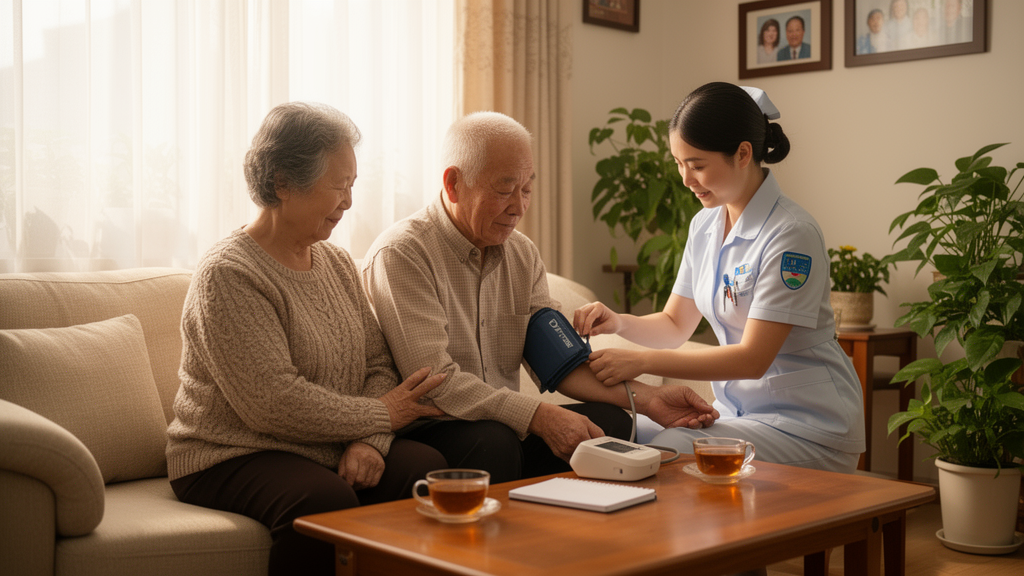
China is aging at a speed and scale that has few parallels in human history. By the end of 2023, the country counted 296.97 million people aged 60 and above, roughly 21.1 percent of its total population, and demographers project that China will cross the threshold into a super-aged society by 2030. Against that backdrop, a new study published in Frontiers in Public Health offers something unusually concrete: a quantified, yuan-by-yuan account of what functionally independent older adults actually want from home care services, and how much they are willing to pay for each one. The answer, drawn from more than 1,200 residents of Xi’an, upends some common assumptions about aging, because the services these older adults value most are not medical at all.
The research team, led by Xiaoke Yang of Fujian University of Technology together with colleagues from the Affiliated Rehabilitation Hospital of Fujian University of Traditional Chinese Medicine, focused on a population that has long been overlooked in gerontological research. Most studies of elder care concentrate on disabled or semi-disabled individuals, whose needs are dominated by medical and nursing support. But healthy, self-caring older adults make up roughly 85 percent of China’s elderly population, and their preferences have remained largely unmeasured. Recent national data suggest that average self-care ability among older Chinese adults has been improving while disability rates decline, making this gap in knowledge increasingly consequential for anyone planning services for the coming decades.
To capture those preferences, the researchers deployed a discrete choice experiment, a stated-preference technique widely used in health economics to quantify how people trade off competing attributes of a service. Rather than simply asking participants what they like, a DCE presents repeated hypothetical choices between carefully constructed service packages, forcing respondents to reveal their priorities through the decisions they make. In this study, each choice set offered two hypothetical home care scenarios alongside a “Neither” option, allowing participants to reject both if neither appealed. The design was generated with Ngene software using a D-optimality criterion, which minimizes the variance of estimated parameters and maximizes the statistical precision of the results.
The experiment was built around four non-monetary service domains, each with three levels, plus a monetary attribute. Healthcare services ranged from nothing to basic vital-sign monitoring of heart rate, blood pressure, and blood sugar, or physiotherapy rooted in traditional Chinese medicine, including electronic massage, moxibustion, and foot reflexology. Safety services spanned a one-button emergency call system and monthly home safety assessments that identify hazards and suggest improvements. Household affairs management covered home repair services for water, electricity, and other utilities, as well as bill payment assistance. Emotional care ranged from weekly phone calls to bi-weekly organized social activities. Monthly payments ranged from zero to 200 yuan, with 7.0467 yuan equal to one US dollar on average in 2023.
Developing the attributes was itself a multi-stage exercise. The team began with a literature review and focus group discussions involving six experts, two each from gerontology, public health, and elder care, together with ten healthy older adults. A pilot test with 35 participants then refined the wording until each attribute was clearly understood, and a larger pilot with 86 respondents supplied the prior estimates used in the experimental design. Thirty-six choice sets were created and divided into twelve blocks, so each respondent evaluated only three choice scenarios, a technique that reduces cognitive burden without sacrificing analytical depth. Every service level was presented in both text and illustration to further ease comprehension.
Data collection took place face-to-face between July 15 and August 7, 2024, across six central districts of Xi’an: Xincheng, Beilin, Lianhu, Weiyang, Yanta, and Baqiao. Using multistage random sampling, the researchers selected nine residential communities per district, stratified by housing price percentiles from the 10th to the 90th, and recruited thirty adults aged 60 and above from each. Of the 1,620 participants, 1,283 questionnaires survived a rigorous screening process that removed 71 protest zeros, 186 responses flagged by self-assessment items, and 80 more excluded on the basis of interviewer evaluations. The final sample averaged 69.4 years of age, was 65.2 percent female, and closely matched official statistics for the city, lending the results considerable representativeness.
The analytical engine was a mixed logit model, estimated in Stata with 2,000 Halton draws. Unlike a standard logit model, which assumes everyone shares identical preferences, the mixed logit allows each individual’s coefficients to vary randomly across the population, capturing genuine heterogeneity in tastes. The payment coefficient was specified as log-normally distributed, a standard approach that guarantees the marginal utility of money stays negative, while the eight service variables followed normal distributions. Model fit was strong, with a McFadden pseudo R-squared above 0.2 and a log-likelihood test significant at the one percent level. Willingness to pay for each service was then computed using the Krinsky and Robb simulation method, which generates proper confidence intervals by repeatedly resampling the estimated parameter distributions.
The headline finding is striking: the single most valued service was home repair, worth 162 yuan per month, followed by traditional Chinese medicine physiotherapy at 125 yuan and social activities at 103 yuan. Respondents were on average willing to pay 628 yuan per month for the full bundle of services. The authors attribute the dominance of home repair to information asymmetry, a classic concept from economics. Older adults often struggle with modern appliances and face non-transparent repair markets riddled with exaggerated problems, substandard work, and inflated prices; outsourcing repairs at a fixed, transparent price eliminates those hidden costs. The strong showing of TCM physiotherapy reflects a cultural shift from disease treatment toward disease prevention and wellness maintenance, while the high valuation of social activities suggests that existing opportunities for organized social engagement fall short of what older adults actually want.
At the other end of the ranking, the one-button emergency call system commanded the lowest willingness to pay, at just 23 yuan per month, plausibly because smartphones and smart voice assistants already provide similar functions. Bill payment assistance ranked second lowest at 27 yuan, though with the highest variability of any service, suggesting that family help and urban smart-service terminals have already absorbed much of that need. Basic health monitoring drew a moderate 39 yuan, while home safety assessments, frequently discussed in the aging-in-place literature, earned a solid 47 yuan per month. Regular supportive phone calls were valued at 65 yuan, confirming that even healthy older adults place real monetary weight on emotional connection.
The heterogeneity analysis, conducted through Tobit-style regression on individual-level willingness-to-pay estimates, revealed clear demographic patterns. Women, older adults living alone, those with worse self-reported health, those holding endowment insurance for urban workers, and those under less financial pressure all showed significantly higher overall willingness to pay. Men were willing to pay roughly 36 yuan less per month than women, driven mainly by lower valuations of household affairs and emotional care, while living alone added about 46 yuan, concentrated in healthcare and emotional services. Each step toward better self-reported health reduced willingness to pay by about 17 yuan, and greater financial pressure reduced it by about 40 yuan, with employee medical insurance adding nearly 44 yuan.
The aggregate implications are enormous. The authors estimate that roughly 85 percent of adults aged 60 and above in Xi’an’s main urban areas qualify as healthy older adults, amounting to about 0.69 million people. Applying the study’s average willingness-to-pay figure to that population yields an annual aggregate demand of approximately 5.19 billion yuan, equivalent to about 0.6 percent of the gross domestic product of Xi’an’s main urban areas in 2024. That figure represents latent market demand waiting to be organized into viable service offerings, and it arrives just as Xi’an’s Civil Affairs Bureau has drafted an implementation plan encouraging public-private partnerships to deliver inclusive home care.
The study’s broader message is that home care for healthy older adults should not be designed as a one-size-fits-all package. The needs of functionally independent older adults extend well beyond traditional medical support into practical household assistance, preventive care, and social engagement, and the substantial variation across gender, health status, living arrangement, and insurance type means different subgroups require different service configurations. The authors acknowledge limitations: the sample was restricted to Xi’an, the cross-sectional design captures preferences at only a single point in time, and the attribute set could be expanded to include cultural and regional factors. Still, as China races toward super-aged status, this experiment provides one of the clearest quantitative roadmaps yet for building home care systems around what older adults themselves say they want, rather than what service providers assume they need.
Subject of Research: Willingness to pay for home care services among healthy older adults in Xi'an, China, measured with a discrete choice experiment and mixed logit model
Article Title: Healthy older adults' preferences for home care services
Article References: Yang, X., Chen, T., Ke, J., Lin, H., & Fan, W. (2026). Healthy older adults' preferences for home care services. Frontiers in Public Health, 14, Article 1967098. https://doi.org/10.3389/fpubh.2026.1967098
Image Credits: AI Generated
DOI: 10.3389/fpubh.2026.1967098
Keywords: home care services, healthy older adults, discrete choice experiment, willingness to pay, mixed logit model, aging population, China, Xi'an, traditional Chinese medicine, elder care policy, preference heterogeneity, public health
Cite Scienmag News
Ophelia Keating. (October 16, 2026). What Healthy Older Adults in China Really Want From Home Care, and How Much They Will Pay. Scienmag. https://scienmag.com/what-healthy-older-adults-in-china-really-want-from-home-care-and-how-much-they-will-pay/
Ophelia Keating. "What Healthy Older Adults in China Really Want From Home Care, and How Much They Will Pay." Scienmag, 16 October 2026, https://scienmag.com/what-healthy-older-adults-in-china-really-want-from-home-care-and-how-much-they-will-pay/. Accessed 16 October 2026.
Ophelia Keating. "What Healthy Older Adults in China Really Want From Home Care, and How Much They Will Pay." Scienmag. October 16, 2026. https://scienmag.com/what-healthy-older-adults-in-china-really-want-from-home-care-and-how-much-they-will-pay/


