


A sweeping collection of studies presented at the 2025 Pan African City Symposium and Exposition (PACSE) offers one of the most detailed portraits yet of what it will take to build cities and human settlements across Africa and the wider Global South that are genuinely inclusive, safe, resilient, and sustainable. The symposium, convened under the theme “Driving Innovation, Advancing Sustainability, and Empowering Equity,” gathered practitioners, researchers, policymakers, and thought leaders from across Africa, the Caribbean, Latin America, and the African diaspora. The resulting editorial, published in Frontiers in Sustainable Resource Management, synthesizes the research into a single argument: the grand challenges of urbanization, energy poverty, waste, flooding, and inequality cannot be solved within any single discipline or jurisdiction, and demand coordinated, transdisciplinary action.
The technical core of the collection begins with the integration of advanced technologies into climate-responsive planning and inclusive governance frameworks. As urban areas across the continent expand at unprecedented rates, the editorial argues that long-term sustainability in infrastructure development depends on coupling smart systems with people-centered design. The goal, according to research highlighted from the symposium, is to create intelligent and adaptable urban environments in which digital innovation serves residents rather than displacing them. This framing rejects the notion that technology alone can fix urban dysfunction; instead, it positions technological tools as one layer within a broader architecture of governance, planning, and community participation that must evolve together.
Energy poverty emerges as one of the most urgent and tractable problems. Many informal settlements and marginalized communities across African cities still experience unreliable electricity access and remain dependent on polluting fuels such as paraffin and firewood, with direct consequences for health, safety, and household economics. One study presented at the symposium examines the decentralization of solar energy systems as a mechanism for addressing energy poverty and advancing energy justice in these marginalized communities. Distributed solar generation, the research suggests, can bypass the slow and often inequitable expansion of centralized grids, delivering clean power directly to households that have historically been excluded from formal energy infrastructure. The editorial frames such decentralized systems as fundamentally important to any serious agenda of urban equity.
Closely related is the problem of municipal solid waste, which remains a critical environmental and social challenge for many African cities. Rather than treating waste purely as a disposal burden, research presented at the symposium explores renewable energy from solid waste as an innovative dual-purpose solution. By converting waste streams into energy, cities could simultaneously address the solid waste management crisis and alleviate energy poverty in marginalized communities. This kind of circular approach, in which one urban system’s output becomes another’s input, exemplifies the resourcefulness the symposium sought to champion, and it illustrates how technical interventions can generate social benefits when they are designed with equity in mind from the outset.
The collection also turns its attention to the countryside, noting that rural communities in Global South countries are undergoing a radical transformation. Scholars cited in the editorial identify the major drivers of rural-urban interaction and trace their implications for land use, governance, and socio-economic organization in urbanizing rural regions. Their contribution goes beyond diagnosis: they conceptualize a novel framework for the governance and planning of rural-urban interfaces, recognizing that the boundary between city and countryside is increasingly porous. As settlements sprawl and economic activity straddles both realms, planning regimes designed for a neat urban-rural divide are failing, and new governance models are needed to manage the flows of people, resources, and land-use pressures that connect them.
In South Africa specifically, the editorial confronts a stubborn legacy. The expansion of dormitory settlements on city peripheries remains a dominant feature of the country’s post-apartheid urbanization, and this phenomenon persistently reproduces the spatial and infrastructural inequalities of the apartheid era, producing marginalized informal communities within cities. These communities face a housing crisis characterized by a growing backlog, unaffordability, and spatial inequality. Research presented at the symposium identifies divergent pathways to formalizing informal settlements, which often generate tensions between state-led urban modernization and community-driven adaptation strategies. The friction between top-down upgrading programs and the organic, incremental strategies residents themselves pursue is a recurring theme, and one that any workable policy must navigate rather than override.
Against this backdrop, the collection advances concrete institutional remedies. One contribution calls for the professionalization of the human settlements development sector, arguing that the scale and complexity of the housing backlog demand a skilled, accountable, and properly credentialed workforce. Another study operationalizes the Sustainable Development Goals principle of “leaving no one behind” by identifying and characterizing marginalized and vulnerable groups, including persons with disabilities, child-headed households, older persons, and refugees. By making these populations visible in data and policy, the research argues, inclusion can move from aspiration to measurable practice, ensuring that vulnerable groups are accounted for in all spheres of settlement planning and service delivery.
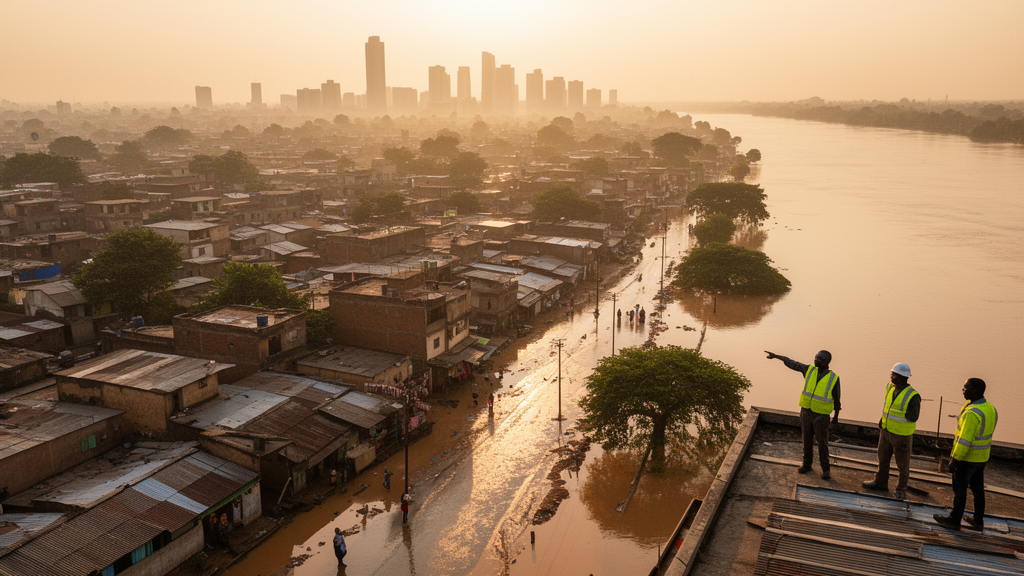
Climate change adds a further layer of hazard to already fragile urban systems. In Lagos, Nigeria, the interaction between urban expansion and flood occurrence was the focus of research presenting innovative strategies to enhance urban resilience. These strategies include integrating climate-tailored early warning systems and fostering active community participation in flood management. The Lagos case demonstrates that resilience is not merely an engineering problem of drainage and barriers; it is also a social problem of communication, trust, and local knowledge. Early warning systems only save lives when communities are organized and empowered to act on them, which reinforces the symposium’s broader emphasis on participatory governance.
Human-made hazards feature prominently as well. Artisanal cobalt miners in the Democratic Republic of the Congo confront exploitative working conditions, hazardous labor, and societal degradation, and the research presented calls for transformative policies and legal frameworks that prioritize equitable resource governance, social justice, and human rights. As global demand for cobalt, a critical mineral for batteries and the energy transition, continues to rise, the conditions under which it is extracted become a matter of international as well as local consequence. The editorial positions equitable resource governance as inseparable from the agenda of sustainable settlements: a city cannot be just if the resource economies feeding it are not.
The unifying conclusion is that the realization of innovative technologies, sustainability, equity, social justice, and resilient infrastructure for sustainable cities and communities cuts across jurisdictional boundaries and requires a multidisciplinary approach to solving these grand challenges. Broader stakeholder collaboration across inter- and intra-organizational systems, including researchers, policymakers, public and private practitioners, non-governmental organizations, and communities, is described as a fundamental requirement for co-creating innovative solutions. As one contribution notes, intentional resource coordination and sustained collaborative commitment can generate meaningful long-term effects on social and upward mobility within underserved urban communities. The message from the Pan African City Symposium is ultimately one of cautious optimism: the problems are interconnected, but so are the solutions, and the expertise to pursue them now spans the entire African diaspora and beyond.
Subject of Research: Sustainable, inclusive, and equitable human settlements in Africa and the Global South
Article Title: Editorial: The dynamics of sustainable, inclusive and equitable human settlements (volume 2): Pan African City symposium 2025
Article References: Khumalo, P., Lukhele, T., & Ntakana, K. (2026). Editorial: The dynamics of sustainable, inclusive and equitable human settlements (volume 2): Pan African City symposium 2025. Frontiers in Sustainable Resource Management, 5, Article 1969053. https://doi.org/10.3389/fsrma.2026.1969053
Image Credits: AI Generated
DOI: 10.3389/fsrma.2026.1969053
Keywords: human settlements, urbanization, energy poverty, informal settlements, solar energy, solid waste management, flood resilience, housing inequality, rural-urban interface, sustainable development, energy justice, Pan African City Symposium
Cite Scienmag News
Sloane Callahan. (October 16, 2026). From Lagos Floods to Congo Cobalt: New Research Charts a Path to Equitable African Cities. Scienmag. https://scienmag.com/from-lagos-floods-to-congo-cobalt-new-research-charts-a-path-to-equitable-african-cities/
Sloane Callahan. "From Lagos Floods to Congo Cobalt: New Research Charts a Path to Equitable African Cities." Scienmag, 16 October 2026, https://scienmag.com/from-lagos-floods-to-congo-cobalt-new-research-charts-a-path-to-equitable-african-cities/. Accessed 16 October 2026.
Sloane Callahan. "From Lagos Floods to Congo Cobalt: New Research Charts a Path to Equitable African Cities." Scienmag. October 16, 2026. https://scienmag.com/from-lagos-floods-to-congo-cobalt-new-research-charts-a-path-to-equitable-african-cities/


