


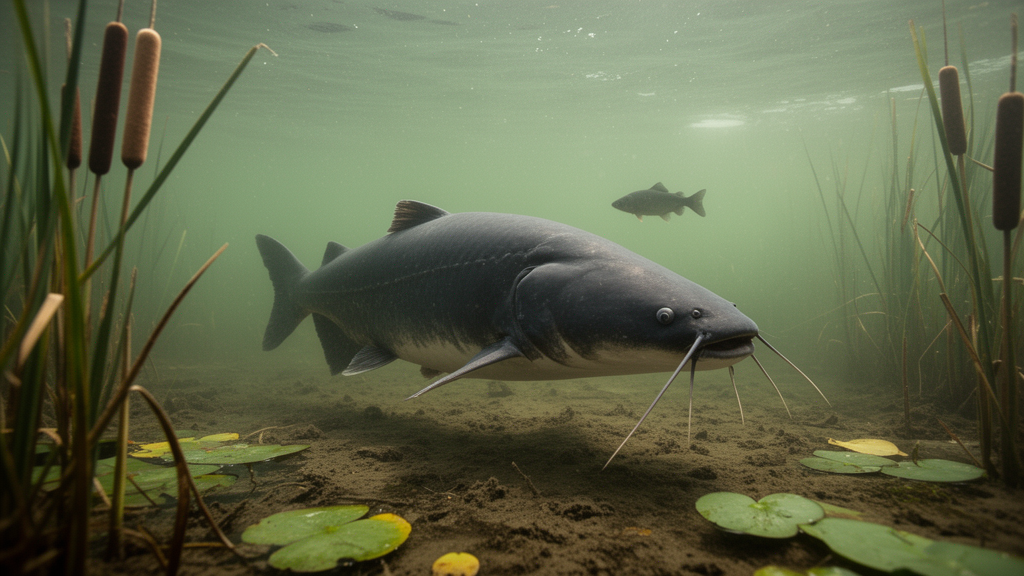
The freshwaters of the Danube Delta Biosphere Reserve, one of Europe’s most biodiverse wetland mosaics, have quietly gained new members of a distinctly whiskered fish order. Between 2018 and 2024, researchers documented three alien catfish species, or silurids, in the Romanian portion of the reserve: the black bullhead (Ameiurus melas), the channel catfish (Ictalurus punctatus) and the North African catfish (Clarias gariepinus) together with its hybrid Heteroclarias, a cross between Clarias gariepinus and Heterobranchus longifilis. The findings, published in the Scientific Annals of the Danube Delta Institute, are based on field records, licensed commercial fishermen’s catches and images shared through a private Romanian ichthyology group, and they reshape the reserve’s official list of alien freshwater fish.
The Danube Delta Biosphere Reserve is an ecological absorber of new species. Its aquatic habitats, spanning rivers, lakes and lagoons, alongside sandbanks, grasslands and forests, support a fish fauna that previously numbered 136 species, including marine, euryhaline and freshwater forms. The reserve’s list of alien freshwater fishes already contained seven entries: five of Asian origin, namely silver carp (Hypophthalmichthys molitrix), bighead carp (Hypophthalmichthys nobilis), grass carp (Ctenopharyngodon idella), topmouth gudgeon (Pseudorasbora parva) and Amur sleeper (Perccottus glenii), plus the North American pumpkinseed (Lepomis gibbosus) and a range extension for Percarina demidoffi. The Amur sleeper in particular has already been shown to negatively affect native fish through its invasion. The new silurid records confirm that two more alien species have spread by natural dispersal from Romanian waters upstream into the Danube Delta.
The channel catfish was the first of the three to appear in the delta’s freshwaters during the study period. Native to North America, Ictalurus punctatus is one of the most commonly farmed fish in European aquaculture facilities. Romania’s own history with the species dates to 1978, when a batch of 50,000 embryonated eggs was imported to the Nucet fish farm in an unsuccessful attempt to establish a population; a second batch imported in 1981 developed successfully. Today, however, the species is represented in Romanian aquaculture by only a few individuals remaining at the Nucet-Dâmbovița Fish Station. It is highly likely that individuals escaped from the Nucet Fish Farm and subsequently established populations in the Danube River and possibly in the Danube Delta, although the number of recorded catches remains low.
The earliest documented occurrence of the channel catfish in the delta region was reported in October 2018 along the Saint George branch at kilometre 49. Additional catches followed in August 2020, when several individuals were taken in the Babina area of the Chilia branch, and in September 2020, when a 1.5 kilogram specimen was caught with a rod near kilometre 29 on the Sulina branch, with the photo sent to the Danube Delta National Institute. On another occasion, fishermen reported capturing several channel catfish near Giurgeni, close to the reserve, including a reportedly 4 kilogram specimen caught in the Danube. No adverse effects on wildlife have been reported, and only a few specimens have been recorded in the reserve’s freshwaters. This scarcity matters for risk assessment: while some authors classify Ictalurus punctatus as a naturalised species, others do not, and the low catch numbers suggest the species is unlikely to pose an immediate threat to aquatic biodiversity.
The black bullhead tells a more concerning story. Ameiurus melas, another North American ictalurid, was first reported in Romania in 1997 in the Ier and Barcău rivers, and is thought to have reached Romanian waters by two migratory routes, Hungarian and Serbian, after escaping from fish farms in Hungary and spreading to western Romanian rivers and the Danube. More recent sightings were reported in the Danube in 2005 and in various Danube sectors, lakes and ponds. Within the Romanian part of the delta, the first recorded occurrence was documented in November 2019 in the Danube between Isaccea in Romania and Reni in Ukraine, at kilometre 123. A more recent observation, reported in October 2024, came from deep inside the reserve near the locality of Jurilovca, where an individual was captured in the Golovița Lake canal between Golovița and Sinoie Lakes by licensed commercial fishermen who sent the photo to the Danube Delta National Institute for Research and Development.
The bullhead’s arrival in Romania also carries a taxonomic detective story. The first alien silurid recorded in Romanian freshwaters, in 1908, and close to the delta area, in 1934 near Brăila, was the brown bullhead (Ameiurus nebulosus). For decades, Ameiurus nebulosus was confused with Ameiurus melas. After studying the taxonomy of the brown bullhead, Bănărescu initially concluded in 1968 that the species could actually be Ameiurus melas, before stating in 2004 that the earlier records were indeed Ameiurus nebulosus and not Ameiurus melas. Morphological analysis of collected specimens shows one significant difference between the two species, apart from colour variation, which can sometimes be misleading: the structure of the pectoral spines, which are smooth in Ameiurus melas and serrate in Ameiurus nebulosus. The apparent decline of brown bullhead populations in Romanian waters has been hypothesised to correlate with the introduction of the black bullhead in 1997. Several studies suggest that Ameiurus melas has outcompeted Ameiurus nebulosus for habitat and trophic resources, leading to its gradual displacement, although contrasting evidence indicates the two species may coexist under certain ecological conditions.
The third silurid, the North African catfish, arrived under very different circumstances. In the warm season of 2021, the owner of a guesthouse in the village of Crișan bought several tonnes of Clarias gariepinus and its Heteroclarias hybrid from a fish farm on thermal waters in western Romania, intending to offer tourists the fish on the menu as native catfish (Silurus glanis). The fish were held in aquatic trap nets near the guesthouse on the Old Danube of the Sulina branch, from where they accidentally escaped through cracks in the net walls. At the end of August 2021, local fishermen began catching many individuals, most of which, according to fishermen interviewed by a journalist, were caught with commercial nets. After the incident, neither scientific nor licensed commercial fisheries caught any more of this species in the reserve’s freshwaters.
Despite being an alien species, the North African catfish should not be added to the reserve’s list of alien freshwater fish, the researchers argue, because it appeared accidentally and cannot withstand the low winter water temperatures of temperate zones. The species is thermophilic: a study published in 2013 showed that Clarias gariepinus exhibited rapid growth when maintained at a water temperature of 22°C and fed a high-protein diet, with individuals over a 55-day experimental period doubling their body weight, from 444.01 grams to 930.68 grams, a gain primarily attributed to water temperatures above 20°C throughout the study. Romania’s natural waters drop significantly below 2°C in winter, far under the minimal survival limit of the North African catfish, which is 8°C. The species is therefore unlikely to survive in an uncontrolled natural environment, and hypothetically could endure freezing winters only in warm thermophilic waters, such as channels with hot water spills from the Cernavodă nuclear power plant. Although some authors consider it capable of surviving in its new natural habitat, it lacks the ability to spread independently, and it cannot yet be classified as invasive.
With the two American catfish species added, the total number of alien freshwater fish species in the Danube Delta Biosphere Reserve rises to nine, and the reserve’s overall fish species count reaches 138. The nine alien entries are silver carp, bighead carp, grass carp, topmouth gudgeon, Amur sleeper, pumpkinseed, Percarina demidoffi, black bullhead and channel catfish. The map of records compiled for the study shows four records for the channel catfish, including one near the reserve, two records for the black bullhead and one record for the North African catfish. Alien species with invasive potential, voluntarily or unintentionally introduced by humans into areas outside their natural range, can affect the balance of the ecosystems they enter, establishing large populations in a short period and, through mechanisms such as predation, parasitism and niche filling, outcompeting and disturbing native species.
The evidence from Romania and other European countries, where the presence of both Ictalurus punctatus and Ameiurus melas has been reported, points to only one of the two as a genuine invader. Only Ameiurus melas has the invasive potential to cause negative impacts on biodiversity, especially on native ichthyofauna, and some European countries have already reported adverse ecological impacts after its introduction. Considering the small number of specimens currently recorded for both species, the researchers conclude that their occurrence in the delta is recent, and that future monitoring should continue to observe possible numerical expansion and assess the impact of alien silurids on native species, with the evolution of the black bullhead demanding particularly careful attention.
Subject of Research: Alien catfish species recorded in the Danube Delta Biosphere Reserve
Article Title: Alien Siluriformes ( Pisces ) recently reported in the freshwaters of the Danube Delta Biosphere Reserve
Article References: Alien Siluriformes ( Pisces ) recently reported in the freshwaters of the Danube Delta Biosphere Reserve. (n.d.). https://doi.org/10.3897/saddi.30.160476
Image Credits: AI Generated
Keywords: Danube Delta, alien species, Siluriformes, Ameiurus melas, Ictalurus punctatus, Clarias gariepinus, invasive fish, Ictaluridae, Clariidae, freshwater biodiversity, biosphere reserve, ichthyology
Cite Scienmag News
Patricia Pace. (October 16, 2026). American Catfish Species Push Alien Fish Count in Danube Delta to Nine. Scienmag. https://scienmag.com/american-catfish-species-push-alien-fish-count-in-danube-delta-to-nine/
Patricia Pace. "American Catfish Species Push Alien Fish Count in Danube Delta to Nine." Scienmag, 16 October 2026, https://scienmag.com/american-catfish-species-push-alien-fish-count-in-danube-delta-to-nine/. Accessed 16 October 2026.
Patricia Pace. "American Catfish Species Push Alien Fish Count in Danube Delta to Nine." Scienmag. October 16, 2026. https://scienmag.com/american-catfish-species-push-alien-fish-count-in-danube-delta-to-nine/


