


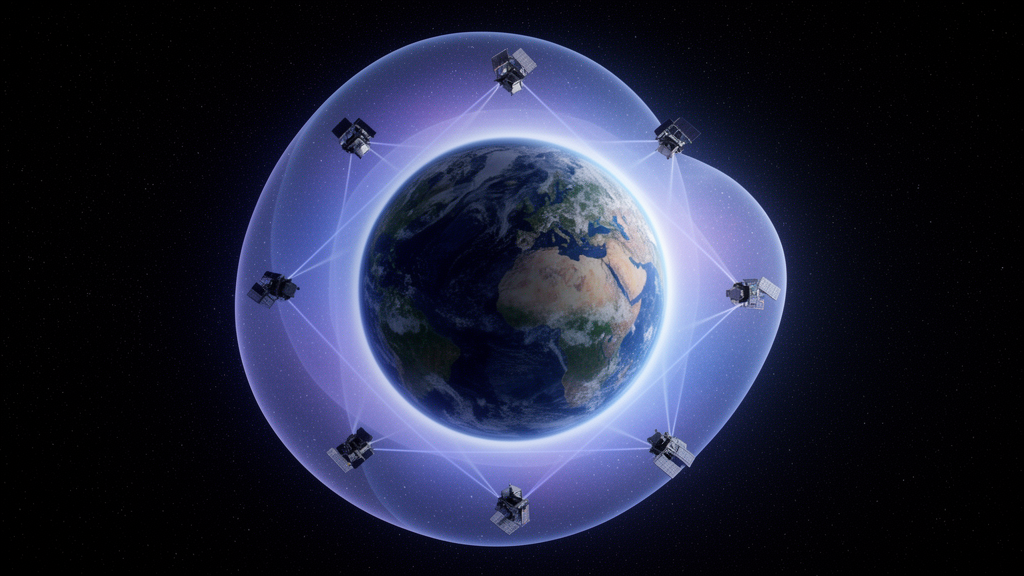
Deep inside Earth’s magnetic environment, a vast donut-shaped cloud of cold, dense plasma wraps around the planet like an invisible atmosphere within an atmosphere. This structure, called the plasmasphere, holds most of the mass of the entire magnetosphere, yet scientists still cannot watch it change in real time. A team of researchers at Orion Space Solutions and the Laboratory for Atmospheric and Space Physics at the University of Colorado Boulder now argues that the missing piece is a fleet of small spacecraft working together like a medical CT scanner. Their proposed Plasmasphere Tomography, or PlaTo, mission concept would use 14 satellites on two orbits to radio-scan the plasmasphere every few minutes, revealing in unprecedented detail how this plasma cloud erodes, refills, and reshapes itself during geomagnetic storms.
The plasmasphere is a torus of cold plasma, roughly 1 electron volt in temperature, with densities between about 100 and 10,000 particles per cubic centimeter, extending from the top of the ionosphere out to between 2 and 6 Earth radii in the equatorial plane. It is fed by plasma flowing upward from the ionosphere, and during quiet geomagnetic conditions it co-rotates with Earth and swells to its largest extent. When a solar storm strikes, however, the enhanced convection electric field peels away the outer layers in a process called plasmasphere erosion. Plasma on open drift paths escapes sunward in a flow channel known as the drainage plume, and the plasmapause, the sharp boundary where density drops by more than a factor of five over less than half an Earth radius, contracts earthward.
Why does this matter beyond pure curiosity? The plasmasphere acts as a master switchboard for the radiation belts. Its density distribution controls where very low frequency and ultra low frequency waves can exist in the magnetosphere, and those waves in turn govern the acceleration and loss of energetic electrons. Whistler-mode hiss waves, which drain electrons from the belts, live primarily inside the plasmasphere and in dense plume regions, while chorus waves, which pump electrons up to relativistic energies, thrive outside it. The plasmapause and plume geometry also form resonance cavities for ULF waves, shaping where drift-bounce resonance can energize particles. In short, mapping the plasmasphere’s fine structure is essential for forecasting the radiation environment that threatens satellites, astronauts, and power grids.
Existing techniques each fall short in a different way. In situ satellites make single-point measurements along their trajectories, but a typical inner-magnetospheric orbit lasts about 8 hours while the plasmasphere erodes in only 3 to 4 hours, so each density profile is badly smeared in time. Extreme ultraviolet imagers such as the camera on NASA’s IMAGE satellite could map line-of-sight integrated density at a 10-minute cadence, but they detect only minor ions like helium and oxygen, not the dominant hydrogen, and they require assumptions to deconvolve a three-dimensional region from two-dimensional projections. Radio tomography sidesteps both problems by measuring total electron content directly along many crossing paths simultaneously.
The principle resembles a hospital CT scan. Each spacecraft transmits a pair of phased radio signals at two different frequencies, a primary and a reference, and every other spacecraft in the constellation records the phase difference between them. From that phase difference, the total electron content along the line of sight between the two spacecraft can be computed. With enough crossing ray paths, a tomographic inversion reconstructs a two-dimensional map of plasma density in the orbital plane. The PlaTo team drew on earlier concepts, including the more ambitious PILOT mission concept developed for the 2024 Heliophysics Decadal Survey, but deliberately narrowed the scope to a focused, cost-effective constellation.
The team distilled the mission’s purpose into three science questions. First, what causes the lumpiness in the drainage plume? Density structures in the plume last about 2 hours at geosynchronous distance, flow at roughly 12 kilometers per second, and can modulate whistler-mode wave intensity and drive localized electron precipitation into the atmosphere. Candidate mechanisms include velocity shear between plume flow and the co-rotating plasmasphere, turbulence, ionospheric coupling timescales, and electric field structuring. Second, does the interchange instability operate at Earth’s plasmapause? This process, known to drive radial plasma transport at Jupiter and Saturn, would amplify density gradients at the plasmapause on timescales of roughly 17 minutes for structures near 0.39 Earth radii in size. Third, does the refilling rate of eroded flux tubes stay constant or change over time, as some observations at geosynchronous orbit suggest it does by a factor of two or more?
Those questions translate into demanding measurement requirements. The mission must resolve density changes as small as 3 to 10 particles per cubic centimeter, at spatial scales of about 0.34 Earth radii, on cadences of 5 to 15 minutes, across an observation region spanning roughly 3 to 5.5 Earth radii and several hours of magnetic local time. A back-of-envelope calculation balancing the number of map pixels against the number of possible ray paths suggested about 11 spacecraft would suffice, so the team padded the estimate to 16 and then ran simulated two-year missions using Ansys Government Initiatives’ Systems Tool Kit software, counting how many usable science observations each constellation size would collect against real historical geomagnetic activity indices.
The simulation results settled on 14 spacecraft as the sweet spot. Ten satellites would fly on an outer orbit with altitudes from 300 to 28,702 kilometers, an apogee near 5.5 Earth radii, spaced 5 degrees apart around apogee, while six would occupy an inner orbit from 5,684 to 11,481 kilometers, near 2.8 Earth radii, spaced 9 degrees apart. Both orbits sit nearly in the equatorial plane with inclinations below 15 degrees, and their perigees are chosen so the lines of apsides precess together. Twelve spacecraft could, on average, meet the minimum science goals, but reducing the expected observations by one standard deviation leaves only about 8 plume events, whereas the 14-spacecraft constellation delivers sufficient observations for all three science questions even with margin for losing up to two spacecraft. Reliability analysis based on decades of satellite lifetime data shows the constellation-level reliability remains above 0.999 for these configurations.
The radio payload design involved a careful balancing act between two error sources. Lower frequencies measure smaller density variations more sensitively, but sharp density gradients at the plasmapause, where density can change by about 100 particles per cubic centimeter over a few tenths of an Earth radius, refract the signals and bend them away from the straight paths the inversion assumes. Higher frequencies reduce refraction error but suffer more from background radio noise, dominated by the Sun, whose spectral irradiance near 100 megahertz reaches about 10 to the minus 18 watts per square meter per hertz under active conditions. Minimizing the combined error pointed to broadcast frequencies near 200 and 600 megahertz, with each spacecraft transmitting at 50 watts for 10 seconds in a ping cycle that completes across all 14 spacecraft every 5 minutes. Even in a worst-case refraction scenario with a ray striking a density gradient at 84 degrees from the normal, the resulting TEC error would be only about 0.02 percent.
The PlaTo concept remains provisional, and the authors lay out a validation path that includes flying the proposed constellation through a high-fidelity magnetosphere model, testing tomographic reconstruction techniques such as the multiplicative algebraic reconstruction method, and running observing system simulation experiments with data assimilation against a truth model. Beyond the three headline questions, a working tomographic constellation would also resolve mysterious mesoscale features such as the dawnside shoulder, the nightside notch, and plasmaspheric fingers, whose formation mechanisms remain unexplained. If the concept advances toward flight, it would mark the first time humanity watches its own planet’s inner plasma shell the way radiologists watch the human body: continuously, in cross-section, and in motion.
Subject of Research: A proposed 14-spacecraft radio tomography constellation to image the dynamics of Earth's plasmasphere.
Article Title: The plasmasphere tomography (PlaTo) mission concept
Article References: Thaller, S., Frank, W., Malaspina, D., Andersson, L., & Ergun, R. E. (2026). The plasmasphere tomography (PlaTo) mission concept. Frontiers in Astronomy and Space Sciences, 13, Article 1809242. https://doi.org/10.3389/fspas.2026.1809242
Image Credits: AI Generated
DOI: 10.3389/fspas.2026.1809242
Keywords: plasmasphere, radio tomography, magnetosphere, space weather, radiation belts, geomagnetic storms, plasmapause, drainage plume, interchange instability, satellite constellation, mission concept, heliophysics
Cite Scienmag News
Cameron Wolfe. (October 16, 2026). A 14-Satellite Constellation Could Give Earth’s Plasmasphere Its First CT Scan. Scienmag. https://scienmag.com/a-14-satellite-constellation-could-give-earths-plasmasphere-its-first-ct-scan/
Cameron Wolfe. "A 14-Satellite Constellation Could Give Earth’s Plasmasphere Its First CT Scan." Scienmag, 16 October 2026, https://scienmag.com/a-14-satellite-constellation-could-give-earths-plasmasphere-its-first-ct-scan/. Accessed 16 October 2026.
Cameron Wolfe. "A 14-Satellite Constellation Could Give Earth’s Plasmasphere Its First CT Scan." Scienmag. October 16, 2026. https://scienmag.com/a-14-satellite-constellation-could-give-earths-plasmasphere-its-first-ct-scan/


