


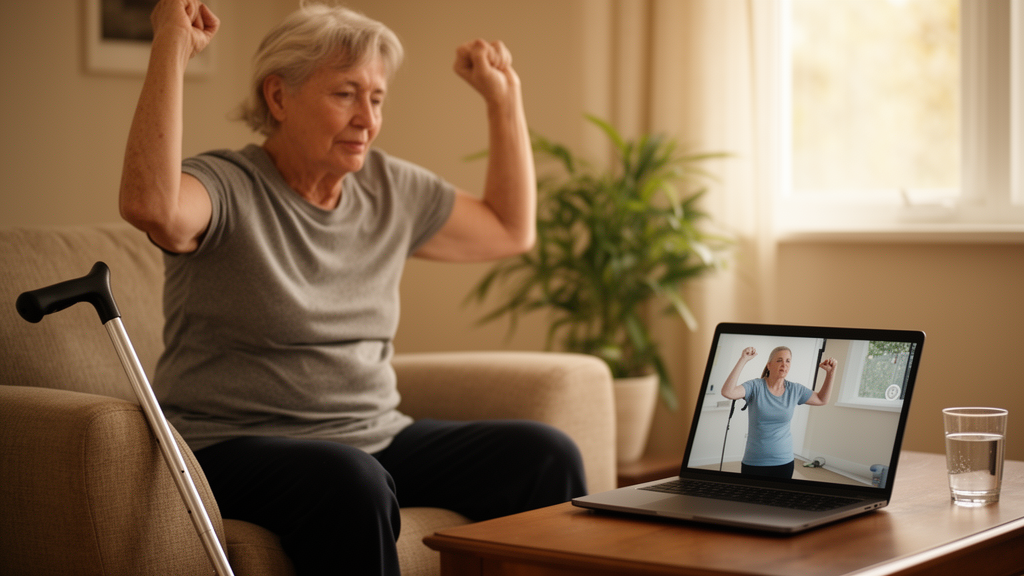
Stroke is one of the leading causes of adult disability worldwide, and for millions of survivors the hardest battles are not only physical. Depression, anxiety, and diminished quality of life shadow the recovery process, sapping the motivation and confidence needed to engage in rehabilitation. As telerehabilitation platforms, wearable sensors, and smartphone coaching have moved therapy out of clinics and into living rooms, a seductive promise has taken hold: that remotely supervised exercise could simultaneously rebuild the body and lift the mind. A new systematic review published in Frontiers in Psychiatry now subjects that promise to a rigorous test, and the verdict is sobering.
The review, conducted by researchers at Guangxi Normal University and Sichuan Minzu College in China and registered in PROSPERO, searched six major databases from inception to March 2026, including PubMed/MEDLINE, Web of Science, SPORTDiscus, the Cochrane Library, Embase, and Scopus. The team applied strict eligibility criteria: only randomized studies of remotely supervised exercise- or physical activity-based rehabilitation after ischemic or hemorrhagic stroke qualified, and only if depression, anxiety, or quality-of-life outcomes could be extracted. From 2,457 identified records, after removal of 1,805 duplicates and assessment of 227 full-text reports, just six randomized studies involving 483 participants survived the gauntlet.
That small yield is itself revealing. The six trials, published between 2015 and 2026, spanned the United Kingdom, Spain, the United States, China, Australia, and Ireland, with sample sizes ranging from 30 to 200 participants. Their interventions were strikingly dissimilar: a wearable arm-activity feedback system with self-management coaching, an mHealth walking program with pedometer and WhatsApp feedback, robot-assisted upper-limb practice with telephone monitoring, a multidisciplinary post-discharge telerehabilitation package, caregiver-mediated exercises delivered through an iPad platform with videoconferencing and Fitbit support, and an adaptive mHealth physical activity program comparing structured online exercise against lifestyle physical activity. This heterogeneity precluded any primary pooled meta-analysis, forcing the reviewers to map the evidence rather than distill it into a single number.
The headline finding concerns depression, and it hinges on a single trial. Sun and colleagues evaluated a 12-week multidisciplinary telerehabilitation program for acute ischemic stroke patients after discharge, which included physical therapy, occupational therapy, speech therapy, videos, games, weekly video consultations, mental-health education, and online psychological counseling. Against standard post-discharge care, the aligned Hedges g for depression measured with the Hamilton Depression Rating Scale was 0.93, with a 95 percent confidence interval of 0.64 to 1.22. By conventional statistical thresholds, that is a large effect. But here is the catch: the program embedded explicit psychological support, and when the reviewers excluded it in a co-intervention sensitivity analysis, no directly analyzable depression effect against standard care remained at all.
The certainty of that lone depression signal was rated very low using the GRADE framework, downgraded for risk of bias, clinical heterogeneity, applicability limitations, small samples, and imprecision. Risk of bias assessment with the Cochrane RoB 2 tool found one trial, a small unblinded Spanish pilot, at high overall risk, while the other five carried some concerns, mainly from subjective outcome measurement in unblinded settings, missing outcome data, and selective or exploratory reporting. Notably, no included trial recruited participants on the basis of a confirmed depressive or anxiety disorder, meaning the evidence base never deliberately targeted the very psychiatric conditions it claimed to treat.
Anxiety fared even worse. No included study provided a separable patient anxiety effect suitable for synthesis. One Australian proof-of-concept trial collected Hospital Anxiety and Depression Scale data from patients and caregivers, but the accessible main report offered no separable patient anxiety estimate, and caregiver results cannot be treated as patient psychiatric effects. Another trial reported only the combined HADS total score, which is not interchangeable with an anxiety subscale. The reviewers are careful to stress that this is an absence of separable outcome data, not evidence that the interventions have no effect on anxiety, but the practical implication is the same: the randomized literature simply cannot answer the anxiety question yet.
Quality of life signals were mixed and instrument-dependent. Against standard care, the UK feasibility trial of wearable arm feedback showed no clear favorable signal on the EQ-5D-5L, while the Chinese telerehabilitation trial reported favorable adjusted coefficients across physical, mental, social, and environmental domains of the WHOQOL-BREF, again within a package that included psychological counseling. Against active conventional rehabilitation, the Spanish pilot yielded a conventionally large standardized effect on a nonstandard EQ-5D problem score, but from a small unblinded high-risk study, while the Australian trial reported mixed Stroke Impact Scale domain findings. In active-versus-active remote comparisons, the American robot-assisted trial found non-significant time-by-treatment interactions across Stroke Impact Scale domains, and the Irish adaptive trial reported no significant first-stage differences between structured exercise and lifestyle physical activity on stroke-specific quality of life or the EQ-5D visual analogue scale.
Why might exercise influence mood after stroke at all? The broader mechanistic literature offers several plausible pathways, which the reviewers carefully distinguish from anything demonstrated by these trials. Exercise-related neurotrophic signaling may support neural plasticity, while changes in inflammatory and hypothalamic-pituitary-adrenal stress-response systems may influence emotional regulation. Behavioral mechanisms may be more proximal: graded activity provides achievable goals and mastery experiences that rebuild self-efficacy after the devastating loss of function, and for anxiety, repeated safe exposure to exertional sensations may reduce fear of bodily arousal and activity avoidance. Improved physical capacity may also facilitate everyday participation, enhancing perceived well-being independently of any change in psychiatric symptoms. But none of the included trials performed a mediation analysis linking these pathways to psychiatric change, leaving them as hypotheses rather than established mechanisms.
The reviewers also emphasize a subtle but critical point about comparators. A remote package tested against standard care includes differences in therapeutic contact, coaching, education, and psychological support, so any observed benefit cannot be attributed to exercise alone. Active-versus-active comparisons, such as robot-assisted telerehabilitation versus a dose-matched home exercise program, estimate only incremental differences between rehabilitation strategies, and a non-significant result does not establish equivalence. Multiple favorable outcomes from one small trial are not independent confirmations of efficacy, and selective emphasis on such findings would overstate this exploratory evidence. The authors argue that feasibility trials, proof-of-concept studies, and adaptive SMART designs are appropriate during early intervention development, but their developmental purpose limits the confirmatory claims that can be drawn from them.
For clinicians and stroke survivors, the message is nuanced rather than dismissive. Remotely supervised exercise and physical activity remain a plausible and potentially valuable component of multidisciplinary stroke rehabilitation, with a logistical rationale for extending monitoring and feedback into the home. But the current evidence does not support these programs as stand-alone treatments for post-stroke depression or anxiety, and survivors with clinically significant psychiatric symptoms should continue to receive evidence-based psychological, psychiatric, and, where indicated, pharmacological care. The reviewers call for confirmatory trials that recruit or stratify participants by baseline psychiatric symptoms, prespecify psychiatric outcomes using validated instruments such as the PHQ-9, HADS subscales, and GAD-7, and use factorial or component designs to separate the contributions of exercise dose, remote supervision, psychological support, education, and coaching. Until such trials deliver, the dream of exercise as a remote antidepressant after stroke remains exactly that: a promising hypothesis awaiting proof.
Subject of Research: Remote supervised exercise- and physical activity-based rehabilitation for post-stroke depression, anxiety, and quality of life: a systematic review, evidence map, and exploratory quantitative synthesis
Article Title: Remote supervised exercise- and physical activity-based rehabilitation for post-stroke depression, anxiety, and quality of life: a systematic review, evidence map, and exploratory quantitative synthesis
Article References: Zhang, C., Zhou, Z., Cai, J., & Li, Y. (2026). Remote supervised exercise- and physical activity-based rehabilitation for post-stroke depression, anxiety, and quality of life: a systematic review, evidence map, and exploratory quantitative synthesis. Frontiers in Psychiatry, 17, Article 1888180. https://doi.org/10.3389/fpsyt.2026.1888180
Image Credits: AI Generated
DOI: 10.3389/fpsyt.2026.1888180
Keywords: stroke, telerehabilitation, post-stroke depression, exercise, systematic review, quality of life, anxiety, remote rehabilitation, Remote, supervised, exercise-, physical
Cite Scienmag News
Glenn Wilkins. (October 16, 2026). Remote Exercise Programs Show Fragile Mental Health Benefits After Stroke, Systematic Review Finds. Scienmag. https://scienmag.com/remote-exercise-programs-show-fragile-mental-health-benefits-after-stroke-systematic-review-finds/
Glenn Wilkins. "Remote Exercise Programs Show Fragile Mental Health Benefits After Stroke, Systematic Review Finds." Scienmag, 16 October 2026, https://scienmag.com/remote-exercise-programs-show-fragile-mental-health-benefits-after-stroke-systematic-review-finds/. Accessed 16 October 2026.
Glenn Wilkins. "Remote Exercise Programs Show Fragile Mental Health Benefits After Stroke, Systematic Review Finds." Scienmag. October 16, 2026. https://scienmag.com/remote-exercise-programs-show-fragile-mental-health-benefits-after-stroke-systematic-review-finds/


