


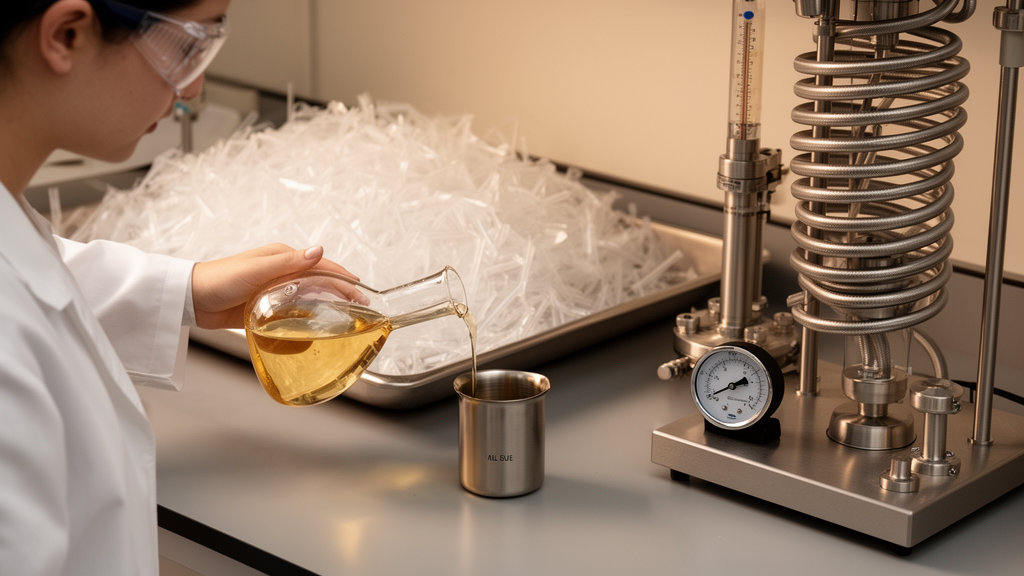
Every year, humanity produces roughly 460 million metric tons of plastic, and around 350 million metric tons of it becomes waste. India alone generates an estimated 9.4 million metric tons of post-consumer polymer refuse annually, and despite a 60 percent recovery rate, more than 9,400 tons escape municipal management every day, piling up in landfills and waterways. Meanwhile, the world’s diesel engines keep burning finite fossil fuel. A new study published in Frontiers in Chemical Engineering argues that these two problems can be solved with a single piece of engineering: converting high-density polyethylene (HDPE) waste into liquid fuel and burning it in an unmodified diesel engine, with the help of machine learning to find the perfect operating recipe.
The research, conducted by Satayu Travadi and Dattatraya Subhedar at Charotar University of Science and Technology in Gujarat, India, is notable not just for what it achieved on the test bench but for how it achieved it. Rather than testing a handful of conditions, the team ran a full-factorial experimental campaign: four compression ratios, five fuel blends, and six engine loads, yielding 120 distinct operating points. They then trained four different machine learning algorithms on the resulting dataset and deployed a genetic algorithm to hunt for the single best combination of fuel mixture, compression ratio, and load. The answer they converged on was strikingly specific: a 40 percent waste plastic oil blend, a compression ratio of 17, and full engine load.
The journey begins with the plastic itself. HDPE, the polymer used in milk jugs and detergent bottles, was selected because of its high hydrogen-to-carbon ratio, which makes it easier to crack into liquid hydrocarbons than plastics like PET or PVC. The researchers cleaned and dried the waste, cut it into 5 to 10 millimeter pieces, and loaded roughly 20 grams at a time into a two-liter stainless steel batch reactor. After purging the chamber with nitrogen to eliminate oxygen, they heated the plastic to between 400 and 500 degrees Celsius at a controlled rate of 12 to 15 degrees per minute. A natural montmorillonite clay catalyst, added at 5 percent by weight, helped crack the polymer chains more efficiently and suppressed the formation of unwanted polycyclic aromatic hydrocarbons.
The process proved remarkably productive. Between 65 and 70 percent of the feedstock mass emerged as liquid fuel, with the remainder split between gas and solid residue. The resulting oil, called waste plastic oil or WPO, had a higher calorific value of 40,950 kilojoules per kilogram, only about 2.5 percent below that of conventional diesel. Its density of 860 kilograms per cubic meter sat slightly above diesel’s 830, and its kinematic viscosity of 2.1 square millimeters per second was actually 19 percent lower than diesel’s 2.6. Perhaps most striking was the sulfur content: below 0.01 percent by weight, a tiny fraction of what commercial diesel contains, meaning combustion would release far less sulfur dioxide without any additional refining.
With the fuel in hand, the team moved to the test engine: a single-cylinder, four-stroke, variable compression ratio diesel research engine equipped with a tilting cylinder block that allowed compression ratio changes from 14 to 18 without stopping the engine. Running at a constant 1,500 revolutions per minute, they tested blends containing 0, 10, 20, 30, and 40 percent WPO across compression ratios of 15, 16, 17, and 18, at loads ranging from 2 to 12 kilograms. Each measurement was repeated three times, and the sequences were randomized to prevent equipment drift from masquerading as fuel effects.
The headline result concerns brake thermal efficiency, a measure of how much of the fuel’s chemical energy becomes useful mechanical work. Baseline diesel achieved 33.33 percent at full load. The B40 blend, containing 40 percent waste plastic oil, reached 38.70 percent at compression ratio 18, a relative improvement of roughly 16 percent. The researchers attribute this to WPO’s physical properties: its lower flash point of 36 degrees Celsius, compared to diesel’s 52, means more of the fuel vaporizes early in the compression stroke, creating a more uniform air-fuel mixture and shortening ignition delay. Its lower viscosity produces finer spray droplets, accelerating evaporation and mixing. At high compression ratios, the elevated in-cylinder temperatures overcome the chemical ignition delay of WPO’s heavier molecular fractions, concentrating heat release near top dead center where thermodynamic conversion is most efficient.
Emissions told a more nuanced story. Carbon monoxide levels from the WPO blends were comparable to or lower than diesel, particularly at higher compression ratios, where more complete combustion drove CO down. Carbon dioxide output was consistently lower for the blends, with B40 producing 1.80 percent at the optimal condition versus 2.0 percent for diesel, a modest but real greenhouse gas benefit stemming from the plastic oil’s lower carbon-to-hydrogen ratio. Nitrogen oxides, however, presented the classic diesel dilemma. NOx rose monotonically with load for all fuels, and compression ratio pushed it higher still: neat diesel climbed from 320 parts per million at compression ratio 15 to 475 ppm at ratio 18. Intriguingly, the intermediate B20 and B30 blends actually peaked at 520 ppm at the highest compression ratio, exceeding diesel, because their heavier molecular fractions prolong ignition delay, allowing more mixture to accumulate before a violent premixed combustion spike drives peak flame temperatures upward.
This is precisely where the study’s optimization framework earns its keep. The team trained random forest, XGBoost, artificial neural network, and support vector regression models on the 120-point dataset, using a 70:30 train-test split and 10-fold cross-validation. The random forest emerged as the most reliable surrogate, explaining 99.7 percent of the variance in brake power and 99.1 percent in thermal efficiency, with cross-validated scores of 0.996 and 0.990 respectively. The neural network, by contrast, proved unstable for nitrogen oxide prediction, and support vector regression faltered on fuel consumption, underscoring that ensemble tree methods handle the nonlinear chemistry of combustion better than conventional architectures. A feature importance analysis revealed that engine load dominated most outputs, contributing over 91 percent of the variance in brake power and nearly 73 percent in NOx, while compression ratio exerted its strongest influence on carbon monoxide emissions.
The final step was multi-objective optimization using the non-dominated sorting genetic algorithm II, or NSGA-II, which simultaneously maximized efficiency and power while minimizing fuel consumption and emissions. Running with a population of 100 across up to 500 generations, the algorithm converged on compression ratio 17, the B40 blend, and full 12-kilogram load. At this Pareto-optimal point, experimentally validated, the engine delivered a brake thermal efficiency of 38.47 percent, brake power of 3.44 kilowatts, carbon monoxide of just 0.020 volume percent, and NOx of 310 parts per million. That NOx figure is 34.7 percent lower than B40 at compression ratio 18, while sacrificing only 0.23 percentage points of efficiency, making it the best combined performance-emission trade-off among all 120 tested conditions.
The implications extend beyond the laboratory. The authors note that B40 is validated as the upper-limit optimal blend for high-compression operation, while 10 to 20 percent blends serve as conservative, zero-modification drop-in fuels for existing engines. Compared to previous variable compression ratio studies on waste plastic oil, which peaked at efficiencies between 34.5 and 38 percent with NOx levels of 360 to 490 ppm, this integrated approach achieved both the highest efficiency and the lowest NOx at its optimum. The work demonstrates that combining systematic experimental matrices with machine learning surrogates and genetic algorithm optimization provides a robust framework for calibrating alternative fuel engines, turning HDPE waste from a disposal liability into a validated, high-efficiency component of the diesel fuel supply.
Subject of Research: Optimization of HDPE pyrolysis oil-diesel blends in a variable compression ratio diesel engine using machine learning and multi-objective genetic algorithms
Article Title: Multi-objective optimization of HDPE pyrolysis oil–diesel blends across variable compression ratios: an integrated experimental and ensemble learning approach
Article References: Travadi, S., & Subhedar, D. (2026). Multi-objective optimization of HDPE pyrolysis oil–diesel blends across variable compression ratios: an integrated experimental and ensemble learning approach. Frontiers in Chemical Engineering, 8, Article 1891010. https://doi.org/10.3389/fceng.2026.1891010
Image Credits: AI Generated
DOI: 10.3389/fceng.2026.1891010
Keywords: HDPE pyrolysis, waste plastic oil, diesel engine, variable compression ratio, brake thermal efficiency, random forest, NSGA-II, machine learning, NOx emissions, alternative fuel, plastic waste valorization, multi-objective optimization
Cite Scienmag News
Denise Maddox. (October 16, 2026). Turning Plastic Waste Into Diesel: AI Finds the Sweet Spot for HDPE Pyrolysis Oil in Engines. Scienmag. https://scienmag.com/turning-plastic-waste-into-diesel-ai-finds-the-sweet-spot-for-hdpe-pyrolysis-oil-in-engines/
Denise Maddox. "Turning Plastic Waste Into Diesel: AI Finds the Sweet Spot for HDPE Pyrolysis Oil in Engines." Scienmag, 16 October 2026, https://scienmag.com/turning-plastic-waste-into-diesel-ai-finds-the-sweet-spot-for-hdpe-pyrolysis-oil-in-engines/. Accessed 16 October 2026.
Denise Maddox. "Turning Plastic Waste Into Diesel: AI Finds the Sweet Spot for HDPE Pyrolysis Oil in Engines." Scienmag. October 16, 2026. https://scienmag.com/turning-plastic-waste-into-diesel-ai-finds-the-sweet-spot-for-hdpe-pyrolysis-oil-in-engines/


