


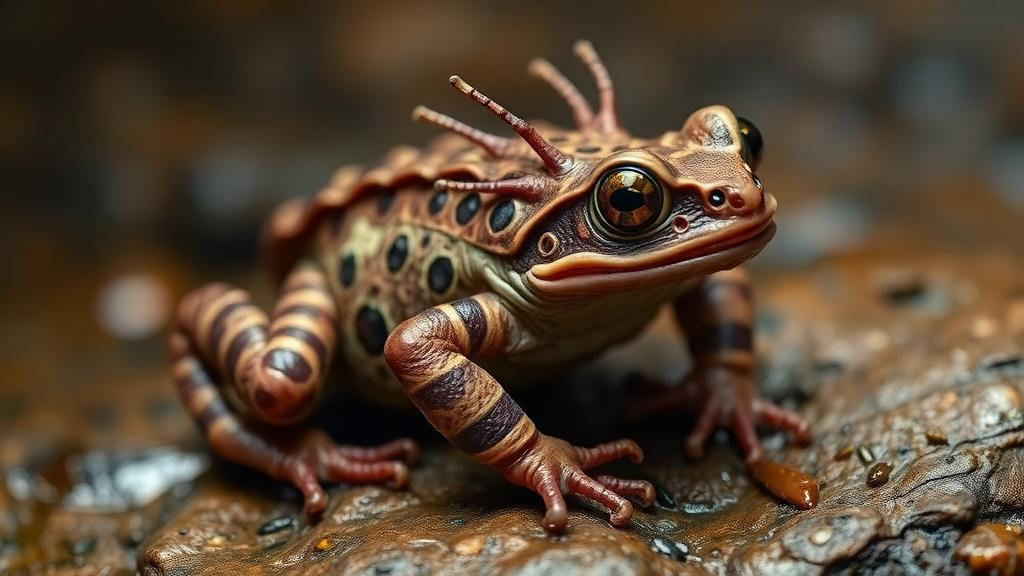
Deep in the subtropical mountain forests of southwestern Sichuan, China, a small, warty toad has been hiding in plain sight. Researchers surveying streams in Liziping National Nature Reserve have described a new species of toothed toad, Oreolalax lizipingensis, after three years of fieldwork that began with a handful of tadpoles whose DNA did not match any known species. The discovery, published in the journal Zoosystematics and Evolution, brings the genus Oreolalax to 22 recognized species, most of them endemic to the mountains of southwestern China.
The trail began in October 2022, when a nighttime survey of a stream at roughly 2,485 meters above sea level in Menghuo Castle, Shimian County, yielded three tadpoles of an unfamiliar Oreolalax. Molecular identification showed that their genetic sequences differed significantly from those of known species in the region. Because adults of this genus are only detectable during the breeding season, while tadpoles linger in streams year-round, the researchers kept returning to the site. Their patience paid off between June and July 2025, when they collected eight adults and a fresh egg mass, enabling a full taxonomic description.
To establish that the population was genuinely new, the team combined three lines of evidence: morphology, bioacoustics and molecular phylogenetics. Genomic DNA was extracted from muscle tissue of the 11 newly collected specimens, and fragments of the mitochondrial genes 12S, 16S and COI were amplified and sequenced, yielding a combined matrix of 1,273 aligned base pairs. Both maximum likelihood and Bayesian inference analyses placed all samples of the undescribed species in an independent monophyletic group, closely related to O. pingii, O. lichuanensis and O. schmidti.
The genetic distances were striking. For the 16S gene, the new species differed from its closest relatives by 2.8 to 3.6 percent, and for the COI gene by 6.0 to 8.0 percent. Those values equal or exceed the distances separating other recognized Oreolalax species, some of which differ by less than one percent at standard barcoding genes. The authors note that low support at some nodes in Oreolalax phylogenies likely reflects rapid diversification or historical introgression, a pattern consistent with the prevalence of incomplete lineage sorting in this group.
Morphologically, the new species is small for the genus. Adult males measure 37.6 to 43.3 millimeters in snout-vent length, with a mean of 40.2 millimeters, while females reach 44.2 to 52.7 millimeters, averaging 47.7. That is dramatically smaller than many congeners, such as O. major, whose males average 64.5 millimeters. The species can be distinguished by a combination of traits including rudimentary webbing between the toes, a dark triangular spot in the interorbital region, dark brown nearly round warts on the back, and, in females, bellies, flanks and lower limb surfaces evenly dotted with white spots that are absent or inconspicuous in males. Males bear spiny warts along the edge of the jaw, on the ventral thighs and on the abdomen near the vent, along with a pair of chest glands densely covered with black spines during the breeding season.
The closest look-alike, O. schmidti from Mount Emei and Baoxing, required particularly careful scrutiny. A principal component analysis based on seven size-corrected morphometric variables showed that individuals of the new species occupy a distinct region of morphospace, with the first two principal components accounting for about 78.5 percent of the variation. Head length, head width, tibia length and foot-and-tarsus length all differed significantly between the two species. Subtle pattern differences help too: O. schmidti carries a triangular mark between the eyes with a distinct demarcation line and light-colored warts, whereas the new species shows an inversely U-shaped pattern without a sharp border and dark warts on the back. Even the egg masses differ, piled in a rounded clutch rather than arranged in a ring.
Sound provided an independent line of evidence. Male advertisement calls of the new species, recorded at the type locality, and those of O. schmidti, recorded at its type locality on Mount Emei, were analyzed in Raven Pro after standardizing temporal properties to a common temperature of 12.5 degrees Celsius and dominant frequency to a common body size. Both species produce hoarse, diphasic calls that sound like a repeated
The combined genetic matrix used in the final analyses ultimately reached 1,365 base pairs across the three mitochondrial loci, a length sufficient to resolve relationships among closely related species within the genus. The researchers aligned sequences with the MUSCLE algorithm and evaluated substitution models using the corrected Akaike information criterion before running their phylogenetic analyses. Maximum likelihood trees were generated with 10,000 ultrafast bootstrap replications, while Bayesian inference involved two independent runs of four Markov chains each, extending over 20 million iterations with the first quarter of sampled generations discarded as burn-in. These complementary approaches converged on the same topology, lending confidence to the conclusion that the Liziping population represents an independently evolving lineage rather than a geographic variant of a known species.
The sampling design behind the study illustrates how modern amphibian taxonomy often proceeds. Sequences from 20 of the 22 recognized Oreolalax species were downloaded from GenBank and analyzed alongside the new material, with Scutiger boulengeri, a close relative from the same family, serving as an outgroup to root the tree. One species, O. weigoldi, could not be included because no genetic sequences were available in public databases, a reminder that even well-established names sometimes rest solely on preserved morphology. Among the newly generated sequences, those from the new species were deposited under a series of accession numbers spanning the 12S, 16S and COI fragments, ensuring that future researchers can verify or extend the molecular evidence independently.
The genus Oreolalax itself has an interesting taxonomic history. It was established by Myers and Leviton in 1962, and its members share a distinctive suite of traits: a concealed tympanum, a dorsum covered with glandular warts that are often keratinized and bear black spines, and, in breeding males, a pair of chest glands plus nuptial pads armed with nuptial spines on the inner two fingers. These features place the genus firmly within Megophryidae, a family of frogs whose Asian members are often collectively called leaf-litter or stream toads. Species in the genus occupy mountain streams across a remarkable elevational range, from roughly 700 meters up to 3,550 meters above sea level, reflecting the group’s adaptation to cold, fast-flowing water in montane terrain.
Geographically, the genus is overwhelmingly Chinese. Twenty of the 22 species are endemic to the mountainous regions of southwestern China, and only two, O. adelphos and O. sterlingae, have been found outside the country, in Vietnam. This concentration of narrow endemics in a single region is characteristic of the Hengduan Mountains, the rugged landscape at the southeastern edge of the Qinghai-Tibet Plateau where the new species was found. The complex topography and pronounced vertical climatic zonation of this ecoregion have repeatedly isolated stream-dwelling amphibian populations in adjacent valleys, allowing distinct lineages to accumulate differences over evolutionary time. The discovery of several new Oreolalax species in recent years suggests that the true diversity of the genus may still be underestimated, particularly in remote high-elevation drainages that receive little survey effort.
The timing of the discovery also reflects the biology of the animals themselves. Adult Oreolalax are notoriously difficult to find outside the breeding season, when they retreat into crevices and leaf litter away from the streams where they reproduce. The breeding season of the new species falls in July and August, which explains why the eight adults were collected between mid-June and late July 2025, while the tadpoles could be encountered in October when adults were no longer active. Tadpoles of these toads typically inhabit the margins of cold, rocky streams, where they graze on biofilm and detritus, and their extended aquatic development is an adaptation to the short growing seasons characteristic of high elevations.
The type locality lies within Liziping National Nature Reserve in Shimian County, Ya’an City, an area of subtropical mixed coniferous and broad-leaved forest. The new species is currently known only from high-elevation streams between 2,400 and 3,100 meters above sea level within the Menghuo Castle area, where it occurs in sympatry with O. liangbeiensis, another recently described member of the genus. Such restricted ranges are common among Oreolalax species and make them inherently vulnerable to environmental change. The Hengduan Mountains face mounting pressures from tourism development, road construction and invasive species, all of which can degrade the clear, cold streams that these toads require for breeding. Habitat fragmentation along stream corridors is particularly consequential for species with limited dispersal ability, since populations separated by degraded reaches may never reconnect.
For conservation assessments, the combination of a small known range, a specialized stream-breeding lifestyle and ongoing habitat disturbance in the region suggests that the new species may warrant prompt evaluation under international criteria. Describing a species formally is only the first step; subsequent work will need to establish its actual population size, determine whether it occurs outside the reserve boundaries, and clarify how vulnerable its breeding sites are to seasonal drying, water diversion or pollution. The egg mass collected in July 2025 provides an additional data point on reproduction, since clutch arrangement differs even between closely related species and can inform monitoring protocols.
More broadly, the study demonstrates the value of integrating multiple independent evidence streams in species delimitation. Neither morphology, nor call structure, nor mitochondrial DNA alone would have been decisive, because the new species closely resembles O. schmidti in appearance and produces a similarly hoarse, diphasic call. It was the concordance of genetic distances, morphometric separation and acoustic differences, each analyzed with appropriate statistical controls, that established the population as a distinct evolutionary lineage. As survey effort intensifies across the mountains of southwestern China, similar integrative approaches will likely continue to reveal hidden diversity in Oreolalax and other stream-breeding amphibian genera, underscoring how much remains to be learned about biodiversity in one of the world’s most species-rich temperate regions.
Subject of Research: Description of a new toad species, Oreolalax lizipingensis, from Sichuan, China
Article Title: A new Oreolalax ( Anura , Megophryidae ) from southwest Sichuan, China
Article References: A new Oreolalax ( Anura , Megophryidae ) from southwest Sichuan, China. (n.d.). https://doi.org/10.3897/zse.102.183210
Image Credits: AI Generated
Keywords: Oreolalax, new species, Megophryidae, amphibian, Sichuan, Hengduan Mountains, taxonomy, bioacoustics, phylogenetics, conservation, tadpole, China
Cite Scienmag News
Margaret Porter. (October 16, 2026). Hidden mountain toad: new spiny species discovered in Sichuan’s Hengduan streams. Scienmag. https://scienmag.com/hidden-mountain-toad-new-spiny-species-discovered-in-sichuans-hengduan-streams/
Margaret Porter. "Hidden mountain toad: new spiny species discovered in Sichuan’s Hengduan streams." Scienmag, 16 October 2026, https://scienmag.com/hidden-mountain-toad-new-spiny-species-discovered-in-sichuans-hengduan-streams/. Accessed 16 October 2026.
Margaret Porter. "Hidden mountain toad: new spiny species discovered in Sichuan’s Hengduan streams." Scienmag. October 16, 2026. https://scienmag.com/hidden-mountain-toad-new-spiny-species-discovered-in-sichuans-hengduan-streams/


