


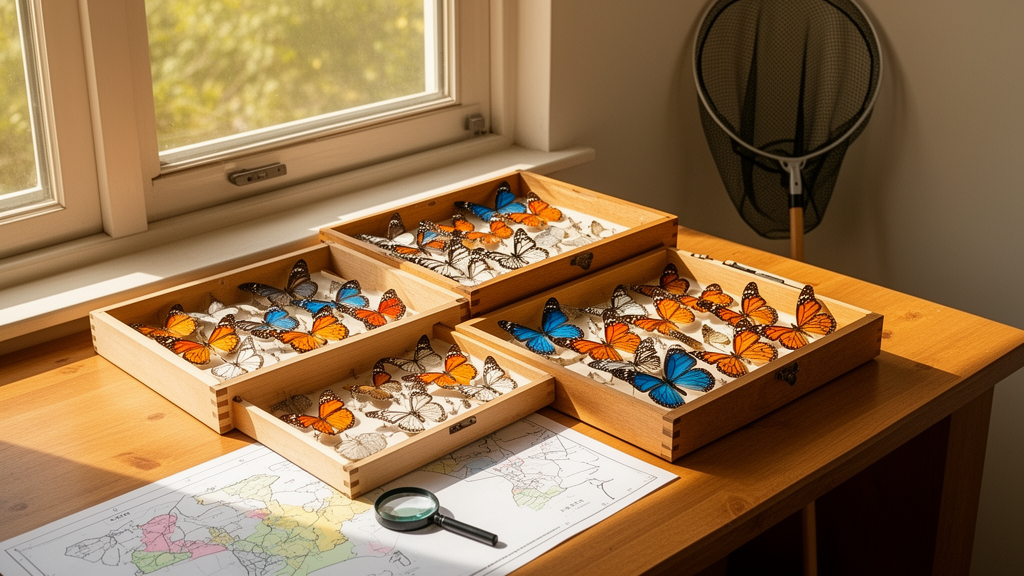
Enrique García-Barros Saura, one of the most influential figures in Iberian lepidopterology, died on January 16 at the age of 66, leaving behind a scientific legacy that reshaped how the butterflies of the Iberian Peninsula and the Balearic Islands are documented, mapped, and conserved. His colleagues at the Universidad Autónoma de Madrid, where he spent nearly his entire career, announced his passing in a heartfelt tribute published in the journal Nota Lepidopterologica, describing a scientist whose intellectual excellence was matched only by his generosity, humor, and quiet humanity.
The trajectory of García-Barros’s career mirrors, in many respects, the broader professionalization of entomological research in Spain during the final decades of the twentieth century. When he began his undergraduate studies at the Universidad Autónoma de Madrid in 1976, the university was still a young institution, having been founded only in 1968, and its Department of Biology was building its teaching collections and research traditions from the ground up. The requirement that students assemble a collection of one hundred animal specimens, an exercise that produced the famous episode of the hand-painted Thymelicus butterfly, reflects a pedagogical culture in which direct engagement with preserved material was considered foundational training. That García-Barros chose to paint a paper model rather than kill a real insect, and defended the choice on ethical grounds, reads in retrospect as an early expression of a sensibility that would later inform his contributions to butterfly conservation, a field in which he became one of the peninsula’s most authoritative voices.
His doctoral work on four species of satyrid butterflies, completed in 1987, addressed a group whose biology was then poorly documented in the Iberian context. The genus Hipparchia and its relatives, the so-called graylings, are notable for their cryptic underside patterns, their preference for dry and rocky habitats, and their characteristic univoltine life cycles, in which a single annual generation passes much of the year as a diapausing larva. Comparative studies of such closely related species, examining differences in pre-oviposition periods, larval development, and adult phenology, were a productive avenue for understanding how ecological divergence accompanies speciation. The fact that his thesis was the first entomology doctorate completed entirely within the UAM’s Department of Biology underscores how recently lepidopterology had taken root as a research line in Spanish universities, and how García-Barros belonged to the first generation of researchers who established it there.
The postdoctoral year in Stockholm under Christer Wiklund proved decisive. Wiklund’s laboratory was then at the forefront of studies on butterfly life-history evolution, particularly the evolution of mating strategies, oviposition behavior, and the timing of development in relation to seasonal constraints. The collaboration that followed between García-Barros and Wiklund connected Spanish field data with the theoretical frameworks emerging from Scandinavian evolutionary ecology, and this synthesis oriented García-Barros toward the questions of body size, allometry, and life-history variation that would occupy much of his later research. Allometry, the study of how body dimensions scale with one another and with overall size, has particular relevance in Lepidoptera, where wing size, thoracic mass, and reproductive investment can vary dramatically both within and among species, and where such variation often correlates with flight capacity, dispersal tendency, and vulnerability to habitat fragmentation.
His move into macroecology and biogeography, exemplified by the 2002 parsimony analysis of endemicity paper in the Journal of Biogeography, placed him among the researchers who brought explicit quantitative methods to the regional biogeography of the western Mediterranean. Parsimony analysis of endemicity, a technique adapted from cladistic methodology, treats the distributions of species as characters and seeks the most parsimonious arrangement of areas into biogeographic units. Its application to the Ibero-Balearic region helped formalize what had long been appreciated informally: that the peninsula harbors distinct faunal subregions shaped by climate, mountain systems, and historical biogeographic connections to both Europe and North Africa. That this remains his most cited work suggests the durability of the methodological contribution, at a time when such approaches were only beginning to be applied to invertebrate distributions in southern Europe.
The 2004 atlas of Iberian butterflies, produced with colleagues, arrived at a moment when digital mapping and volunteer-based faunal recording were transforming European butterfly monitoring. Atlases of this kind depend on the aggregation of decades of scattered records, from museum specimens to field notebooks to emerging online databases, and their value extends beyond documentation: they establish baselines against which subsequent distributional shifts, whether driven by land-use change or climate warming, can be measured. Butterflies have become one of the most important indicator groups for such assessments in Europe precisely because they are well-surveyed, sensitive to environmental change, and ecologically dependent on specific host plants and habitat conditions. The Iberian Peninsula, with its high diversity and its position at the southwestern edge of the European continent, is particularly significant in this regard, as it harbors numerous species at their range limits and several endemics.
The culmination of this cartographic and synthetic tradition was the Fauna iberica volume on Papilionoidea, published in 2013 and running to 1216 pages. Monographic treatments of this scale are rare in modern entomology, and their preparation demands mastery of taxonomy, nomenclature, morphology, ecology, and distribution alike. The volume’s integration of a documentary database spanning more than a century of records gives it a historical depth that few regional butterfly faunas anywhere in the world can match. Such works serve multiple constituencies simultaneously: taxonomists requiring authoritative diagnoses, ecologists needing verified distributions, conservation practitioners assessing threat status, and amateur naturalists whose records increasingly feed national monitoring schemes.
His involvement with the Atlas and Red Book of Spanish Butterflies, completed only after his death, reflects the continuing urgency of conservation assessment for the group. Red Books and national atlases form the evidentiary basis for listing decisions and protected-area planning, and the fact that García-Barros passed away three months after its submission, without seeing it published, lends the volume a poignant character. The doctoral theses he co-directed, spanning Portuguese faunistics, Ibero-Balearic biogeography, and the application of fuzzy logic to population spatial structure, illustrate the breadth of methods he embraced, from classical faunistics to novel computational approaches. The 2008 thesis by Helena Romo Benito, which used butterflies to delimit biogeographic regions, was an early example of employing a single well-surveyed insect group as the basis for regionalization, an approach that has since gained currency in spatial conservation planning.
His standing within the Society for European Lepidopterology, sustained over three decades of biennial congresses and more than ninety presentations, speaks to a style of science built on sustained collegial exchange rather than isolated publication. European lepidopterology has long depended on such societies to knit together researchers working across linguistic and national boundaries, and figures who serve on councils, organize congresses, and present regularly become nodes in the network through which methods, records, and ideas circulate. His role in organizing the tenth European Congress at Miraflores de la Sierra in 1996 brought that network to the Sierra de Guadarrama, a landscape whose butterfly communities he knew intimately from decades of fieldwork.
Beyond the laboratory and the congress hall, García-Barros embodied a tradition in which the naturalist and the academic are inseparable. His childhood in the Retiro neighborhood, within earshot of the zoo animals in Madrid’s central park, and his lifelong keeping of pets, from hamsters to lizards, belong to a familiar biography of European naturalists of his generation, shaped by direct contact with animals before formal training. The breadth of his later teaching, from introductory Zoology to Biogeography in the master’s program, and even an undergraduate thesis on the environmental dimensions of Hieronymus Bosch’s painting, reveals an intellectual curiosity that refused disciplinary boundaries. The zoology practical manual he coordinated, illustrated in part with his own drawings, continues to serve students at the university where he spent more than four decades, a quiet institutional legacy that will persist alongside his scientific one.
For the community of Iberian lepidopterists, his death leaves a void that is both scientific and personal. The 169 publications, the atlases, the monograph, the students trained, and the congresses enlivened together constitute a body of work that will continue to shape how the butterflies of the peninsula are studied and protected. The tribute published in Nota Lepidopterologica closes with the signatories’ struggle to accept the loss, a sentiment that will be shared across the many institutions, societies, and friendships that his career touched.
Subject of Research: In memoriam: the life and scientific contributions of Spanish entomologist Enrique García-Barros Saura
Article Title: Dr. Enrique García-Barros Saura. In Memoriam
Article References: Viejo Montesinos, J. L., Romo Benito, H., & Munguira, M. L. (2026). Dr. Enrique García-Barros Saura. In Memoriam. Nota Lepidopterologica, 49, 17-33. https://doi.org/10.3897/nl.49.189708
Image Credits: AI Generated
DOI: 10.3897/nl.49.189708
Keywords: Enrique García-Barros, lepidopterology, butterflies, Iberian Peninsula, biogeography, Fauna Iberica, Universidad Autónoma de Madrid, conservation, entomology, Lepidoptera, Spain, obituary
Cite Scienmag News
Margaret Porter. (October 16, 2026). Remembering Enrique García-Barros, the Entomologist Who Mapped Spain’s Butterflies. Scienmag. https://scienmag.com/remembering-enrique-garcia-barros-the-entomologist-who-mapped-spains-butterflies/
Margaret Porter. "Remembering Enrique García-Barros, the Entomologist Who Mapped Spain’s Butterflies." Scienmag, 16 October 2026, https://scienmag.com/remembering-enrique-garcia-barros-the-entomologist-who-mapped-spains-butterflies/. Accessed 16 October 2026.
Margaret Porter. "Remembering Enrique García-Barros, the Entomologist Who Mapped Spain’s Butterflies." Scienmag. October 16, 2026. https://scienmag.com/remembering-enrique-garcia-barros-the-entomologist-who-mapped-spains-butterflies/


