


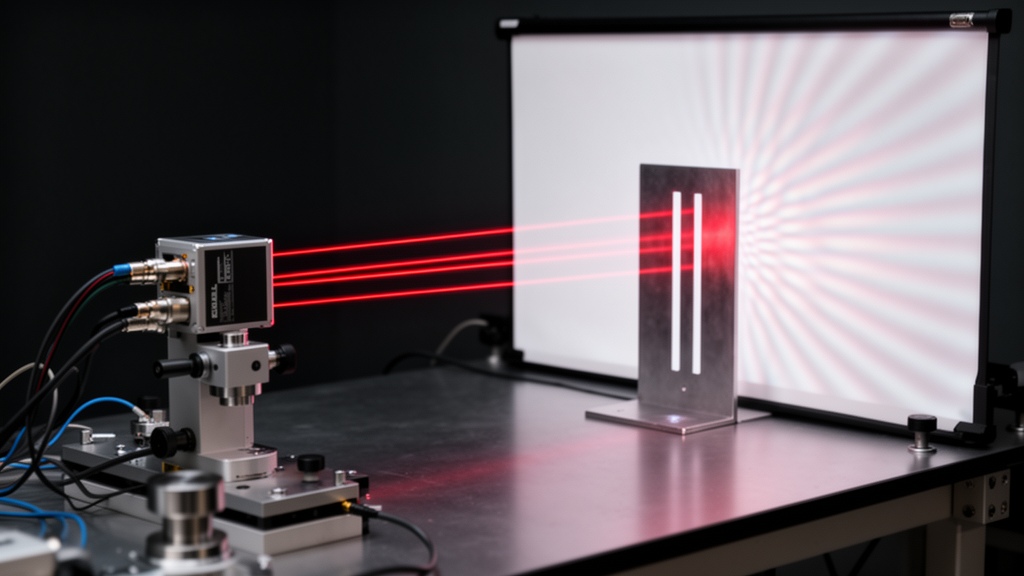
More than two centuries after Thomas Young first let light pass through a pair of narrow slits, the double-slit experiment remains the defining demonstration of the wave nature of light. Yet nearly every textbook treatment of the problem shares a quiet limitation: it assumes the slits are illuminated by a single plane wave arriving head-on. A new theoretical study, published in Frontiers in Photonics, breaks with that convention. Researchers at the Universidad Autónoma del Estado de México in Toluca have derived compact, closed-form Fresnel expressions for a double slit illuminated not by one beam but by three mutually coherent plane waves, and they show how the resulting diffraction pattern can be engineered almost at will.
The work, led by J. Sumaya-Martínez together with M. A. Ortiz-Ferreyro and O. Rojas-Hernandez, addresses a gap that has grown increasingly relevant as modern photonics has moved beyond simple illumination schemes. Multi-beam interference is now a standard tool in structured illumination microscopy, digital holography, Fourier-based deflectometry and interference lithography. When such an engineered field strikes an aperture, the observed diffraction pattern is a product of two things at once: the transmission of the aperture and the deliberate structure of the illumination itself. Until now, compact analytical formulas describing that combined effect in the Fresnel regime have been scarce, particularly for configurations in which the illumination is designed to vanish exactly at the geometric edges of the transmitting region.
The heart of the new analysis is what the authors call the edge-zero condition. The setup consists of one plane wave incident normally on the double slit, flanked by two identical waves tilted symmetrically at angles of plus and minus theta in the plane of the slits. All three waves share the same wavelength and amplitude, and a controllable relative phase is introduced between them, for example through path-length differences in the interferometric arms. By choosing the incidence angles and phases appropriately, the total incident field can be made to evaluate to zero at each of the four slit boundaries. The aperture itself is untouched; the nulls are written into the light before it ever reaches the metal film.
This constraint has a pleasing mathematical consequence. For a symmetric double slit, the admissible edge phases follow directly from the geometry, and selecting the first adjacent roots of the resulting condition yields a compact prescription in which one central lobe of the engineered illumination sits neatly inside each slit. Bright fringes are thereby confined within the transmitting regions, while the field naturally dies away at the edges. Physically, this amounts to a built-in apodization: the diffraction pattern inherits suppressed sidelobes without any modification to the aperture. The authors note that other choices of adjacent root pairs generate wider slits containing additional oscillations while still preserving the edge-zero property, giving experimenters a family of illumination profiles to choose from.
On the analytical side, the derivation follows the classical machinery of scalar diffraction theory. Under the Fresnel approximation, valid when the propagation distance is much larger than the squared slit width divided by the wavelength, the Rayleigh-Sommerfeld integral reduces to a form in which the finite slit width limits the integration and the three-wave illumination contributes three exponential terms. Completing the square in the exponent and changing variables reduces each contribution to combinations of the standard Fresnel integrals, evaluated at transformed slit edges. The measurable intensity in the observation plane then encodes both the double-slit diffraction and the three-beam interference in a single closed expression. The formalism extends without conceptual difficulty to an arbitrary number of coherent plane waves, each contributing a term whose transformed edge arguments are simply shifted by the beam’s transverse wavenumber.
To validate the formulas, the team performed numerical Fresnel propagation by direct evaluation of the diffraction integral on a spatial grid, comparing the resulting intensity profiles against the closed-form solutions. The agreement was striking. For a representative symmetric design at a wavelength of 633 nanometers with propagation distances of the order of one meter, the root-mean-square error between normalized analytical and numerical intensities remained at the level of numerical precision, with reported values ranging from roughly 10 to the minus 11 down to 10 to the minus 12 across propagation distances from 0.2 to 1.5 meters. Errors of a few percent or less were routinely obtained over the main lobes and first sidelobes, confirming both the validity of the Fresnel approximation and the correctness of the analytical construction.
The framework also confronts two realities that ideal plane-wave theory usually ignores: imperfect coherence and non-ideal beams. The authors introduce a scalar degree-of-coherence parameter that interpolates smoothly between fully coherent superposition of complex amplitudes and completely incoherent addition of individual intensities. As the coherence parameter decreases, the fringe visibility of the three-beam pattern is progressively reduced while the overall envelope remains largely unchanged. A more refined treatment employs the mutual intensity, or cross-spectral density, at the aperture and propagates it to the observation plane, with a Gaussian transverse coherence-decay model in which beams separated by larger angles experience stronger coherence loss. As the effective transverse coherence length shrinks, fringe visibility falls in exactly the manner the model predicts.
Real laboratory lasers, moreover, produce Gaussian beams rather than ideal plane waves. The authors model each component at the aperture as a Gaussian envelope carrying the transverse wavenumber associated with its incidence angle. The Gaussian factor acts as an additional smooth apodization across the slits, damping the effective contribution of the slit edges and suppressing the high-frequency components of the angular spectrum. The result is a diffraction pattern with reduced sidelobes and a slightly broadened main lobe, with smaller beam waists producing stronger apodization. An intensity map versus propagation distance shows a near field rich in interference structure that gradually evolves into a smoother profile, with the Gaussian envelope narrowing the region over which high-contrast fringes persist.
The practical payoff spans several domains of optics. Because the set of beam angles and phases functions like a handful of tunable Fourier coefficients, the illumination across the aperture can approximate classical apodization windows: a suitable choice of coefficients realizes Blackman-like apodizers, while retaining only the first harmonic yields Hann-like windows, both familiar from signal processing as means of controlling spectral leakage. Fitting an integer number of bright interference fringes inside each slit, truncated precisely at the field’s natural zeros, produces profiles that behave approximately as eigenmodes of Fresnel propagation over a finite range, acting as quasi-invariant channels useful for free-space optical interconnects and alignment beams, though the authors are careful to distinguish these from truly propagation-invariant modes such as ideal Bessel or Airy beams. The same three-beam geometry naturally generates the sinusoidal carriers used in structured illumination microscopy, and distinct incidence angles serve as distinct spatial-frequency carriers, enabling coherent multiplexing in digital holographic microscopy and coherent diffraction imaging.
The authors also sketch a laboratory validation that requires nothing exotic. A single-frequency, linearly polarized laser at 633 nanometers is expanded and spatially filtered, then split into three arms using a non-polarizing beam splitter and a pick-off mirror, with two arms steered to the symmetric tilt angles and path lengths matched within the laser’s coherence length. A photolithographically fabricated double slit whose edges follow the edge-zero prescription is mounted on a kinematic holder, and the transmitted intensity is recorded on a CCD or CMOS sensor on a translation stage. A staged calibration, first with a single beam, then one tilted arm, then all three, allows the fringe spacing, symmetry and phase sensitivity to be verified step by step, with a piezo-mounted mirror scanning the relative phase. Partial coherence can be probed by inserting a rotating diffuser or deliberately detuning path lengths beyond the coherence length. Agreement within a few percent over the central lobe, the authors suggest, would confirm the model for practical purposes. What began as a nineteenth-century demonstration of superposition, it turns out, still has room for new analytical elegance, and a three-beam trick may soon be shaping everything from lithographic lattices to multiplexed holographic sensors.
Subject of Research: Closed-form Fresnel diffraction analysis of a double slit under multi-wave coherent illumination with edge-zero conditions, partial coherence and Gaussian beams
Article Title: Closed-form Fresnel analysis of double-slit diffraction with multi-wave coherent illumination
Article References: Sumaya-Martínez, J., Ortiz-Ferreyro, M. A., & Rojas-Hernandez, O. (2026). Closed-form Fresnel analysis of double-slit diffraction with multi-wave coherent illumination. Frontiers in Photonics, 7, Article 1755191. https://doi.org/10.3389/fphot.2026.1755191
Image Credits: AI Generated
DOI: 10.3389/fphot.2026.1755191
Keywords: double-slit diffraction, Fresnel diffraction, coherent illumination, multi-wave interference, apodization, partial coherence, Gaussian beams, structured illumination, interference lithography, beam shaping, wave optics, photonics
Cite Scienmag News
Katie Riggs. (October 16, 2026). Three Beams and a Double Slit: Physicists Rewrite a Classic Diffraction Problem in Closed Form. Scienmag. https://scienmag.com/three-beams-and-a-double-slit-physicists-rewrite-a-classic-diffraction-problem-in-closed-form/
Katie Riggs. "Three Beams and a Double Slit: Physicists Rewrite a Classic Diffraction Problem in Closed Form." Scienmag, 16 October 2026, https://scienmag.com/three-beams-and-a-double-slit-physicists-rewrite-a-classic-diffraction-problem-in-closed-form/. Accessed 16 October 2026.
Katie Riggs. "Three Beams and a Double Slit: Physicists Rewrite a Classic Diffraction Problem in Closed Form." Scienmag. October 16, 2026. https://scienmag.com/three-beams-and-a-double-slit-physicists-rewrite-a-classic-diffraction-problem-in-closed-form/


