


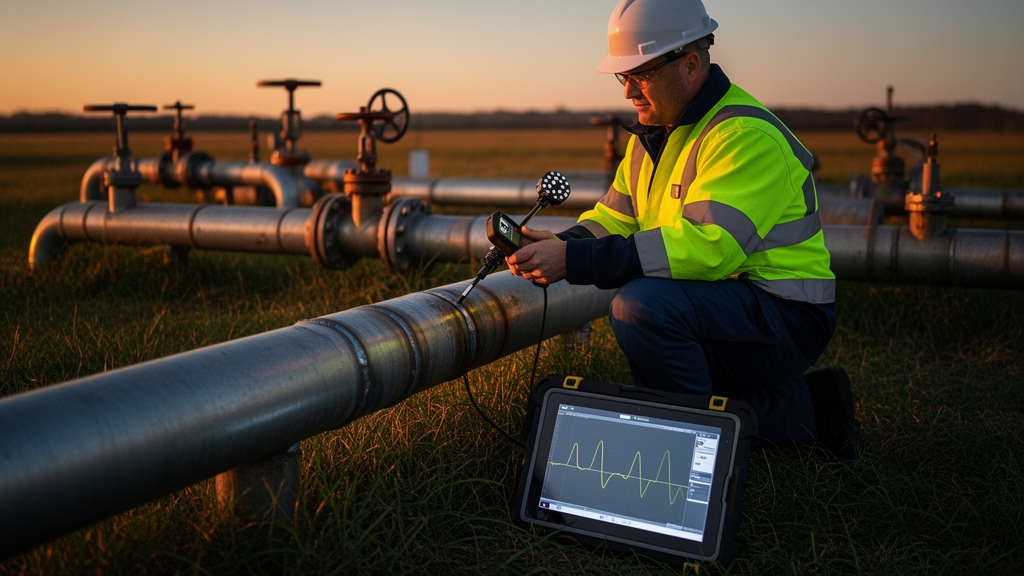
Every year, natural gas pipelines quietly stretch across continents, carrying fuel to homes and industries while facing an invisible enemy: leaks. Detecting a leak in a pipeline buried under a city or running through a compressor station is hard enough, but doing so when the surrounding noise is louder than the leak itself has long been one of the field’s most stubborn challenges. Now, researchers at Southwest Petroleum University in Chengdu, China, have built a pair of deep learning models that can not only hear a leak through that din but also pinpoint exactly where it is, with accuracy approaching perfection.
The study, published in Frontiers in Acoustics, tackles a problem that has frustrated engineers for decades. Conventional leak detection methods, whether hardware-based tools like magnetic flux leakage scanners and ground-penetrating radar, or software-based algorithms that analyze sensor data, tend to falter when background noise is strong. The leak signal gets buried, features become fragmented, and localization results become unstable. In industrial or urban environments, where compressor units, valves, and traffic generate constant vibration, the difference between a leak and ordinary operational noise can be nearly impossible to separate with traditional signal processing.
Yifei Gao and Huiying Zhang, the authors of the new study, took a different approach. Rather than treating leak detection as a simple yes-or-no classification task, they reframed the problem as two related challenges: first, classifying which section of the pipeline contains the leak, and second, continuously regressing the exact leak position as a number along the pipeline. This dual formulation allows the system to provide both a coarse-grained answer, useful for rapid triage, and a fine-grained one, useful for dispatching repair crews to the right spot.
To train and test their models, the researchers built an experimental platform using the HD-II oil and gas pipeline system. The pipeline network spans 160 meters of 304 stainless steel with a 4-millimeter wall thickness and a 50-millimeter outer diameter. Air, regulated by an air compressor, served as the working medium, with the internal pressure held steadily at 0.5 megapascals. A leakage orifice of 0.5 millimeters simulated small-hole leaks, and piezoelectric acoustic sensors were installed at both ends of the pipeline, spaced 100 meters apart, with a leakage point set every 10 meters along the test section. The result was a dataset of acoustic signals from ten distinct leak locations, all captured under strong noise conditions dominated by compressor vibration and environmental interference.
The researchers deliberately chose air rather than natural gas for safety and repeatability, but they took care to ensure the experimental conditions mirrored real pipelines in key ways. The measured Mach number in the experimental pipeline was approximately 0.04, and the Reynolds number was 1.32 × 10⁵, both consistent with the turbulent flow regime found in actual natural gas transmission lines, where Mach numbers are generally below 0.1 and Reynolds numbers are on the order of 10⁵. This similarity in internal flow characteristics gives the experimental results a meaningful connection to field conditions, even though the authors acknowledge that gas composition, pipe diameter, and buried boundary conditions in real pipelines introduce additional complexity that future work must address.
For the classification task, Gao and Zhang proposed a Multi-Channel Hybrid Self-Attention Convolutional Neural Network, or MCSA. The model combines three parallel convolutional pathways, one that preserves detailed signal information without pooling, one that uses global average pooling to capture broad context, and one that uses global max pooling to emphasize dominant features. These pathways feed into a Channel-Spatial Attention module, which adaptively weights the importance of different feature channels and spatial locations, strengthening leak-related patterns while suppressing noise. A Softmax classifier then maps the processed features to one of ten leak-location categories.
The results were striking. Under the original strong-noise condition, the MCSA model achieved an average classification accuracy of 99.2 percent, with precision, recall, and F1-score all exceeding 99 percent. When the researchers added Gaussian white noise at signal-to-noise ratios of 12, 8, and 4 decibels to further stress the system, the MCSA model maintained accuracies of 97.5, 96.5, and 95.0 percent respectively. By comparison, benchmark models including a standard one-dimensional CNN, an LSTM-CNN hybrid, and ResNet degraded sharply under the same conditions, with the 1D-CNN dropping to just 60.5 percent accuracy at the 4-decibel signal-to-noise ratio. An ablation study confirmed that both the attention mechanism and the multi-path structure contributed meaningfully, with the complete model outperforming a feature-extraction-only baseline by 13.7 percentage points in accuracy.
For the continuous localization task, the researchers proposed a second model, the Multi-level Cascaded Residual Mixed Attention network, or MCR-MA. This architecture stacks three residual blocks in cascade, each incorporating the same Channel-Spatial Attention mechanism, allowing the network to progressively refine its representation of complex leak features while preserving critical information through residual connections. The model takes two-channel acoustic signal segments from the upstream and downstream sensors as input, learning the time-delay and attenuation characteristics that encode leak position without ever being told the true location. A global average pooling layer and a fully connected regressor then produce a continuous estimate of the normalized leak position.
The MCR-MA model achieved an average localization accuracy of 98.75 percent, with a mean squared error of 0.0004, a root mean square error of 0.0207, and a mean absolute error of 0.0165, all the lowest among the compared models. Its R² value reached 0.9999, indicating near-perfect agreement between predicted and actual leak positions. The mean bias was just 0.0051, which for the 160-meter pipeline corresponds to an average localization offset of approximately 0.816 meters. Error analysis across the ten leak positions showed that localization errors were mainly concentrated between 0.5 and 1.2 meters, with only slight increases at positions P7 and P9, likely related to signal attenuation and the similarity of acoustic features between neighboring leak points.
The implications for pipeline safety are considerable. Natural gas transmission networks span hundreds of thousands of kilometers worldwide, and leaks, whether from corrosion, third-party damage, or joint failure, pose risks of explosion, environmental harm, and supply disruption. A system that can reliably localize a leak to within a meter, even when the acoustic environment is dominated by compressor noise, could transform how operators respond to incidents, reducing response times and preventing small leaks from escalating into catastrophic failures. The authors suggest their approach provides a technically promising solution for intelligent monitoring and safety warning of natural gas transmission pipelines.
The researchers are careful to note the limitations of their work. The experimental platform used air rather than natural gas, operated at a fixed pressure and orifice diameter, and relied on Gaussian white noise for robustness testing, which cannot fully represent the non-Gaussian, transient, and frequency-dependent noise found in real industrial environments. Future work, they say, will validate the models using field-measured data, test them under different operating pressures and leak orifice diameters, evaluate robustness against impulsive and valve-operation noise, and explore lightweight model deployment for real-time edge applications. Even so, the combination of multi-channel feature extraction, hybrid attention, and cascaded residual learning demonstrated in this study marks a meaningful step toward leak localization systems that can be trusted in the acoustically hostile environments where pipelines actually operate.
Subject of Research: Acoustics
Article Title: Research on leakage detection and location method of natural gas pipeline under strong noise condition
Article References: Gao, Y., & Zhang, H. (2026). Research on leakage detection and location method of natural gas pipeline under strong noise condition. Frontiers in Acoustics, 4, Article 1840924. https://doi.org/10.3389/facou.2026.1840924
Image Credits: AI Generated
DOI: 10.3389/facou.2026.1840924
Keywords: deep learning, natural gas pipeline, leak detection, acoustic sensing, attention mechanism, neural network, pipeline safety, noise robustness, Research, leakage, detection, location
Cite Scienmag News
Blake Davidson. (October 16, 2026). AI Listens Through the Noise to Pinpoint Gas Pipeline Leaks With Meter-Level Precision. Scienmag. https://scienmag.com/ai-listens-through-the-noise-to-pinpoint-gas-pipeline-leaks-with-meter-level-precision/
Blake Davidson. "AI Listens Through the Noise to Pinpoint Gas Pipeline Leaks With Meter-Level Precision." Scienmag, 16 October 2026, https://scienmag.com/ai-listens-through-the-noise-to-pinpoint-gas-pipeline-leaks-with-meter-level-precision/. Accessed 16 October 2026.
Blake Davidson. "AI Listens Through the Noise to Pinpoint Gas Pipeline Leaks With Meter-Level Precision." Scienmag. October 16, 2026. https://scienmag.com/ai-listens-through-the-noise-to-pinpoint-gas-pipeline-leaks-with-meter-level-precision/


