


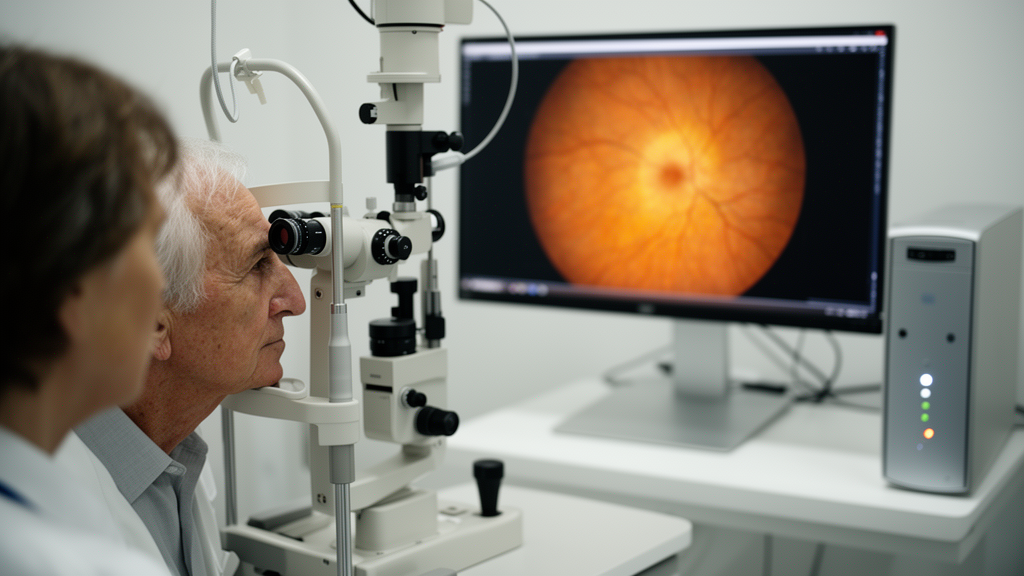
Age-related macular degeneration, or AMD, quietly steals the central vision of millions of older adults, and by the time many patients notice a problem, the damage is already irreversible. A new study published in Frontiers in Imaging offers a fresh line of defense: a two-stage artificial intelligence framework that not only detects AMD in retinal scans with up to 98 percent accuracy but also attempts something far harder—grading the severity of the disease without any human-provided severity labels at all.
The research, conducted by Ahmad Ryad Soobhany and Mohammed Thafheem at Heriot-Watt University in Dubai, tackles one of the most stubborn bottlenecks in medical imaging. While it has become relatively routine for deep learning models to answer a binary question—is this scan diseased or not?—assigning a disease stage requires expert annotation that is expensive, slow, and prone to disagreement between specialists. Public datasets rarely include severity labels for optical coherence tomography, the cross-sectional imaging technique that has become the workhorse of retinal diagnosis. The team’s answer was to sidestep the problem entirely, letting an algorithm discover severity patterns on its own.
The stakes are considerable. According to the World Health Organization, AMD is a leading cause of vision loss in developed countries, and roughly 200 million people worldwide already live with some form of the disease. The global population of older adults is projected to swell from around 962 million to two billion by 2050, which means the number of OCT scans requiring expert interpretation will only grow. Because AMD has no cure, the window for meaningful intervention lies in its early stages, when deposits called drusen—yellow accumulations beneath the retina—can be monitored before they progress to vision-threatening disease.
AMD comes in two broad forms. Dry AMD, which accounts for 80 to 85 percent of cases, progresses slowly as drusen accumulate and the retinal pigment epithelium thins. Wet AMD, affecting the remaining 15 to 20 percent, is far more aggressive: abnormal blood vessels grow beneath the retina in a process called choroidal neovascularization, leaking fluid and blood into the macula and causing rapid, severe vision loss. Roughly 10 to 15 percent of dry cases eventually convert to the wet form, which is precisely why reliable early detection and staging matter so much—catching the disease before conversion gives clinicians a chance to act.
For the detection stage, the researchers fine-tuned two classic convolutional neural network architectures, ResNet-18 and VGG-16, on the widely used Mendeley OCT dataset, which contains roughly 108,000 labeled images across four categories: normal, choroidal neovascularization, diabetic macular edema, and drusen. The team remapped these into three clinically meaningful classes—wet AMD, no AMD, and dry AMD—and addressed a significant class imbalance in the training data, which held about 51,000 normal images but only around 8,600 drusen cases, using augmentation techniques such as horizontal flipping and rotation. Both networks were initialized with ImageNet pre-trained weights and adapted to the retinal task.
The results were striking. On a balanced test set of 1,000 images, ResNet-18 achieved 98 percent accuracy, edging out VGG-16 at 96 percent, with ResNet-18 showing particular strength in detecting drusen—likely thanks to its residual connections, which help gradients flow through deep networks and preserve sensitivity to subtle pathological patterns. Notably, the researchers also benchmarked a Vision Transformer, the architecture behind many recent AI breakthroughs, and found it reached only 95 percent accuracy. The convolutional networks, it turns out, still hold their own on modest-sized medical datasets, where transformers’ lack of built-in spatial biases can leave them at a disadvantage.
The second stage is where the study breaks new ground. With no severity labels available, the team extracted 512-dimensional feature vectors from ResNet-18’s penultimate layer for all 8,616 drusen images, then projected them into a lower-dimensional space using UMAP, a technique chosen over linear methods like PCA because retinal features lie on a non-linear manifold. K-means clustering with three groups—chosen to mirror the Beckman Classification’s clinically defined early, intermediate, and advanced stages—was then applied. The clustering achieved a silhouette score of 0.49, indicating moderate but meaningful separation, exactly what one would expect given that drusen progression is continuous rather than sharply compartmentalized.
Crucially, the clusters were not just statistical artifacts. The researchers independently measured drusen area and equivalent diameter from the raw OCT scans using a classical segmentation pipeline, and found a statistically significant monotonic increase in drusen burden across the three clusters, confirmed by a Kruskal-Wallis test with a p-value below 0.001. Mean drusen area rose from about 36,400 pixels in the earliest cluster to over 46,300 pixels in the most advanced one. Interestingly, the separation between early and intermediate stages was modest—a 5.8 percent difference in mean area—while the gap between intermediate and advanced disease was far more pronounced at 20.3 percent, suggesting the algorithm is better at flagging advanced disease than at drawing fine distinctions in the earliest phases.
The team also stress-tested their models against domain shift, the phenomenon where models trained on data from one scanner or clinic falter on data from another. Without adaptation, the Mendeley-trained models collapsed to roughly 44 percent accuracy on the Duke OCT dataset. But after transfer learning, performance rebounded to between 82 and 84 percent, demonstrating that the framework can adapt to different imaging environments—a critical property for any tool hoping to leave the laboratory. The authors candidly note a limitation in their evaluation: because the Duke data was split at the slice level rather than the patient level, the reported cross-dataset figures may be somewhat optimistic.
The researchers are careful to position the system as a decision-support tool rather than a replacement for ophthalmologists, and they acknowledge that the unsupervised severity grading remains exploratory until validated against expert annotations or a ground-truth dataset such as AREDS. Still, the combination of high detection accuracy, clinically anchored clustering, and demonstrated cross-dataset adaptability points toward a scalable future in which AI triages the growing flood of retinal scans, flags the patients who need attention most urgently, and helps preserve sight for millions before the disease advances beyond reach.
Subject of Research: Machine learning-based detection and unsupervised severity grading of age-related macular degeneration using retinal OCT images
Article Title: Detection and exploratory severity grading of age-related macular degeneration using machine learning
Article References: Soobhany, A. R., & Thafheem, M. (2026). Detection and exploratory severity grading of age-related macular degeneration using machine learning. Frontiers in Imaging, 5, Article 1888372. https://doi.org/10.3389/fimag.2026.1888372
Image Credits: AI Generated
DOI: 10.3389/fimag.2026.1888372
Keywords: age-related macular degeneration, optical coherence tomography, deep learning, ResNet, VGG-16, unsupervised clustering, drusen, severity grading, transfer learning, UMAP, K-means, retinal imaging
Cite Scienmag News
Beatrice Stafford. (October 16, 2026). AI Reads Eye Scans to Catch Age-Related Macular Degeneration Early. Scienmag. https://scienmag.com/ai-reads-eye-scans-to-catch-age-related-macular-degeneration-early/
Beatrice Stafford. "AI Reads Eye Scans to Catch Age-Related Macular Degeneration Early." Scienmag, 16 October 2026, https://scienmag.com/ai-reads-eye-scans-to-catch-age-related-macular-degeneration-early/. Accessed 16 October 2026.
Beatrice Stafford. "AI Reads Eye Scans to Catch Age-Related Macular Degeneration Early." Scienmag. October 16, 2026. https://scienmag.com/ai-reads-eye-scans-to-catch-age-related-macular-degeneration-early/


