


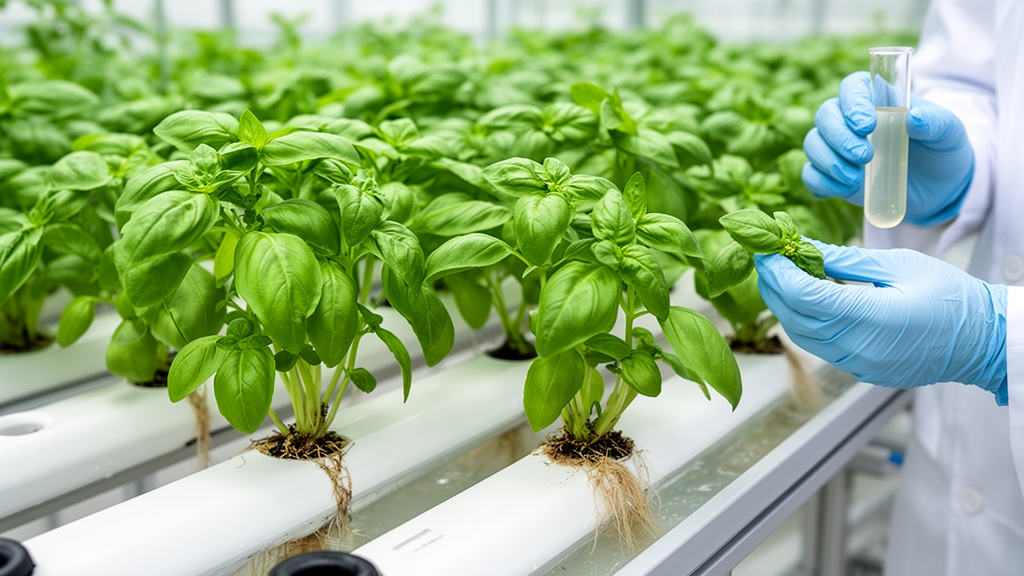
Basil is one of the world’s most beloved herbs, but a new study from Belgium suggests that the secret to a more fragrant, more potent crop may lie not in the plant’s genes or the greenhouse climate, but in the precise chemistry of the water flowing past its roots. Researchers at Gembloux Agro-Bio Tech, University of Liège, have shown that adjusting the concentrations of nitrogen, phosphorus, and potassium in a hydroponic nutrient solution can dramatically reshape both the size of basil plants and the relative abundance of the volatile organic compounds that give the herb its characteristic aroma. The findings, published in Frontiers in Horticulture, point toward a future where growers can
The idea that mineral nutrition can act as a lever on plant secondary metabolism is not new, but the Belgian study offers an unusually systematic demonstration of the principle in a controlled soilless environment. Because hydroponic systems deliver nutrients directly to the root zone in dissolved form, every element of the recipe can be specified, adjusted, and replicated with a precision that is difficult to achieve in field soil, where buffering by organic matter, clay particles, and microbial activity blurs the relationship between what a grower applies and what a plant actually absorbs. This precision is precisely what makes the nutrient film technique used in the experiment such an effective platform for nutrition experiments: a thin film of solution flows continuously along channels containing the roots, ensuring that the composition of the solution the plants experience remains close to what the researchers intended.
The three volatile compounds at the center of the study each carry distinct commercial weight. Linalool, a monoterpene alcohol with a floral, slightly spicy character, is one of the most widely encountered fragrance molecules in the flavor and perfume industries and has been studied for antimicrobial and calming properties. Eugenol, a phenylpropanoid better known as the dominant constituent of clove oil, contributes warm, spicy notes and is valued for antiseptic and insecticidal activity. Eucalyptol, a monoterpene oxide also called 1,8-cineole, lends a fresh, camphoraceous quality and appears in both medicinal and culinary contexts. The relative balance of these three molecules largely determines whether a given basil lot reads as sweet, spicy, or camphor-like to the nose, which is why a nutrient regime that shifts their proportions without sacrificing yield is of genuine interest to processors and essential oil producers.
From a plant physiology standpoint, the strong coupling between nitrogen supply and biomass in the experiment is consistent with well-established understanding of nitrogen’s role as a structural and metabolic driver. Nitrogen is a constituent of amino acids, nucleic acids, chlorophyll, and countless enzymes, and when it is abundant, plants typically invest heavily in leaf area and photosynthetic capacity. The observed pattern, in which high-nitrogen treatments produced aerial fresh weights in the range of 365 to 430 grams and approached the 471 grams recorded with the standard Hoagland reference solution, while low-nitrogen treatments fell below 100 grams, mirrors the classic growth response curve to nitrogen availability. The parallel declines in dry weight, leaf number, leaf area, and plant height indicate that nitrogen limitation constrained growth at multiple organizational levels rather than merely altering water content.
What makes the study more than a confirmation of textbook nitrogen responses is the divergence between shoot and root behavior. Root parameters remained broadly similar across treatments even as aerial biomass varied several-fold. This asymmetry is often interpreted as a consequence of sink priority: when nutrients are scarce, plants tend to maintain root investment to improve acquisition capacity, while shoot expansion, being the more resource-demanding and more readily deferred component, bears the brunt of the restriction. For hydroponic growers, the observation carries a practical implication, since root development in NFT channels affects channel occupancy and flow dynamics, and a root system that remains comparatively stable across nutrient regimes simplifies system management when solution composition is tuned for quality rather than quantity objectives.
The compositional groupings suggested by the exploratory principal component analysis add a layer of metabolic logic to the dataset. High nitrogen clustered with eugenol, intermediate nitrogen with eucalyptol, and low nitrogen with linalool. Nitrogen is a direct precursor for amino acid biosynthesis, and phenylalanine, an amino acid whose availability is sensitive to nitrogen status, sits at the entry point of the phenylpropanoid pathway that yields eugenol. A link between generous nitrogen supply and enhanced phenylpropanoid abundance is therefore plausible on biochemical grounds. Monoterpenes such as linalool and eucalyptol arise from a different biosynthetic branch, the mevalonate and methylerythritol phosphate pathways, and their relative prominence under lower nitrogen availability may reflect a shift in carbon allocation when vegetative growth is restrained, a pattern frequently reported in studies of essential oil crops under moderate stress.
The Hoagland solution, used as the reference treatment, deserves a note of context. Developed in the early twentieth century, the Hoagland formulation remains the de facto standard nutrient recipe in plant research, supplying generous, balanced concentrations of all essential elements. Its intermediate volatile profile in this experiment suggests that the conventional recipe represents a compromise point rather than an optimum for any single aroma compound. That is an important conceptual takeaway: a solution designed to maximize general growth is not necessarily the solution that maximizes a specific quality attribute, and the two objectives can pull the formulation in different directions.
The modeling approach represents the methodological novelty of the work. Response surface methodology uses designed experiments and fitted polynomial equations to map how responses change across combinations of factors, allowing researchers to interpolate between tested conditions and locate factor combinations associated with desired outcomes. Here, quadratic models fitted to the data explained a substantial share of the variance in the relative abundance of the three target compounds, with coefficients of determination of 0.64 for linalool, 0.82 for eugenol, and 0.73 for eucalyptol. The model-predicted candidate combinations differed markedly from one another: roughly 62 milligrams per liter of nitrogen paired with 17 milligrams per liter of phosphorus and 80 milligrams per liter of potassium for linalool, about 105, 31, and 135 milligrams per liter respectively for eugenol, and approximately 58, 31, and 93.5 milligrams per liter for eucalyptol. The fact that each compound is associated with a distinct nutritional signature underscores that aroma traits are not governed by a single dial but by the interplay of several elements.
Because potassium was treated as a dependent element in the experimental design, covarying with the nitrogen and phosphorus levels rather than being varied independently, the predicted optima should be read as combined nutrient signatures rather than as isolated effects of each element. This is a common and pragmatic choice in hydroponic formulation studies, since salts used to supply one nutrient inevitably contribute others, but it means that attribution of the observed effects to nitrogen alone would be an oversimplification. Potassium itself is known to influence enzyme activation, photosynthate transport, and the biosynthesis of secondary metabolites, so its covariation may well have contributed to the volatile responses recorded.
The compound production indices offer a way to reconcile the tension between yield and quality. By multiplying aerial fresh weight by the relative gas chromatographic peak area of each compound, the researchers obtained a single figure that reflects the total amount of a given volatile harvested per unit of crop, not merely its concentration. Against the Hoagland reference, the predicted candidate regimes roughly doubled the linalool index, from 8.46 to 17.43, and the eugenol index, from 5.61 to 14.7, and more than tripled the eucalyptol index, from 1.29 to 4.10. These gains are notable because they were achieved through formulation alone, without changing genetics, lighting, or climate, all of which were held constant under the fixed photoperiod and artificial lighting of the greenhouse.
The controlled environment in which the work was conducted strengthens the internal validity of the results. Temperature, ventilation, and lighting were managed by automated systems, with horticultural floodlights delivering a spectrum dominated by red and green radiation within the photosynthetically active range under a sixteen-hour photoperiod. Holding these factors constant means that the differences among treatments can be attributed with reasonable confidence to the nutrient solutions themselves, something rarely achievable in field experiments where weather and soil heterogeneity introduce noise.
Several caveats temper the practical application of the findings. The models were fitted in-sample to a limited set of nine nutrient combinations plus the reference, so the predicted optima are candidate formulations that would require validation in independent experiments before being adopted as recommendations. The volatile analysis focused on three major constituents, whereas basil essential oil contains dozens of minor compounds that collectively shape its full sensory and functional profile; a regime optimized for eugenol could conceivably alter other constituents in ways not captured here. The experiment also covered a single growing cycle of roughly two months under winter conditions with artificial lighting, and seasonal effects, cultivar choice, and harvest stage are all known to modulate basil volatile composition.
Even with these limitations, the study sketches a credible path toward quality-targeted hydroponic nutrition. If subsequent validation confirms the predicted formulations, growers of culinary basil and essential oil producers could in principle select a nutrient recipe the way a winemaker selects a terroir, steering the same cultivar toward a linalool-forward, eugenol-forward, or eucalyptol-forward character depending on the intended market. More broadly, the work illustrates how statistical modeling tools borrowed from industrial process optimization can be repurposed to navigate the multidimensional space of crop nutrition, turning the nutrient solution from a static recipe into a tunable instrument for shaping both the quantity and the chemistry of a harvest.
Subject of Research: Effects of nutrient solution regimes on biomass and volatile organic compound profiles of hydroponically grown basil
Article Title: Biomass and volatile profile responses of hydroponically grown Basil (Ocimum basilicum L.) to different nutrient solution regimes
Article References: Elakrouch, M., Mohaddab, M., Elmoussaoui, S., Odem, S., Hasni, S., Libault, A., Rachid, A., & Jijakli, M. H. (2026). Biomass and volatile profile responses of hydroponically grown Basil (Ocimum basilicum L.) to different nutrient solution regimes. Frontiers in Horticulture, 5, Article 1946574. https://doi.org/10.3389/fhort.2026.1946574
Image Credits: AI Generated
DOI: 10.3389/fhort.2026.1946574
Keywords: hydroponics, basil, Ocimum basilicum, volatile organic compounds, linalool, eugenol, eucalyptol, nutrient solution, nitrogen, phosphorus, response surface methodology, controlled environment agriculture
Cite Scienmag News
Bethany Barker. (October 16, 2026). Tuning Hydroponic Nutrient Recipes Steers Basil’s Aroma Chemistry, Study Finds. Scienmag. https://scienmag.com/tuning-hydroponic-nutrient-recipes-steers-basils-aroma-chemistry-study-finds/
Bethany Barker. "Tuning Hydroponic Nutrient Recipes Steers Basil’s Aroma Chemistry, Study Finds." Scienmag, 16 October 2026, https://scienmag.com/tuning-hydroponic-nutrient-recipes-steers-basils-aroma-chemistry-study-finds/. Accessed 16 October 2026.
Bethany Barker. "Tuning Hydroponic Nutrient Recipes Steers Basil’s Aroma Chemistry, Study Finds." Scienmag. October 16, 2026. https://scienmag.com/tuning-hydroponic-nutrient-recipes-steers-basils-aroma-chemistry-study-finds/


