


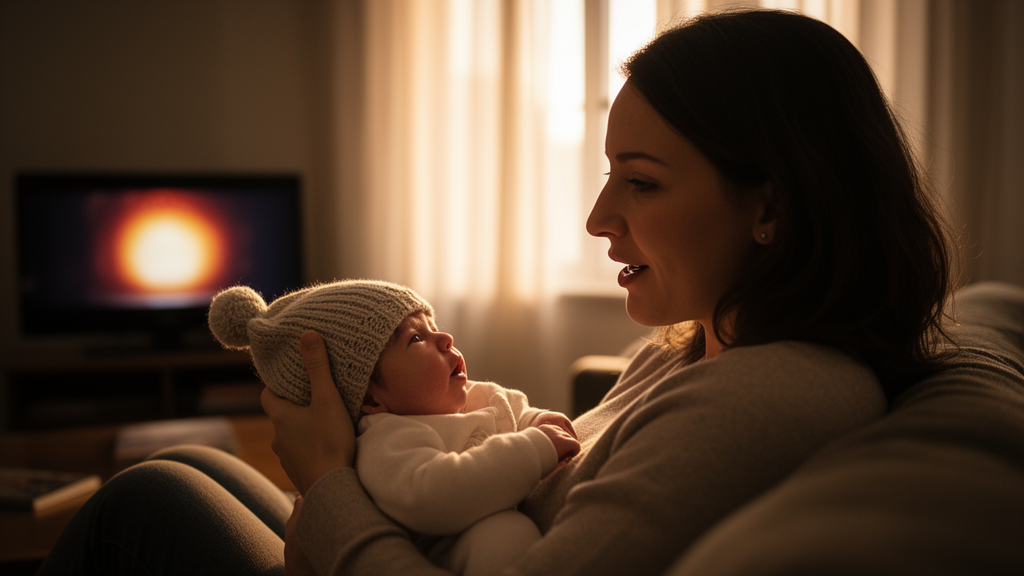
Very preterm infants—those born before 32 weeks of gestation—already face elevated risks of cognitive, language, and behavioral difficulties. A new pilot study from Geneva University Hospitals and the University of Geneva now suggests that screens may add to that burden surprisingly early. Among 64 very preterm infants assessed at 12 months of corrected age, those who spent more time directly in front of screens showed measurably lower cognitive and language scores, and explored toys with fewer tactile strategies, than their peers who watched screens less. The associations held even after the researchers statistically controlled for gestational age at birth and the family’s socio-economic status, two of the strongest known predictors of early neurodevelopment.
The study, published in Frontiers in Developmental Psychology, is, according to its authors, the first to examine the relationship between screen exposure and psychomotor, communicative, socio-emotional, and tactile competencies in very preterm infants at 12 months corrected age. Its findings arrive amid a striking shift in the digital environments surrounding infants: television running in the background, parents’ smartphones perpetually within reach, and content that is rarely designed for babies at all.
Recruitment drew on the routine follow-up program that all very preterm survivors in the region attend after hospital discharge. Of 147 children born very preterm who survived, the researchers excluded those with major congenital malformations, severe brain injury, or parents insufficiently fluent in French to complete the questionnaires. After accounting for refusals, families lost to follow-up, and incomplete questionnaires, 64 infants entered the analysis—38 boys and 26 girls, with a mean gestational age of 28.9 weeks and a mean birth weight of just 1,162 grams. Fifty-nine percent had bronchopulmonary dysplasia, and nearly one in five had experienced neonatal sepsis, underscoring how medically fragile this cohort was from the start.
Parents completed the Family Media Use questionnaire, which catalogued the household’s electronic devices and asked them to estimate, for weekdays and weekends alike, how much time their child spent watching television or using tablets and smartphones. The answers revealed a household landscape saturated with screens: an average of seven devices per home, with parents spending nearly six hours a day on screens for work and about five hours a day for personal use. Seventy-two percent of parents reported using screens while their child was in the room, averaging one hour daily. Twenty-three percent said the television was often on in the background, and roughly one in five systematically watched television during family meals.
Direct exposure among the infants themselves was less universal but still substantial. Thirty-nine percent of the babies—25 of the 64—were directly exposed to screens, averaging about four hours per week, with individual exposure ranging from half an hour to 14 hours weekly. That figure exceeds the roughly 1.75 hours per week reported for infants under one year in earlier research, and the authors note that screen time typically climbs with age: data from the French Elfe cohort show average daily viewing rising from 52 minutes at age two to one hour and 40 minutes by age 5.5.
Each child underwent a battery of assessments during the routine follow-up consultation. Child psychologists, psychomotor therapists, and physiotherapists administered the Bayley Scales of Infant Development III, a standardized instrument measuring cognitive, language, and motor development. Parents completed the Ages and Stages Questionnaire: Social-Emotional, a screening tool covering self-regulation, compliance, autonomy, affect, and interaction with others. The team also designed experimental tasks: one tested whether the infant preferred a helpful puppet over one that withheld a ball; another observed whether the child, after watching one experimenter help another build a tower, would hand over blocks themselves; a third counted gaze alternations and pointing gestures to quantify joint attention. Finally, a tactile exploration task video-recorded each child playing with a textured plastic cube and three different toys, coding the duration of active exploration and the variety of strategies used—pressing, shaking, stroking, mouthing, rotating, throwing. Crucially, the single trained rater who coded all the videos did so before ever seeing the screen-time questionnaires, guarding against bias.
The statistical picture that emerged was nuanced. When the researchers simply compared screen-exposed infants with unexposed ones, no significant differences appeared on any Bayley scale, the social-emotional questionnaire, or any of the experimental tasks. Nor did correlations across the entire cohort reach significance. But when the analysis narrowed to the 25 directly exposed infants, a clear dose-response pattern surfaced: greater screen time correlated negatively with cognitive scores (ρ = −0.34, p = 0.048) and, more strongly, with language scores (ρ = −0.56, p = 0.002). Higher exposure also predicted fewer exploration strategies during the tactile task (ρ = −0.39, p = 0.02), an association that actually strengthened after adjustment for gestational age and socio-economic status. Notably, motor scores showed no relationship with screen time, and neither did prosocial behavior, joint attention, or the parent-rated social-emotional total.
That last null result surprised the team, given how much prior research links early screen exposure to poorer social and emotional outcomes. The authors offer several explanations. Socio-emotional skills may evolve on a different timetable and only become measurable later in development. Pointing, in particular, emerges late in preterm children—studies have shown that extremely preterm infants produce significantly fewer pointing gestures at 18 months than full-term peers, a deficit linked to later language delay—so the rarity of pointing in this 12-month sample may have limited the task’s sensitivity. Previous work has also found that gaze-based joint attention behaviors are more affected by screens than gesture-based ones, and only a subset of infants in this cohort had begun pointing at all.
The findings align with a substantial literature. A longitudinal study of 2,441 children found that heavier screen use at 24, 36, and 60 months predicted poorer performance on developmental screening questionnaires at subsequent ages. A meta-analysis of language outcomes reported negative correlations between children’s language skills and both daily screen duration and background television, and found that later first exposure was associated with better language skills. Research on the mechanisms is equally telling: when a television is on, parents speak less and infants vocalize less, eroding the dyadic exchanges on which early language depends. The displacement theory offers a complementary frame—every hour in front of a screen is an hour not spent in interactive play, physical exploration, or social engagement, experiences that are especially critical for very preterm infants whose brains are already maturing atypically.
The study also uncovered a social gradient: within the exposed subgroup, lower family socio-economic status was associated with greater screen exposure, echoing earlier findings that parents of lower socio-economic status adhere less strictly to screen-time guidelines for toddlers. The authors are careful to frame their work as a pilot. Parent-reported screen time is vulnerable to recall and social-desirability bias; the questionnaire captured quantity but not content quality, co-viewing, or background exposure; the observational design precludes causal inference; and the small, attrition-prone sample limits statistical power. Still, the message for families is concrete. The researchers argue that awareness campaigns alone are insufficient, and that parents need practical guidance—skills for reading their infant’s cues, and alternatives to screens that foster meaningful interaction from birth. For a population already navigating elevated neurodevelopmental risk, the first year may be precisely the wrong time to hand over a screen.
Subject of Research: Associations between early screen exposure and cognitive, language, socio-emotional, and tactile development in very preterm infants at 12 months corrected age
Article Title: Screen exposure and reduced cognitive abilities, language development, and tactile exploration in very preterm infants aged 12 months—A pilot study
Article References: Liverani, M. C., Lordier, L., Durand-Ruel, M., Gillioz, E., Ha-Vinh Leuchter, R., Gentaz, E., Lejeune, F., & Borradori-Tolsa, C. (2026). Screen exposure and reduced cognitive abilities, language development, and tactile exploration in very preterm infants aged 12 months—A pilot study. Frontiers in Developmental Psychology, 4, Article 1875016. https://doi.org/10.3389/fdpys.2026.1875016
Image Credits: AI Generated
DOI: 10.3389/fdpys.2026.1875016
Keywords: very preterm infants, screen exposure, cognitive development, language development, tactile exploration, Bayley Scales, joint attention, prosocial behavior, socio-economic status, infant development, pilot study, digital media
Cite Scienmag News
Glenn Wilkins. (October 16, 2026). Screen Time in the First Year Linked to Weaker Language and Thinking Skills in Very Preterm Babies. Scienmag. https://scienmag.com/screen-time-in-the-first-year-linked-to-weaker-language-and-thinking-skills-in-very-preterm-babies/
Glenn Wilkins. "Screen Time in the First Year Linked to Weaker Language and Thinking Skills in Very Preterm Babies." Scienmag, 16 October 2026, https://scienmag.com/screen-time-in-the-first-year-linked-to-weaker-language-and-thinking-skills-in-very-preterm-babies/. Accessed 16 October 2026.
Glenn Wilkins. "Screen Time in the First Year Linked to Weaker Language and Thinking Skills in Very Preterm Babies." Scienmag. October 16, 2026. https://scienmag.com/screen-time-in-the-first-year-linked-to-weaker-language-and-thinking-skills-in-very-preterm-babies/


