


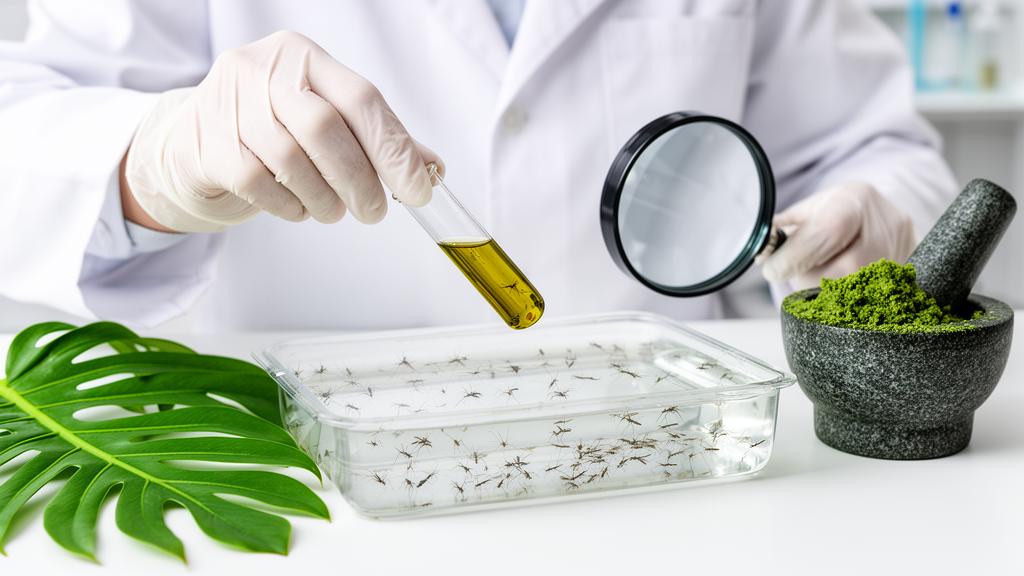
Mosquitoes remain the deadliest animals on Earth, and the battle against them is growing harder. Synthetic insecticides that once decimated vector populations are losing their edge as resistance spreads across Anopheles, Aedes, and Culex genera worldwide. Now, a research team from Nigeria has reported that humble plant parts—leaves, seeds, and stems of two common tropical trees—can kill mosquito larvae with remarkable efficiency, offering a potential green weapon in the fight against malaria, dengue, and lymphatic filariasis.
The study, published in Frontiers in Parasitology, examined ethyl acetate extracts prepared from Terminalia catappa (Indian almond) leaves and from the seeds and stems of Eucalyptus citriodora (lemon-scented gum). Researchers led by Eze Elijah Ajaegbu of David Umahi Federal University of Health Sciences set out to fill a notable gap in the botanical pesticide literature, which has historically favored leaf assays while largely ignoring other plant organs. Their comparative evaluation across three medically important mosquito species—Aedes aegypti, Anopheles gambiae, and Culex quinquefasciatus—provides one of the more comprehensive simultaneous bioassays reported to date.
The team collected plant material from two Nigerian locations: T. catappa foliage from Trans-Ekulu in Enugu State and E. citriodora stems and seeds from Lakokari Farm in Gombe State. After taxonomic authentication and voucher deposition, the dried materials were milled into fine powder and subjected to cold maceration with ethyl acetate for 48 hours. Extraction yields varied by organ: the seed extract (LEEE) produced the highest recovery at 4.7 percent by weight, the leaf extract (TLEE) yielded 3.3 percent, and the stem extract (LSEE) gave the lowest at 2.8 percent. Interestingly, yield did not predict potency—a theme that would recur throughout the study.
Larvicidal bioassays were conducted on fourth-instar larvae using a concentration gradient spanning 125 to 1000 parts per million, with mortality assessed at 24 and 48 hours. Groups of 25 larvae were exposed in quadruplicate, and results were corrected using Abbott’s equation. The findings were striking. Against Ae. aegypti, the dengue and Zika vector, the eucalyptus stem extract proved the most aggressive toxicant, achieving complete 100 percent mortality at 1000 ppm within 24 hours and posting an LC50 of 172.851 ppm. By 48 hours, its LC50 had dropped further to 144.393 ppm, with total population elimination persisting down to 500 ppm.
The malaria vector An. gambiae showed even greater vulnerability over longer exposure. After 48 hours, the T. catappa leaf extract recorded an extraordinary LC50 of just 13.271 ppm, killing 96 percent of larvae at a mere 125 ppm and wiping out entire cohorts at 250 ppm and above. The eucalyptus stem extract was nearly as potent, with an LC50 of 20.370 ppm and complete mortality from 250 ppm upward. The seed extract, while weaker, still reached an LC50 of 84.841 ppm at the same time point. These figures suggest that even modest concentrations of these botanical preparations could deliver lethal blows to malaria-transmitting larvae given sufficient contact time.
Culex quinquefasciatus, the filariasis vector, presented a different vulnerability hierarchy. The T. catappa leaf extract dominated here, eradicating entire cohorts at 1000 ppm within 24 hours and maintaining an LC50 of 20.370 ppm at 48 hours with complete mortality from 250 ppm onward. The eucalyptus seed extract consolidated its performance over time, reaching an LC50 of 49.090 ppm by 48 hours, while the stem extract lagged behind with an LC50 of 302.323 ppm. The species-specific differences likely reflect variations in larval detoxification enzymes, cuticular permeability, and receptor sensitivities—factors that underscore the importance of testing botanical larvicides against multiple vector species before field deployment.
Phytochemical screening revealed the chemical underpinnings of these effects. Tannins appeared uniformly across all three extracts, but the eucalyptus derivatives carried a richer metabolic load, concentrating flavonoids, resins, and steroids. Alkaloids were detected exclusively in the stem tissue, while saponins were absent from all samples. The researchers explain that these compound classes act through complementary mechanisms: alkaloids inhibit acetylcholinesterase, causing continuous nerve firing, muscle spasms, and paralysis; flavonoids and tannins bind digestive enzymes in the larval midgut, disrupting nutrient assimilation and inducing oxidative stress; and steroids and resins can compromise membrane integrity and arrest developmental processes.
Gas chromatography–mass spectrometry (GC-MS) profiling of the T. catappa leaf extract resolved 16 discrete volatile compounds, dominated by fatty acids and their methyl esters—including n-hexadecanoic acid, 9,12-octadecadienoic acid, and hexadecanoic acid methyl ester—alongside nitrogenous heterocycles such as 2-methyl-7-phenylindole and 7-methyl-7H-purin-6-amine. Prior research links these lipophilic fatty acid configurations to membrane disruption and energy production failure in insects. The authors argue that the broad-spectrum toxicity likely arises from synergistic interactions among multiple metabolites rather than the action of any single molecule, a hallmark of botanical insecticides that also complicates the evolution of resistance in target populations.
The study’s implications extend beyond the laboratory. With malaria claiming approximately 608,000 lives and causing 249 million cases in 2022 according to the World Health Organization, and dengue now endemic in over 100 countries, the search for sustainable alternatives to synthetic neurotoxicants has become urgent. Botanical larvicides degrade rapidly in the environment, pose reduced risks to non-target organisms, and employ multiple modes of action that delay resistance development. The U.S. Environmental Protection Agency has already classified lemon eucalyptus oil as a biopesticide candidate for integrated vector management, lending regulatory precedent to this approach.
Nevertheless, the authors caution that laboratory results do not automatically translate to field success. Sunlight, water chemistry, microbial degradation, and temperature fluctuations may all alter larvicidal performance under natural breeding conditions. Moreover, because the extracts were evaluated as complex mixtures, the individual contribution of each identified compound remains unknown. Future work, they note, should focus on bioassay-guided fractionation, purification of active constituents, elucidation of specific mechanisms of action, toxicity assessment toward non-target aquatic organisms, formulation studies to improve stability, and ultimately field evaluation. For now, the findings position Terminalia catappa and Eucalyptus citriodora as promising candidates in the ongoing quest for eco-friendly mosquito control tools.
Subject of Research: Larvicidal activity and GC-MS chemical profiling of Terminalia catappa leaf and Eucalyptus citriodora seed and stem extracts against Aedes aegypti, Anopheles gambiae, and Culex quinquefasciatus mosquitoes
Article Title: GCMS profiling and larvicidal potentials of the extracts of Terminalia catappa leaf, Eucalyptus citriodora seed and stem against malarial, dengue and filarial vector mosquitoes (Diptera: Culicidae)
Article References: Ajaegbu, E. E., Nwigwe, J. O., Chikezie, C. C., & Enyi, N. C. (2026). GCMS profiling and larvicidal potentials of the extracts of Terminalia catappa leaf, Eucalyptus citriodora seed and stem against malarial, dengue and filarial vector mosquitoes (Diptera: Culicidae). Frontiers in Parasitology, 5, Article 1934443. https://doi.org/10.3389/fpara.2026.1934443
Image Credits: AI Generated
DOI: 10.3389/fpara.2026.1934443
Keywords: mosquito larvae, botanical insecticides, Terminalia catappa, Eucalyptus citriodora, larvicidal activity, GC-MS analysis, vector control, malaria, dengue, lymphatic filariasis, phytochemicals, insecticide resistance
Cite Scienmag News
Alan Morgan. (October 16, 2026). Tropical Tree Extracts Show Potent Larvicidal Power Against Major Disease-Carrying Mosquitoes. Scienmag. https://scienmag.com/tropical-tree-extracts-show-potent-larvicidal-power-against-major-disease-carrying-mosquitoes/
Alan Morgan. "Tropical Tree Extracts Show Potent Larvicidal Power Against Major Disease-Carrying Mosquitoes." Scienmag, 16 October 2026, https://scienmag.com/tropical-tree-extracts-show-potent-larvicidal-power-against-major-disease-carrying-mosquitoes/. Accessed 16 October 2026.
Alan Morgan. "Tropical Tree Extracts Show Potent Larvicidal Power Against Major Disease-Carrying Mosquitoes." Scienmag. October 16, 2026. https://scienmag.com/tropical-tree-extracts-show-potent-larvicidal-power-against-major-disease-carrying-mosquitoes/


