


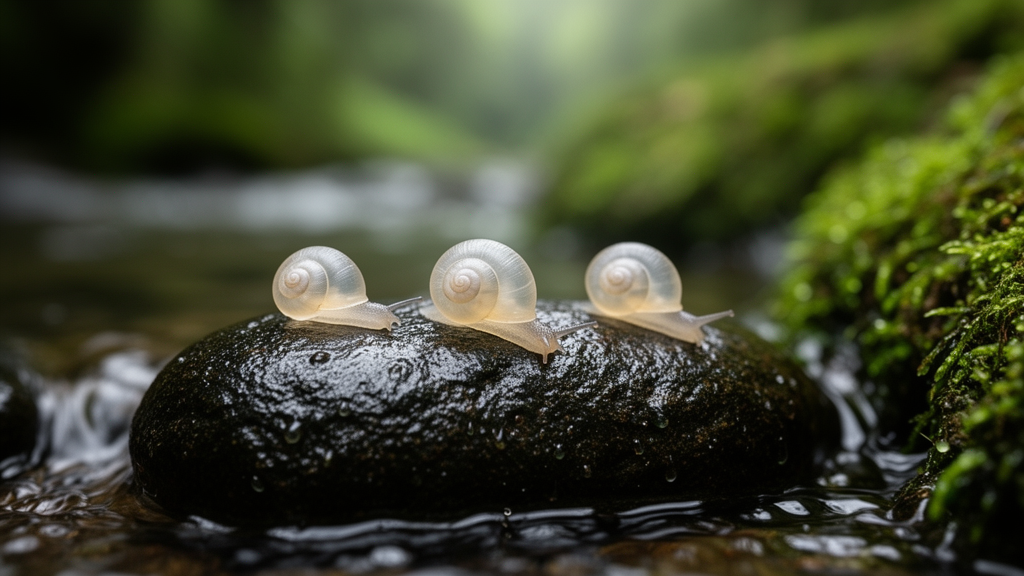
Deep inside a limestone sinkhole in the Ecuadorian Amazon, scientists have found something no one expected: minute land snails belonging to a genus previously known only from Brazil, more than 3,000 kilometers away. A new study published in the journal Evolutionary Systematics describes three brand-new species of the microsnail genus Habeastrum from the eastern slopes of the Andes, dramatically expanding the known range of this enigmatic group and raising fresh questions about how such tiny, seemingly immobile creatures came to be scattered across the continent.
Habeastrum was established only in 2019, when researchers discovered two minute snail species in caves in Mato Grosso do Sul, Brazil. A third species followed in 2020 from caves in Minas Gerais. The genus was tentatively placed in the family Diplommatinidae, a species-rich group of terrestrial microsnails with more than 500 species distributed across southern and eastern Asia, Sri Lanka, Japan, Indonesia, the Philippines, northern Australia, and the Pacific islands. In South America, however, Diplommatinidae were long considered nearly absent, represented only by the genus Adelopoma and, more recently, by Habeastrum itself.
The new discoveries come from the eastern Andean slope in Ecuador, where researchers collected specimens in Pastaza, Morona-Santiago, Sucumbios, and Napo provinces. Until recently, Ecuador had no documented diplommatinid records at all: a 2022 review reported none from the country, and it was only in 2023 that a single Adelopoma species confirmed the family’s presence there. The appearance of three Habeastrum species in the same region suggests that the diversity of these microsnails in northwestern South America has been greatly underestimated.
The first new species, Habeastrum striolatum, was found inside the Cueva de los Tayos in Pastaza province, at the bottom of a 100-meter vertical sinkhole at 740 meters above sea level. Its shell is minute, barely 1.3 millimeters high, white, and elongated conical, with 5.25 to 5.5 strongly convex whorls. The name refers to its striolate sculpture: the shell surface carries dense fine riblets, numbering between 26 and 38 per half millimeter on the body whorl, and the protoconch bears indistinct radial wrinkles. The narrow umbilicus accounts for only 9 to 11 percent of the shell diameter.
The second species, Habeastrum tayos, was collected in the area around the same cave system and at the Sunka Biological Station in Morona-Santiago province, at elevations between 720 and 1,032 meters. It shares the slender conical shell shape but is distinguished by much coarser ribbing, with only 8 to 12 ribs per half millimeter. The species name honors the oilbird, known in Spanish as the tayo, a cave-breeding bird after which many local caves, including those at the type locality, are named. Interestingly, shells resembling this species were also found far away in Napo province, at 1,700 and even 3,090 meters elevation, in acidic habitats without calcareous rocks. Statistical tests found no significant differences in shell dimensions between the lowland and Andean specimens, but the authors caution that the identity of the high-altitude populations must be confirmed given their very different environments.
The third species, Habeastrum decussatum, stands apart in several ways. It was discovered in Sucumbios province, on the leaf litter at the base of a non-calcareous rocky wall along a small river cliff at 500 meters elevation. Its shell is corneous-brown rather than white, wider and more conical than its relatives, and its fine ribs, 24 to 25 per half millimeter, are crossed by distinct spiral lines, a decussate pattern that gives the species its name. The protoconch displays dense, irregular indentations unlike anything seen in the other species.
The ecological implications of these finds are intriguing. All previously known Habeastrum species from Brazil were cave dwellers in karst areas, and the Ecuadorian Habeastrum striolatum fits that pattern, having been collected inside a cave. But Habeastrum tayos was found exclusively outside caves, leading the researchers to speculate that it may nonetheless be a subterranean species living in rock crevices, with empty shells occasionally washed out to the surface. Habeastrum decussatum, found on non-calcareous bedrock and bearing a brown, pigmented shell, may live on the soil surface rather than underground, a lifestyle that would be unique within the genus so far.
The classification of Habeastrum itself remains a fascinating puzzle. The genus superficially resembles Acmella, a group of Southeast Asian snails in the family Assimineidae that also frequently inhabits caves. However, anatomical evidence supports its placement in Diplommatinidae: Habeastrum possesses the duplicated eyes that serve as a defining trait of the family or a subgroup within it, and it retains a plesiomorphic hypoathroid central nervous system, unlike the derived epiathroid nervous system characteristic of the Sorbeoconcha, the larger group to which Assimineidae belong. It also lacks a seminal vesicle, another Sorbeoconcha hallmark. Yet complicating the picture, Habeastrum has a coiled radular sac, a feature otherwise considered an autapomorphy of Sorbeoconcha. The authors note that further phylogenetic investigations are clearly needed to resolve the genus’s true evolutionary position.
The discovery carries broader significance for conservation and biogeography. The Ecuadorian species were found in piedmont evergreen forests on limestone outcrops of the Amazonian Cordilleras, fragile habitats that are increasingly threatened by deforestation and mining. That a genus of minute snails could remain undetected for so long in a well-studied country underscores how little is known about the microinvertebrate fauna of tropical Andean forests. Each new species was described using scanning electron microscopy of the shells, with measurements taken from images and whorl counts assessed to a precision of a quarter whorl, reflecting the meticulous morphological work required to distinguish species whose entire shells are smaller than a grain of rice.
Specimens are deposited in the invertebrate collections of the Zoological Museum of the Pontificia Universidad Catolica in Quito, the Instituto Nacional de Biodiversidad, also in Quito, and the Zoological Museum of the Leibniz Institute for the Analysis of Biodiversity Change in Hamburg. As researchers continue to explore the caves, limestone outcrops, and forest litter of the eastern Andes, it seems likely that Habeastrum holds further surprises, and that the story of this tiny, widespread, and still-mysterious genus is only beginning to unfold.
Subject of Research: Discovery of three new Habeastrum microsnail species in Ecuador
Article Title: First records of Habeastrum species from Ecuador ( Gastropoda , Diplommatinidae )
Article References: Hausdorf, B., Roosen, M. T., & Tapia, E. (2026). First records of Habeastrum species from Ecuador (Gastropoda, Diplommatinidae). Evolutionary Systematics, 10(2), 295-301. https://doi.org/10.3897/evolsyst.10.199967
Image Credits: AI Generated
DOI: 10.3897/evolsyst.10.199967
Keywords: Habeastrum, Diplommatinidae, Ecuador, Andes, new species, microsnails, cave biology, taxonomy, biodiversity, Gastropoda, South America, Evolutionary Systematics
Cite Scienmag News
Margaret Porter. (October 16, 2026). Three Tiny Cave Snails Reveal a Mysterious Genus in Ecuador’s Andes. Scienmag. https://scienmag.com/three-tiny-cave-snails-reveal-a-mysterious-genus-in-ecuadors-andes/
Margaret Porter. "Three Tiny Cave Snails Reveal a Mysterious Genus in Ecuador’s Andes." Scienmag, 16 October 2026, https://scienmag.com/three-tiny-cave-snails-reveal-a-mysterious-genus-in-ecuadors-andes/. Accessed 16 October 2026.
Margaret Porter. "Three Tiny Cave Snails Reveal a Mysterious Genus in Ecuador’s Andes." Scienmag. October 16, 2026. https://scienmag.com/three-tiny-cave-snails-reveal-a-mysterious-genus-in-ecuadors-andes/


