


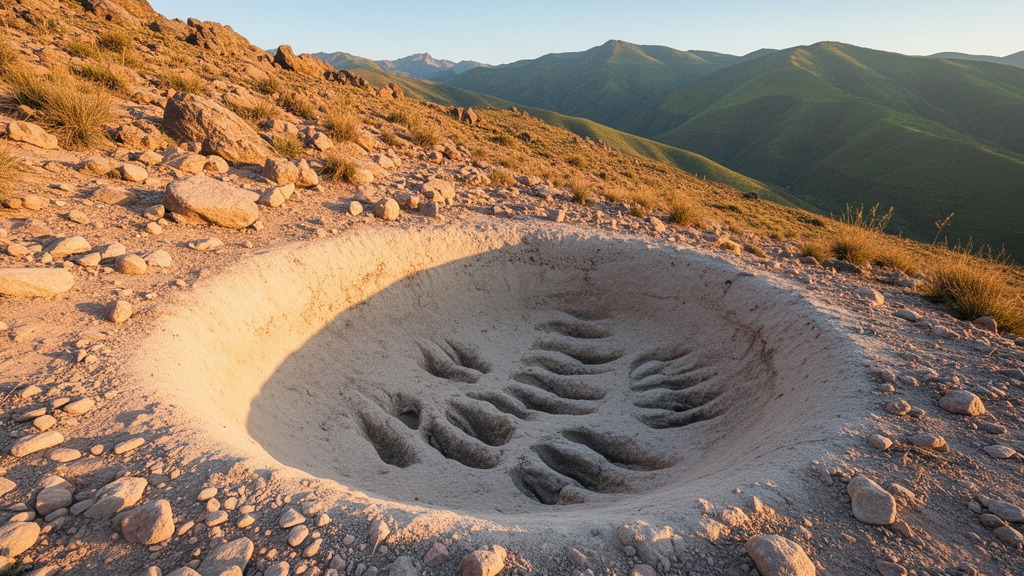
High in the Bolivian Andes, at a site called Mullurina Mayu some 3,450 metres above sea level in the Maragua Syncline of Chuquisaca, palaeontologists have documented one of the most enigmatic structures ever found on a dinosaur track surface: a bowl-shaped depression carved into 70-million-year-old mudstone, apparently scraped out by a titanosaurid sauropod. The structure, described in the journal Fossil Record, measures 4.2 metres long and 3.2 metres wide, with a maximum depth of about 60 centimetres, and sits just metres from the trackways of the giant plant-eaters themselves. Its walls and floor carry bundles of parallel grooves that the researchers interpret as scratch marks left by dinosaur feet — and possibly by dinosaur skin.
The discovery comes from the upper part of the Lower Member of the El Molino Formation, a Late Cretaceous unit deposited roughly 73 to 67 million years ago during the Maastrichtian age. Bolivia’s Cretaceous rocks survive today only in small, overthrust folds and synclines, and the Maragua Syncline has become famous for its trackways. Nearby sites include Humaca, where a herd of eleven subadult titanosaurids left their prints, and Niñu Mayu, home to ankylosaur tracks and footprints of even larger sauropods. Together, the El Molino Formation and its equivalents in Peru and Argentina form a megatracksite covering around 100,000 square kilometres, which previous researchers have linked to seasonal migration routes along the shores and deltas of an ancient lake system.
At Mullurina Mayu, an exposed palaeosurface of 522 square metres preserves at least four sauropod trackways assigned to the ichnotaxon Calorckosauripus lazari, a footprint type attributed to non-derived titanosaurids. The tracks show classic sauropod anatomy: half-moon-shaped hand impressions averaging 41 centimetres across and elongated hind-foot prints around 56 centimetres long, with an average stride of 1.7 metres. The trackmakers appear to have been subadult animals, intermediate in size between the smaller individuals at Humaca and the giants of Niñu Mayu. Soft-sediment deformation features around some hand impressions hint that the animals were moving across a wet, yielding substrate — conditions that would prove crucial for preserving what came next.
Towards the western edge of the surface, the strange depression interrupts the sequence. It cuts into a massive, cemented claystone interpreted as an overbank or levee deposit, and its sharp rim and deeper inner basin bear two longitudinal trough-like structures at the western end. Most striking are the traces along its walls: within semi-circular impressions 23 to 28 centimetres wide, groups of six to seven parallel grooves run up to 30 centimetres long. Each groove is about a centimetre wide, with roughly 1.8 centimetres between neighbouring scratches, and the bundles show two dominant orientations — northeast–southwest and east-southeast–west-northwest. Isolated, broader scratches measuring 5 to 10 centimetres long occur on the basin floor and are interpreted as claw marks. Soft-sediment bulges and collapse structures accompany the impressions, indicating the features formed while the sediment was still fresh and waterlogged.
Sorting out how such a structure formed required systematically testing alternative explanations. Hydraulic scouring by fast, sediment-laden water was considered first, but scour and gutter casts typically produce elongated, flow-aligned features with smooth or polished walls and tool marks — none of which appear here. Weathering pits, or panholes, formed by pooling water were also ruled out: they normally occur in multiples on the same surface, fall within a smaller size range, and lack the internal sediment disturbance seen at Mullurina Mayu. Only one such bowl exists on this surface, and its syn-sedimentary deformation features point to formation during deposition, not later erosion. That left a biological origin, supported by the scratch-like traces and their spatial association with sauropod trackways.
The interpretation of the grooves rests on a remarkable set of comparisons with sauropod skin traces from elsewhere. In 2025, researchers described titanosaur tracks from the Nemegt Formation of Mongolia preserving parallel scale scratch lines produced by keratinised foot scales dragging through sediment. In the Mongolian trackmaker’s hand prints, these striations measure roughly 10 to 12 millimetres wide with interspaces of 2 to 7 millimetres, while the heel region preserves the widest scratch lines at around 20 millimetres. The Mullurina Mayu grooves — about 10 millimetres wide with 18-millimetre interspaces — fall squarely within this range. Similar skin-slip striations have been documented in a Late Jurassic sauropod hand-print cast from Denmark and in Maastrichtian titanosaur traces from the southern Pyrenees of Spain. The multidirectional arrangement of the Bolivian bundles, however, differs from simple locomotion traces and suggests repeated foot movements around the margin of the depression — a scraping or digging action.
That possibility gains support from functional anatomy. Studies of sauropod pedal claws suggest that only about 10 to 13 percent of the ungual protruded from the fleshy cuticle, yet early work as far back as 2005 proposed that scratch digging remained feasible for sauropod feet. Cretaceous nesting structures from Argentina and Spain, described in landmark studies of sauropod reproduction, show that pit-like structures were excavated by the hind feet of nesting sauropods. Proposed criteria for recognising such nests include eggs or eggshell within the depression, truncation of primary stratification, an elevated rim of displaced sediment, and a contrasting infill. The Mullurina Mayu structure satisfies two of these — it truncates the primary claystone layering and is filled by caliche-bearing marls distinct from the host sediment — but lacks eggs, eggshell, or evidence of the communal nesting seen at known sauropod rookeries.
Other biological scenarios were weighed and mostly set aside. A trampled watering hole, or dinoturbation basin, seemed plausible at first: in modern semi-arid landscapes, animals congregate at low points that hold water, compacting and churning the substrate. But the hypothesis predicts laminated sediments deposited between trampling episodes, and the Mullurina Mayu depression and its fill are entirely structureless, with no sign of repeated wet-and-dry trampling cycles and no congregation of tracks around the basin. Geophagy — the ingestion of soil for minerals, known in elephants today — was discounted because the substrate contains only quartz and mica. Digging to reach groundwater cannot be proven or disproven. A lek-like courtship display scrape, known from a trace fossil called Ostendichnus linked to theropods, was also excluded, since the Bolivian structure lacks that trace’s characteristic central ridge and paired parallel troughs.
Crocodiles offered one more comparison worth testing. Longirostrine crocodyliforms lived in Bolivia during the Late Cretaceous, and Brazilian notosuchians built nests in floodplain mudstones. Modern Nile crocodiles dig burrows with openings of roughly 23 to 75 centimetres leading to egg chambers 25 to 48 centimetres across — far smaller than the Bolivian bowl — and no crocodyliform tracks are known from the country. The geometry of the scratch bundles also matches sauropod foot movements better than crocodylian limb actions. The researchers’ preferred reading is that the grooves represent skin-slip striations produced by repeated foot movement in soft sediment during excavation, making this tentatively a sauropod digging trace and possibly an abandoned nest scrape. Intriguingly, even if the trackmakers were subadults, this would not preclude nesting: titanosaurids reached sexual maturity before attaining maximum body size.
The structure was documented with rigorous modern methods, including drone photography, photogrammetric modelling, and false-colour depth maps, following standard protocols for digitising trace fossils — though rock sampling is currently not permitted at the site, limiting certain analyses. Whatever the final verdict on nesting, the Mullurina Mayu depression stands as a rare compound structure linking dinosaur behaviour to sedimentary architecture: a single low-energy excavation event on an ancient lake-margin levee, followed by drying and infill, preserved alongside the walking traces of the animals themselves. If the scratch-digging interpretation holds, it offers a fleeting, physical snapshot of giant dinosaurs manipulating their environment with purpose — shaping the ground beneath their feet in ways that, until now, palaeontologists could only infer from egg clutches and nesting grounds elsewhere in the Cretaceous world.
Subject of Research: Possible sauropod nest-scrape excavation structure associated with titanosaurid trackways in the Late Cretaceous El Molino Formation of Bolivia
Article Title: Digging Sauropods: excavation behaviour or evidence for nest building? An example from the Late Cretaceous El Molino Formation (Maragua, Bolivia)
Article References: Meyer, C. A., Heymann, J. H., Ibarra, E. C., Flores, E. L., & Sciscio, L. (2026). Digging Sauropods: excavation behaviour or evidence for nest building? An example from the Late Cretaceous El Molino Formation (Maragua, Bolivia). Fossil Record, 29(2), 519-532. https://doi.org/10.3897/fr.29.198794
Image Credits: AI Generated
DOI: 10.3897/fr.29.198794
Keywords: sauropods, titanosaur, trace fossils, dinosaur tracks, nesting behaviour, El Molino Formation, Bolivia, Maastrichtian, ichnology, Calorckosauripus, paleontology, Maragua Syncline
Cite Scienmag News
Glenn Wilkins. (October 16, 2026). Giant Dinosaurs Dug Nests? Mysterious Bowl-Shaped Pit Found Beside Titanosaur Tracks in Bolivia. Scienmag. https://scienmag.com/giant-dinosaurs-dug-nests-mysterious-bowl-shaped-pit-found-beside-titanosaur-tracks-in-bolivia/
Glenn Wilkins. "Giant Dinosaurs Dug Nests? Mysterious Bowl-Shaped Pit Found Beside Titanosaur Tracks in Bolivia." Scienmag, 16 October 2026, https://scienmag.com/giant-dinosaurs-dug-nests-mysterious-bowl-shaped-pit-found-beside-titanosaur-tracks-in-bolivia/. Accessed 16 October 2026.
Glenn Wilkins. "Giant Dinosaurs Dug Nests? Mysterious Bowl-Shaped Pit Found Beside Titanosaur Tracks in Bolivia." Scienmag. October 16, 2026. https://scienmag.com/giant-dinosaurs-dug-nests-mysterious-bowl-shaped-pit-found-beside-titanosaur-tracks-in-bolivia/


