


Samoa’s ambitious campaign to eliminate lymphatic filariasis has run into an uncomfortable reality: even after two rounds of a powerful three-drug regimen distributed five years apart, the parasitic worm that causes the disfiguring disease is still circulating in the island nation. A new five-year evaluation, published in PLOS Neglected Tropical Diseases, tracked both infected residents and virus-carrying mosquitoes across three survey rounds, and its findings offer one of the clearest pictures yet of what happens when elimination programs hit a stubborn transmission plateau.
Lymphatic filariasis, commonly known as elephantiasis, is caused by thread-like parasitic worms transmitted by mosquitoes. The infection can silently damage the lymphatic system for years before triggering the grotesque limb swelling and genital deformities that give the disease its name. The World Health Organization recommends repeated rounds of mass drug administration, in which entire eligible populations receive antiparasitic medication regardless of infection status, as the cornerstone of global elimination efforts. Samoa, which has battled persistent filarial transmission for decades, deployed triple-drug therapy combining ivermectin, diethylcarbamazine and albendazole in 2018 and again in 2023, making it one of the few countries with two rounds of this intensified regimen.
The research team, led by Helen J. Mayfield of Australian National University and colleagues, designed a study to answer a deceptively simple question: did the second round of triple-drug treatment actually push transmission down? To find out, they conducted household surveys in eight primary sampling units at three time points. The first survey ran six to nine months after the 2018 campaign, the second came four and a half years later in 2023, and the third took place ten months after the 2023 treatment round. Participants aged five and older from randomly selected households were tested for circulating filarial antigen, a marker of adult worm infection, and for microfilariae, the microscopic offspring of adult worms that circulate in the blood and are the form mosquitoes pick up when they bite.
The human data told a sobering story. Antigen prevalence barely moved across the entire study period, sitting at 9.8 percent in 2019, 9.9 percent in 2023 and 10.3 percent in 2024. Statistical comparison of the 2024 and 2023 results confirmed the flat trend, with an odds ratio of 1.0 for antigen positivity, meaning no detectable decrease. Microfilariae prevalence, a more direct marker of active transmission potential, showed a suggestive but statistically uncertain decline, falling from 5.1 percent in 2023 to 3.1 percent in 2024, with an odds ratio of 0.6 whose confidence interval crossed the threshold of significance.
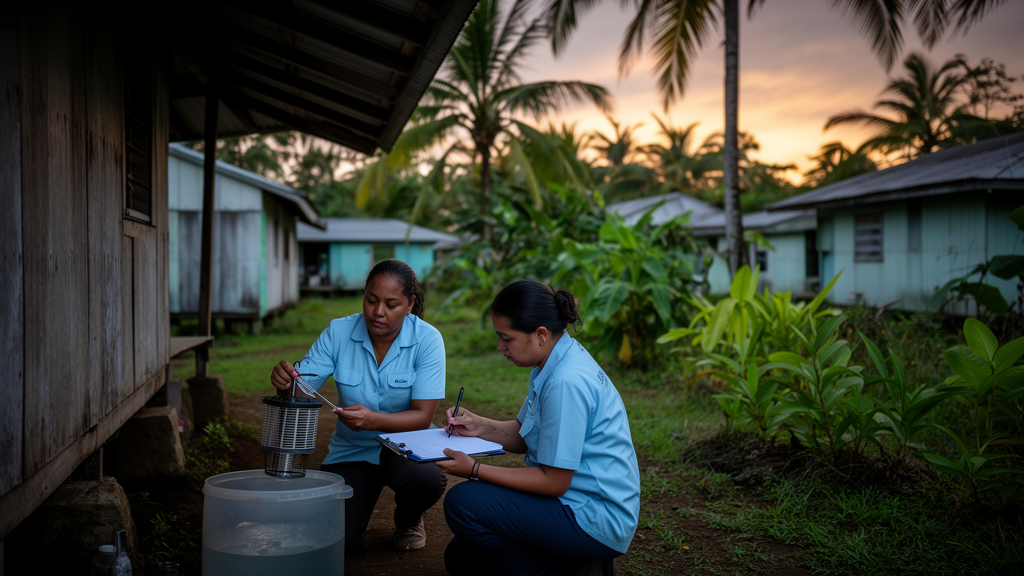
The mosquito data, however, revealed something the blood tests could not. The team deployed BG-Sentinel traps at participating households, sorted captured mosquitoes into species-specific pools, and screened them for filarial DNA using quantitative polymerase chain reaction, a technique known as molecular xenomonitoring. This approach detects parasite genetic material inside the insects themselves, providing a direct readout of how much transmission is actually occurring in the environment. After the 2023 treatment round, the prevalence of qPCR-positive mosquitoes dropped significantly, with an odds ratio of 0.4, meaning positive pools were roughly 60 percent less common than before the campaign.
Looking across the full five-year window from 2019 to 2024, the mosquito-based indicators showed sustained improvement for the species that matters most. Samoa’s filariasis problem is driven largely by Aedes polynesiensis, a day-biting mosquito with peculiar feeding habits that make standard interventions less effective. Prevalence of qPCR-positive Aedes species overall declined with an odds ratio of 0.5, and for Aedes polynesiensis specifically the odds ratio was 0.4, both indicating meaningful reductions over the study period.
The divergence between human and mosquito indicators is the study’s most consequential finding. Antigenemia reflects the presence of adult worms, which can survive for five years or more inside the human body even when treatment has sterilized them. This means antigen prevalence is a lagging indicator, slow to respond to successful interventions, and it may substantially overestimate ongoing transmission in the years immediately after a drug campaign. Microfilariae levels respond faster because the drugs rapidly clear the blood-stage parasites, but human surveys are expensive, logistically demanding and subject to participation bias.
Molecular xenomonitoring sidesteps several of these problems. Mosquitoes sample the transmission process itself, they can be collected in large numbers without requiring individual medical consent, and parasite DNA in mosquitoes reflects recent infections rather than long-lived adult worms. The Samoa results suggest that the 2023 triple-drug round did suppress transmission, as the mosquito data show, even while human antigen levels remained stubbornly unchanged. Had the program relied solely on antigen surveys, officials might have concluded the campaign had failed entirely, potentially triggering unnecessary additional rounds of drug distribution or misdirected resources.
These findings carry weight well beyond Samoa. The Global Programme to Eliminate Lymphatic Filariasis has set 2030 as its target date, and dozens of countries remain in the difficult endgame phase where transmission persists despite repeated treatment. Triple-drug therapy, which adds ivermectin to the traditional two-drug combination, was rolled out precisely because it clears microfilariae more completely and for longer than the standard regimen. Yet Samoa’s experience demonstrates that even this intensified approach, delivered twice with a five-year gap, could not fully interrupt transmission in a setting where the primary vector is unusually efficient at maintaining the parasite.
The authors conclude that mosquito-based indicators can provide a more sensitive measure of intervention impact in the immediate post-treatment period and should complement human serological surveillance for long-term monitoring. As elimination programs worldwide approach the finish line, the Samoa study offers a methodological lesson as much as an epidemiological one: choosing the right yardstick may determine whether hard-won progress is recognized, sustained and ultimately converted into elimination, or dismissed as failure by metrics that cannot yet see the difference.
Subject of Research: Impact of triple-drug mass drug administration on lymphatic filariasis transmission indicators in Samoa
Article Title: Evaluating the impact of triple-drug mass drug administration using human and mosquito-based indicators of lymphatic filariasis in Samoa, 2019 – 2024
Article References: Evaluating the impact of triple-drug mass drug administration using human and mosquito-based indicators of lymphatic filariasis in Samoa, 2019 – 2024. (n.d.). https://doi.org/10.1371/journal.pntd.0013895
Image Credits: AI Generated
DOI: 10.1371/journal.pntd.0013895
Keywords: lymphatic filariasis, mass drug administration, Samoa, molecular xenomonitoring, Aedes polynesiensis, triple-drug therapy, neglected tropical diseases, microfilariae, filarial antigen, qPCR, mosquito surveillance, transmission elimination
Cite Scienmag News
Ophelia Keating. (October 16, 2026). Triple-Drug Treatment Fails to Halt Lymphatic Filariasis in Samoa, Mosquito Surveys Reveal. Scienmag. https://scienmag.com/triple-drug-treatment-fails-to-halt-lymphatic-filariasis-in-samoa-mosquito-surveys-reveal/
Ophelia Keating. "Triple-Drug Treatment Fails to Halt Lymphatic Filariasis in Samoa, Mosquito Surveys Reveal." Scienmag, 16 October 2026, https://scienmag.com/triple-drug-treatment-fails-to-halt-lymphatic-filariasis-in-samoa-mosquito-surveys-reveal/. Accessed 16 October 2026.
Ophelia Keating. "Triple-Drug Treatment Fails to Halt Lymphatic Filariasis in Samoa, Mosquito Surveys Reveal." Scienmag. October 16, 2026. https://scienmag.com/triple-drug-treatment-fails-to-halt-lymphatic-filariasis-in-samoa-mosquito-surveys-reveal/


