


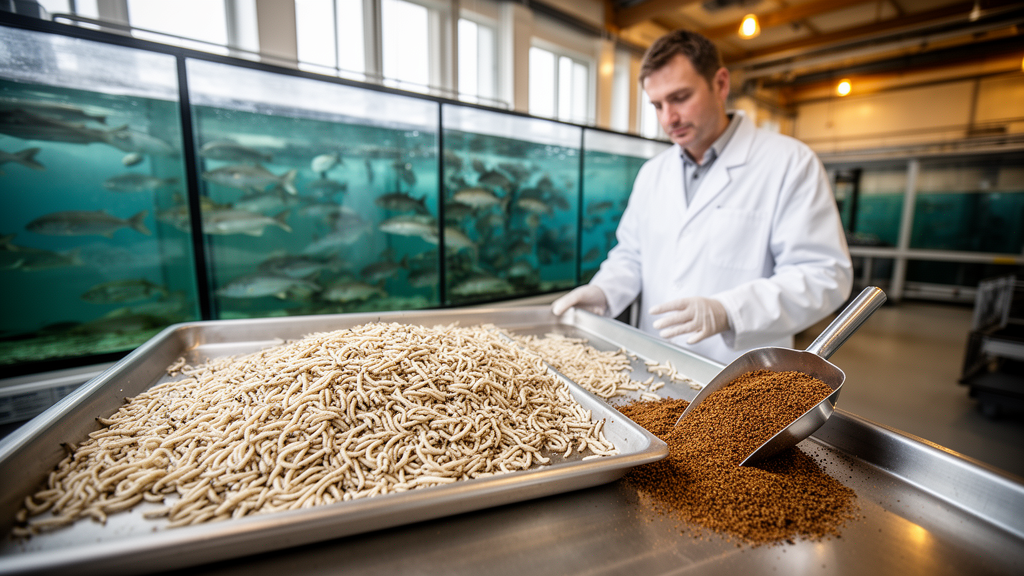
Aquaculture has become one of the fastest-growing food production industries on Earth, but its expansion is built on an increasingly fragile ingredient: fishmeal. According to the Marine Ingredients Organization, more than 87 percent of the fishmeal produced in 2021 went into feed for farmed fish, while global capture fisheries removed roughly 185.4 million tons of aquatic animals from the ocean in 2022. With overfishing climbing from 35.4 percent in 2019 to 37.7 percent in 2021, and annual per capita consumption of aquatic animal foods rising from 9.1 kilograms in 1961 to an estimated 20.7 kilograms in 2022, the pressure on wild stocks and the rising cost of fishmeal have pushed researchers to hunt for alternatives. A comprehensive new review published in Frontiers in Aquaculture argues that one unglamorous candidate, the larvae of the black soldier fly (Hermetia illucens), may be the most practical protein source for the aquafeed of the future.
The review, led by Faisal Rashid and colleagues at Sher-e-Kashmir University of Agricultural Sciences and Technology of Kashmir, synthesizes evidence from feeding trials conducted across finfish and crustacean species, from rainbow trout and Atlantic salmon to Nile tilapia, Jian carp, European sea bass and Pacific white shrimp. The authors assessed final body weight, specific growth rate, feed conversion ratio, feed intake, feed efficiency, survival and apparent digestibility coefficients, always benchmarked against conventional fishmeal diets. Their conclusion is cautiously optimistic: black soldier fly larvae meal can replace a substantial share of fishmeal in many species, but the response depends heavily on the target species, its life stage, the processing method applied to the larvae and the inclusion level in the diet.
Part of the appeal lies in the larvae’s raw potential. On a dry-matter basis, black soldier fly larvae typically contain 32 to 53 percent crude protein and 18 to 33 percent lipid, figures that rival fishmeal’s protein content. Yet the composition is anything but fixed. Protein, lipid, fiber, ash, amino acid and fatty acid profiles all shift with the rearing substrate, the developmental stage at harvest, the drying method and the degree of defatting. Published analyses show crude protein values ranging from roughly 26 percent to 47 percent and crude lipid from 18 to nearly 48 percent, which is why the authors stress that values must always be compared on the same analytical basis, whether dry-matter or as-fed. Defatting, notably, lowers lipid content and raises the relative protein concentration, making defatted meal the preferred ingredient for high-inclusion diets.
The rearing substrate itself is a biochemical dial that farmers can turn. Studies cited in the review show that prepupae raised on different vegetable by-products contained 67 to 89 milligrams of leucine per gram of protein and 47 to 72 milligrams of lysine per gram of protein, while larvae fed kitchen waste accumulated more proline, tyrosine and phenylalanine than those reared on chicken manure or brewer’s spent grain. Substrate manipulation can even reshape the fatty acid profile: adding brown seaweed to the feeding medium increased the omega-3 fatty acid EPA in larval tissue, although seaweed inclusion above 50 percent reduced larval growth and total lipid content. Saturated fatty acids, dominated by lauric acid, remain the major component of larval fat, which raises both formulation challenges and, intriguingly, functional opportunities.
Those opportunities extend beyond simple nutrition. The larvae contain chitin from their exoskeleton, lauric acid, antimicrobial peptides and other biologically active compounds that can influence antioxidant status, innate immunity and gut microbial communities. In European sea bass, replacing 25 to 50 percent of fishmeal protein with larvae meal improved antioxidant and non-specific immune responses and increased resistance to challenge with the pathogen Vibrio alginolyticus. In Pacific white shrimp, a diet replacing 10 percent of fishmeal protein improved survival after a Vibrio parahaemolyticus challenge, although a 30 percent replacement reduced growth and damaged intestinal structure. In Atlantic salmon, 10 percent dietary inclusion under farm-like conditions produced positive changes in skin mucosal, hematological and gene expression profiles without compromising growth or welfare.
The economics look increasingly persuasive as well. In European sea bass, replacing up to half of the fishmeal protein with defatted larvae meal maintained growth while cutting estimated feed costs by about 15.6 percent. In Siberian sturgeon, diets containing 10 to 15 percent full-fat larvae meal delivered the best economic returns, and under earthen-pond conditions in Kenya, replacing 25 to 75 percent of fishmeal maintained Nile tilapia growth while improving profit-related indicators. The review cautions that simply removing fishmeal does not automatically make a diet cheaper, because commercially produced insect meal can sometimes cost more than traditional protein sources, and economic analyses should track feed cost per unit of weight gain and sensitivity to insect meal prices rather than cost per kilogram of feed alone.
Beneath the nutrition lies a broader environmental story. Black soldier flies are voracious saprophagous feeders, originally native to South America and now distributed across the tropics, capable of converting fruit and vegetable waste, manure and municipal organic refuse into protein- and lipid-rich biomass. The residual material left behind can serve as organic fertilizer or soil amendment, and larval fat can even be processed into biodiesel. With roughly 1.05 billion tonnes of food wasted at the retail, food-service and household levels in 2022, nearly 19 percent of the food available to consumers, insect bioconversion offers a dual benefit: it diverts waste from landfills, generates lower greenhouse gas emissions than conventional disposal, degrades antibiotics in contaminated substrates and reduces pathogen loads, all while producing a feed ingredient.
Scaling that vision, however, demands mastering the fly’s biology. The species undergoes complete metamorphosis through egg, larva, pupa and adult stages, and its reproduction is acutely sensitive to light, temperature and humidity. Mating requires strong light and sufficient space, with quartz-iodine lamps supporting indoor mating, though at lower rates than natural sunlight, and LED lighting now recommended for small-scale rearing on grounds of energy efficiency. Egg hatching peaks at 30 to 35 degrees Celsius, survival from young larvae to adulthood ranges from 74 to 97 percent at 27 to 30 degrees Celsius but collapses to 0.1 percent at 36 degrees, and relative humidity of at least 50 percent is required to maintain colonies. These narrow environmental windows mean that commercial larval production carries real energy costs, particularly for heating and drying.
That energy question is central to the review’s most sobering assessment. Life-cycle assessment studies show that the environmental performance of larvae meal depends strongly on the rearing substrate, the energy used for heating and drying, transport distances and how impacts are allocated among larval meal, oil and residual material. Energy-intensive processing or purpose-grown substrates can offset much of the benefit gained from waste valorization, and the authors argue that only transparent assessments with clearly defined system boundaries and region-specific energy data can determine whether larvae meal genuinely outperforms fishmeal or plant proteins. Safety also demands vigilance: while dioxins, PCBs, PAHs, pesticides and mycotoxins generally do not accumulate in the larvae, heavy metals such as cadmium and lead can bioaccumulate, occasionally exceeding permitted feed levels, and heavy metal concentrations intensify in the residual fraction, limiting its use as fertilizer.
Even so, the species-level evidence suggests real headroom. Feeding trials show no clear harm from replacing more than 50 percent of fishmeal in general, and some species, including Atlantic salmon, Jian carp and Nile tilapia, have been raised successfully on diets with high or even complete fishmeal replacement, with Nile tilapia tolerating 100 percent replacement without adverse effects on growth, survival or blood parameters, and even showing enhanced skin-mucus lysozyme activity. Other species, notably turbot and shrimp, respond poorly beyond modest inclusion levels, likely because of the larvae’s chitin and fat content and their limited capacity to digest insect-based feeds. Fermentation and other processing techniques can reduce chitin, amino acid supplements can correct the meal’s relative deficiency in certain essential amino acids, and regulatory frameworks, still underdeveloped in many regions, are gradually catching up. The review’s bottom line is that the right inclusion level must be established species by species, using consistently processed larvae products and properly balanced diets, and that only through integrated assessment of nutrition, economics, safety and verified life-cycle impacts can black soldier fly larvae meal earn its place as the sustainable backbone of a rapidly growing aquaculture industry.
Subject of Research: Use of black soldier fly larvae meal as a fishmeal alternative in aquafeeds for sustainable aquaculture
Article Title: Black soldier fly (Hermetia illucens) larvae meal in aquafeed for a sustainable aquaculture industry: a review
Article References: Saba, K., Iqbal, G., Aakila, Mushtaq, S., Asimi, O., & Rashid, F. (2026). Black soldier fly (Hermetia illucens) larvae meal in aquafeed for a sustainable aquaculture industry: a review. Frontiers in Aquaculture, 5, Article 1862744. https://doi.org/10.3389/faquc.2026.1862744
Image Credits: AI Generated
DOI: 10.3389/faquc.2026.1862744
Keywords: aquaculture, aquafeed, black soldier fly, Hermetia illucens, fishmeal replacement, insect protein, sustainable feed, fish nutrition, Pacific white shrimp, Atlantic salmon, life-cycle assessment, food waste valorization
Cite Scienmag News
Gavin Prescott. (October 16, 2026). Fly Larvae on the Menu: Insect Protein Could Reshape the Future of Fish Farming. Scienmag. https://scienmag.com/fly-larvae-on-the-menu-insect-protein-could-reshape-the-future-of-fish-farming/
Gavin Prescott. "Fly Larvae on the Menu: Insect Protein Could Reshape the Future of Fish Farming." Scienmag, 16 October 2026, https://scienmag.com/fly-larvae-on-the-menu-insect-protein-could-reshape-the-future-of-fish-farming/. Accessed 16 October 2026.
Gavin Prescott. "Fly Larvae on the Menu: Insect Protein Could Reshape the Future of Fish Farming." Scienmag. October 16, 2026. https://scienmag.com/fly-larvae-on-the-menu-insect-protein-could-reshape-the-future-of-fish-farming/


