


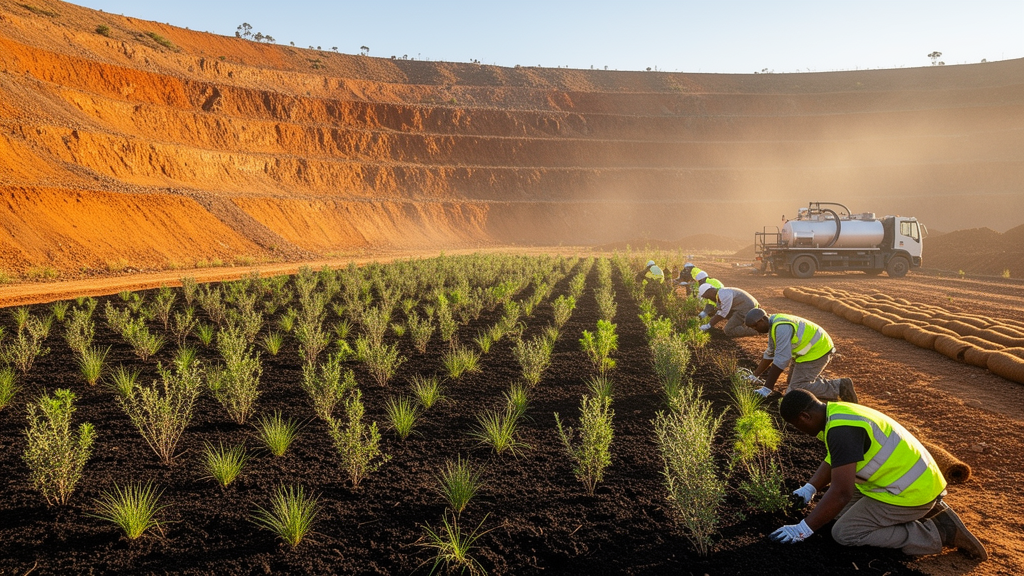
Across South Africa’s goldfields, platinum belts and strip-mined terrain, rehabilitation has long been treated as a compliance exercise: reshape the land, spread some soil, plant vegetation, and walk away. A new systematic review argues that this static model is failing, and that mine rehabilitation should instead be reframed as a continuous process of learning, monitoring and adjustment — an approach known as adaptive ecological restoration.
The distinction between rehabilitation and restoration matters more than it might first appear. Rehabilitation, as traditionally practiced in the mining sector, tends to emphasize physical stability and regulatory sign-off: slopes are reshaped, topsoil is replaced, and vegetation cover is established to meet closure criteria. Restoration, by contrast, carries the ambition of recovering ecological function — nutrient cycling, hydrological regulation, habitat structure, and the return of native species assemblages. The systematic review, published in Frontiers in Sustainable Resource Management by researchers at the University of the Free State, Copperbelt University and Emeris, situates itself within this broader shift, arguing that even ambitious restoration targets will fall short if the process itself remains rigid and one-directional.
The review’s methodology reflects the growing maturity of this field of inquiry. The authors searched Google Scholar, Scopus and Web of Science for peer-reviewed publications issued between 2000 and 2025, using search terms that included adaptive ecological restoration, adaptive management, mine rehabilitation, mine closure, ecological restoration and post-mining landscapes. After applying predefined inclusion and exclusion criteria, they synthesized the resulting studies both thematically and chronologically, an approach that allowed them to trace not just what the literature says but how its emphasis has shifted over a quarter of a century.
That chronological analysis yielded a three-phase narrative. In the earliest phase, scholarship concentrated on ecological resilience and the theory of adaptive management, borrowing concepts from systems ecology that had been developed to explain how ecosystems absorb disturbance and reorganize. A transitional phase followed, in which researchers began to integrate social-ecological systems thinking and environmental governance into restoration debates, recognizing that mined landscapes are shaped as much by institutions, livelihoods and land-use conflicts as by soil chemistry or seed availability. The contemporary phase, according to the review, is characterized by stakeholder-inclusive, ecosystem-based and climate-responsive strategies — a vocabulary that signals restoration’s entanglement with climate adaptation, community rights and landscape-scale planning.
From this synthesis the authors distill a set of core principles that recur across the literature: long-term monitoring, iterative decision-making, ecosystem resilience, community participation and integrated environmental governance. Each of these challenges a familiar weakness of conventional mine closure. Monitoring, for instance, is often truncated shortly after closure certificates are issued, yet ecological trajectories on mined land can take decades to reveal whether recovery is genuine or merely cosmetic. Iterative decision-making implies that closure plans should be treated as hypotheses to be tested and revised, not blueprints to be executed without amendment. Community participation acknowledges that post-mining land uses — grazing, conservation, agriculture, or renewable energy installations — depend on the people who will live with the consequences long after mining companies have departed.
The South African context gives these abstractions particular urgency. Mining contributes substantially to the national economy, but it is also associated with enduring environmental risks, including the contamination and degradation of water resources. Acid mine drainage on the Witwatersrand, the salinization of catchments in coal-mining regions, and the dust and instability of unrehabiliated tailings dumps illustrate how mining legacies can outlast the operations that created them. The country has, on paper, one of the more comprehensive regulatory frameworks for mine rehabilitation, requiring financial provisioning and closure planning, yet the gap between regulatory intent and ecological outcome remains a persistent concern. The review’s authors argue that adaptive approaches could help close that gap by embedding learning and flexibility into the way closure obligations are designed, financed and audited.
To make this concrete, the review presents illustrative South African practice vignettes showing how adaptive restoration principles might be operationalised in post-mining landscapes. While the vignettes are presented as demonstrations rather than exhaustive case studies, they point toward a style of practice in which monitoring data feed directly back into management decisions, and in which local communities and other stakeholders participate in setting and revising restoration goals. This is a departure from the linear model in which a closure plan is drafted at the start of a mine’s life and implemented, largely unchanged, at its end.
The timing of the review is significant. The United Nations Decade on Ecosystem Restoration, running from 2021 to 2030, has positioned restoration as a central strategy for addressing climate change, land degradation and biodiversity loss, and has raised expectations that degraded landscapes — including those scarred by extraction — can be returned to productive ecological function. Yet the review’s authors note a sobering reality: despite widespread enthusiasm for restoration, most ecosystem restoration initiatives have underperformed, failed outright, or been burdened by costs that prevent them from being scaled up. If restoration is to become a core sustainability strategy, they argue, both its effectiveness and its cost-efficiency must improve substantially. Adaptive restoration is offered as one route to that improvement, precisely because it builds feedback and correction into the process rather than discovering failures only when it is too late to fix them.
The review also connects its argument to the United Nations Sustainable Development Goals, particularly SDG 6 on clean water and sanitation, SDG 13 on climate action, SDG 15 on life on land, and SDG 17 on partnerships for the goals. This framing is more than rhetorical. Mined landscapes are described in the review as characterized by long-term ecological degradation, hydrological instability and social-ecological vulnerability — conditions that intersect directly with water security, climate resilience and rural livelihoods. Treating rehabilitation as an adaptive, learning-oriented process is presented as a way of aligning mine closure practice with these broader development commitments rather than treating it as an isolated regulatory obligation.
One of the intellectual contributions of the review is its diagnosis of conceptual inconsistency. Although the term adaptive restoration has gained prominence in restoration scholarship over the past decade, the authors find considerable ambiguity in how it is used and an absence of a clearly articulated research agenda. By mapping the field’s evolution and specifying drivers, key components and practical pathways, the review attempts to give the concept a more integrated framework — a step the authors regard as necessary both for responding to large-scale mining degradation and for clarifying what adaptive ecological restoration actually entails in practice.
For South Africa’s mining sector, the implications are substantial. Adaptive restoration would require closure plans that anticipate revision, monitoring regimes that extend well beyond current norms, governance arrangements that bring regulators, companies, communities and scientists into ongoing dialogue, and financial instruments capable of funding decades of iterative management. It would also demand a cultural shift within an industry accustomed to engineering-led, compliance-driven approaches. The review does not claim that adaptive restoration is a panacea; rather, it positions the approach as a robust governance and learning framework for operating under uncertainty — an acknowledgment that the ecosystems being restored are dynamic, that climate conditions are changing, and that the knowledge available at the moment of closure planning will always be incomplete.
What emerges from the synthesis is a vision of the post-mining landscape not as a finished product but as an ongoing project: one in which ecological trajectories are monitored, management actions are adjusted in light of evidence, and the people who inherit the land are partners in its recovery. Whether that vision can be translated into regulatory requirements, financial provisioning and on-the-ground practice in South Africa and other mining-dependent regions remains an open question — but the review makes a compelling case that the static model of rehabilitation is no longer adequate to the task.
Subject of Research: Adaptive ecological restoration as a framework for mine rehabilitation in South Africa
Article Title: Reframing mine rehabilitation: a systematic review of adaptive ecological restoration, with special reference to the implications for South Africa's mined landscapes
Article References: Korie, D. N., Nkhata, B. A., Schoeman, Y., Nyirenda, V. R., & Downsborough, L. (2026). Reframing mine rehabilitation: a systematic review of adaptive ecological restoration, with special reference to the implications for South Africa's mined landscapes. Frontiers in Sustainable Resource Management, 5, Article 1929799. https://doi.org/10.3389/fsrma.2026.1929799
Image Credits: AI Generated
DOI: 10.3389/fsrma.2026.1929799
Keywords: adaptive restoration, mine rehabilitation, ecological restoration, South Africa, resilience, social-ecological systems, mine closure, adaptive management, post-mining landscapes, environmental governance, systematic review, ecosystem services
Cite Scienmag News
Gavin Prescott. (October 16, 2026). Adaptive Restoration Could Rewrite the Future of South Africa’s Mined Landscapes. Scienmag. https://scienmag.com/adaptive-restoration-could-rewrite-the-future-of-south-africas-mined-landscapes/
Gavin Prescott. "Adaptive Restoration Could Rewrite the Future of South Africa’s Mined Landscapes." Scienmag, 16 October 2026, https://scienmag.com/adaptive-restoration-could-rewrite-the-future-of-south-africas-mined-landscapes/. Accessed 16 October 2026.
Gavin Prescott. "Adaptive Restoration Could Rewrite the Future of South Africa’s Mined Landscapes." Scienmag. October 16, 2026. https://scienmag.com/adaptive-restoration-could-rewrite-the-future-of-south-africas-mined-landscapes/


