


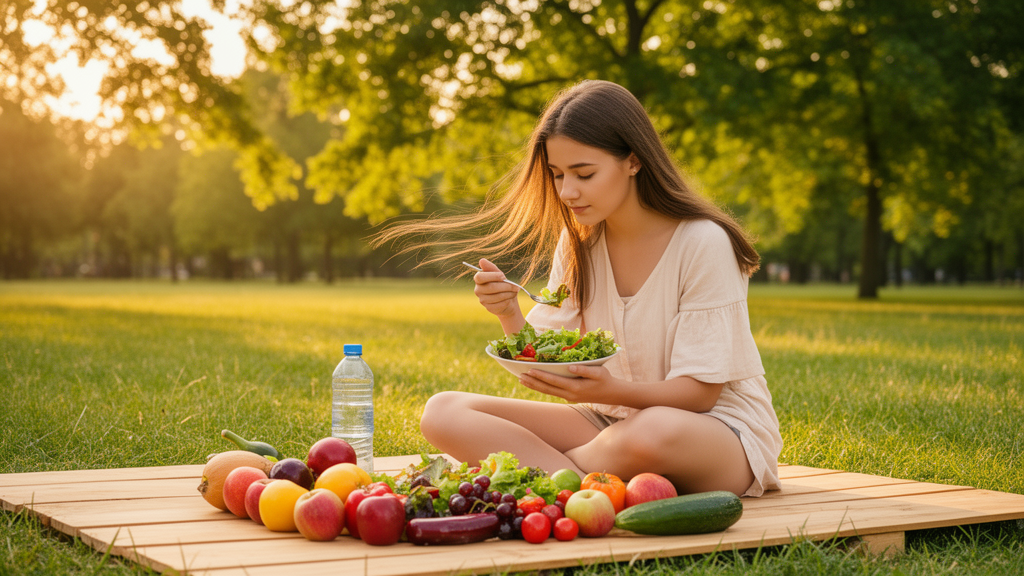
A walk in the park may do more than lift your mood. New research from Anglia Ruskin University suggests that spending time in natural environments, and even simply noticing nature in everyday life, is associated with healthier eating habits. The study, published in the journal Body Image, is the first to provide evidence that contact with the natural world can influence people’s relationship with food, offering a surprising new dimension to the well-documented health benefits of green space.
The research team, led by Professor Viren Swami, Professor of Social Psychology at Anglia Ruskin University in Cambridge, surveyed 500 adults in the United Kingdom. Participants were assessed on their individual levels of contact with nature, including how much they noticed nature during their daily routines and how frequently, and for how long, they spent time in natural environments. They also completed questionnaires measuring body image, self-compassion, connectedness to nature and intuitive eating.
Intuitive eating is an anti-dieting approach that focuses on listening to the body’s internal signals of hunger and fullness rather than following strict external eating rules. Rather than counting calories or categorising foods as forbidden, intuitive eaters trust their physiological cues and choose foods that satisfy their body’s actual needs. The concept has attracted growing interest from researchers because restrictive dieting is associated with poor long-term outcomes, while intuitive eating has been linked to psychological wellbeing and more stable eating patterns.
The findings revealed a direct positive relationship between nature contact and intuitive eating: the more contact people had with natural environments, the more likely they were to eat intuitively. However, the study found that indirect pathways involving other psychological factors were even more important than this direct association, pointing to the mechanisms through which nature appears to shape eating behaviour.
The first pathway ran through body appreciation. The researchers suggest that contact with nature helps people feel more comfortable in their bodies, more appreciative of what their bodies can do, and more responsive to their bodies’ needs. This heightened body appreciation, in turn, was associated with higher levels of intuitive eating. In other words, people who spent more time engaging with the natural world tended to value their bodies more, and that appreciation appeared to translate into eating habits guided by internal signals rather than external rules.
The second pathway involved self-compassion. Greater nature contact was linked to higher levels of self-compassion, and the researchers believe this psychological resource provides a buffer against responding to difficult thoughts and emotions through impulsive eating. Instead of reaching for food as a coping mechanism during moments of stress or negative self-judgement, people with greater self-compassion may be more inclined to follow their body’s signals and choose foods that better meet their physiological needs.
These mechanisms fit within a broader body of research on the psychological benefits of nature exposure. Previous studies have shown that contact with natural environments can reduce anxiety and depression and improve various measures of wellbeing, including life satisfaction. Attention restoration theory proposes that natural settings replenish depleted cognitive resources, while stress reduction frameworks suggest that green and blue spaces lower physiological arousal. The new findings extend this literature by suggesting that these benefits may ripple outward into domains as specific as eating behaviour, mediated by how people feel about their bodies and how kindly they treat themselves.
Lead author Viren Swami said the findings are important because they provide the first evidence that contact with nature may shape people’s eating habits. He noted that the new study is the first to show how nature can influence eating habits, by helping people develop more positive relationships with their bodies and greater self-compassion, and that these findings could have practical benefits for public health professionals.
The researchers acknowledge limitations in the study, particularly its reliance on self-reported data, which can be influenced by memory biases and social desirability. Because the study measured participants at a single point in time, it also cannot establish whether nature contact causes healthier eating habits or whether people who eat intuitively are simply more likely to seek out nature. Further studies in other countries are needed to test whether the associations hold across different cultures, climates and patterns of access to green space.
Even with those caveats, the initial results suggest that greater access to and engagement with nature could support public health efforts to promote healthier, more sustainable eating behaviours. If future experimental research confirms the pathways identified here, prescribing time in green spaces could become a complementary tool alongside nutrition education, one that works not by imposing dietary rules but by strengthening the psychological foundations, body appreciation and self-compassion, on which intuitive eating depends.
The connection between nature and eating behaviour sits within a growing field of research sometimes described as the nature–wellbeing literature, which has expanded rapidly over the past two decades. Much of this work has focused on measurable outcomes such as reduced rumination, lower levels of the stress hormone cortisol, and improved mood after walks in green settings. What distinguishes the new study is its focus on a behaviour that is not typically associated with the outdoors. Eating is usually studied in the context of kitchens, restaurants, food advertising and dieting culture, so the idea that the natural environment might shape it represents a notable widening of the field.
Body appreciation, one of the two mediating pathways identified in the study, is itself an established predictor of intuitive eating in prior research. People who evaluate their bodies positively, focusing on function and gratitude rather than appearance, tend to be less driven by external dietary rules and more attuned to hunger and satiety cues. The suggestion that nature contact might feed into this psychological resource is consistent with earlier findings that exposure to natural settings can reduce appearance-focused thinking. Some researchers have argued that natural environments draw attention outward, toward surroundings rather than the self, which may temporarily interrupt the self-scrutiny that fuels body dissatisfaction.
The self-compassion pathway is similarly grounded in existing psychology. Self-compassion, defined as treating oneself with kindness during moments of failure or distress, has repeatedly been associated with less emotional eating and fewer episodes of loss-of-control eating. Emotional eating is often understood as an attempt to regulate unpleasant feelings through palatable food, and interventions that strengthen self-compassion have shown promise in reducing this pattern. If nature contact genuinely fosters self-compassion, as the study’s findings suggest, it could offer a low-cost, accessible route to supporting people who struggle with impulsive eating.
The study’s reliance on cross-sectional data means the direction of the associations remains open. It is plausible that the relationship runs in both directions. People who feel comfortable in their bodies and eat intuitively may find it easier to spend time outdoors, unburdened by the self-consciousness that can make public spaces feel threatening. Longitudinal designs, which follow participants over time, and experimental studies that assign people to nature exposure or control conditions would help clarify whether nature contact actively improves eating behaviour or simply correlates with it.
There are also practical questions about dosage and setting. The study measured everyday nature contact, including noticing nature during routine activities, which suggests that even small doses, such as tending plants, walking through a park or pausing to observe trees on a commute, may contribute. However, the researchers did not report whether wilder or more biodiverse environments produce stronger effects than manicured urban greenery, an issue that has divided researchers in related work on green space and mental health. Access is another consideration. In many countries, proximity to parks and green space is unevenly distributed, with lower-income neighbourhoods often having less and poorer-quality green infrastructure, which could mean that any nature-based public health strategy would need to address inequities in access.
The UK sample also raises questions about generalisability. Attitudes toward nature, patterns of outdoor recreation and cultural norms around food and body image vary considerably across countries. In some cultures, meals are strongly shaped by social and family structures that may interact differently with the psychological pathways identified here. Testing the model in countries with different climates, urban forms and dietary traditions would be an important next step, as the authors themselves acknowledge.
For public health professionals, the appeal of the findings lies in their potential complementarity with existing approaches. Nutrition education and dietary guidance often struggle to produce lasting behaviour change, partly because rigid rules can undermine the internal regulation they aim to support. Intuitive eating, by contrast, emphasises trust in the body’s own signals, and the new research suggests that the psychological conditions for that trust, body appreciation and self-compassion, may be cultivable through engagement with the natural world. If confirmed, this would position green space not merely as a venue for physical activity but as an environment that shapes how people relate to their bodies and, by extension, to food.
The study also adds to a broader conversation about how urban planning, mental health and nutrition policy intersect. Green prescriptions, in which health professionals encourage patients to spend time in nature, are already being trialled in several countries for conditions ranging from anxiety to hypertension. The new findings suggest that such schemes could carry benefits beyond mood and physical activity, potentially reaching eating behaviour through the psychological mechanisms the researchers identified. Whether these effects are large enough to matter at a population scale remains to be established, but the study opens a line of inquiry that connects two domains, environmental exposure and eating behaviour, that have rarely been examined together.
Subject of Research: The relationship between contact with natural environments and intuitive eating, mediated by body appreciation and self-compassion
Article Title: Contact with nature is linked to healthy eating
Article References: Contact with nature is linked to healthy eating. (n.d.). Original publication
Image Credits: AI Generated
DOI: Not provided
Keywords: nature contact, intuitive eating, body image, body appreciation, self-compassion, eating behaviour, public health, green space, mental wellbeing, Anglia Ruskin University, Body Image journal, UK adults
Cite Scienmag News
Glenn Wilkins. (October 16, 2026). Time in Nature Is Linked to Healthier Eating Habits, Study Finds. Scienmag. https://scienmag.com/time-in-nature-is-linked-to-healthier-eating-habits-study-finds/
Glenn Wilkins. "Time in Nature Is Linked to Healthier Eating Habits, Study Finds." Scienmag, 16 October 2026, https://scienmag.com/time-in-nature-is-linked-to-healthier-eating-habits-study-finds/. Accessed 16 October 2026.
Glenn Wilkins. "Time in Nature Is Linked to Healthier Eating Habits, Study Finds." Scienmag. October 16, 2026. https://scienmag.com/time-in-nature-is-linked-to-healthier-eating-habits-study-finds/


