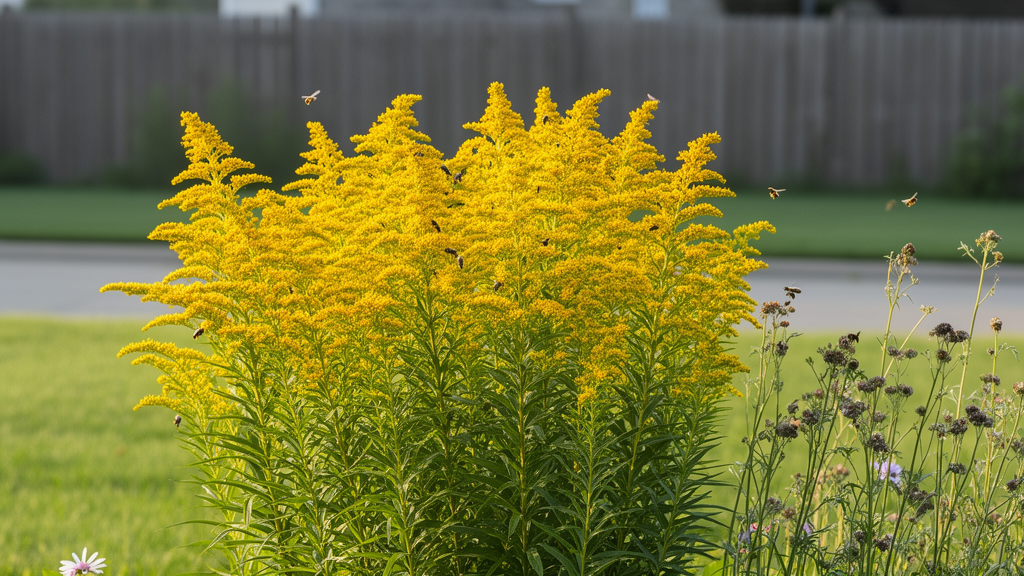
A late-summer spectacle familiar across Central Europe — dense stands of Canadian goldenrod glowing yellow at the field edge — is doing more than feeding hungry honey bees. New research published in the journal NeoBiota shows that when the invasive Solidago canadensis reaches local dominance in suburban habitats, it visibly reorganizes which pollinators show up at flowers, boosting honey bees and hoverflies while thinning out wild bees and butterflies. Crucially, the study captured this shift at an intermediate stage of invasion, before the goldenrod had swallowed the entire landscape mosaic.
Canadian goldenrod arrived in Europe in the seventeenth century as an ornamental garden plant and has since spread from Spain to Scandinavia and from northern Italy deep into Eastern Europe. It is now regarded as one of the continent’s most aggressive invasive plants. The species thrives in human-altered habitats, forming extensive, dense stands that displace native flora through rapid growth, vast numbers of light wind-dispersed seeds, easy vegetative reproduction, tolerance of a wide range of conditions, and the absence of natural enemies outside its native range. Allelopathic chemicals that suppress neighboring plants may add to its competitive arsenal.
For pollinators, goldenrod presents a paradox. On one hand, its mass flowering late in the season delivers a flood of nectar and pollen at a time when most other blooms have faded, potentially extending the foraging window for honey bee colonies preparing for winter. On the other hand, invasive plants can disrupt plant-pollinator mutualisms and simplify plant communities, narrowing the dietary options available to insects that depend on complementary resources across their life cycles. Whether goldenrod acts as a seasonal lifeline or an ecological trap depends heavily on which pollinators are considered — a question the new study set out to answer directly.
Researchers working in the metropolitan area of Poznań in western Poland selected twenty sites of ruderal vegetation, each dominated or co-dominated by goldenrod, with cover ranging from thirty percent to nearly complete. Within 200 meters of each goldenrod stand, they established a paired control plot of diverse non-goldenrod vegetation, so that both plots sat inside the same suburban landscape already containing the invader. This design defines what the authors call an intermediate stage of invasion: goldenrod dominates focal patches, but heterogeneous co-flowering vegetation persists nearby. Across two flowering seasons in August and September, the team netted pollinators for twenty minutes per plot per visit, sampling each site three times per season under standardized warm, sunny conditions.
The haul was substantial: 1,245 pollinators representing 63 species across wild bees, butterflies, and hoverflies. Honey bees dominated numerically, accounting for 66 percent of all individuals, with 577 recorded in goldenrod plots versus 254 in controls. The white butterfly Pieris rapae and the drone fly Eristalis tenax followed far behind. Among wild bees, the red-tailed bumblebee Bombus lapidarius, the common carder bee Bombus pascuorum, and the mining bee Colletes similis led the counts. Notably, the survey also documented six taxa from the Polish Red List, including the vulnerable bumblebee Bombus veteranus, and Halictus scabiosae, a species first recorded in Poland only shortly before the study began.
Statistical analysis revealed a clear compositional divide. Non-metric multidimensional scaling of community data separated goldenrod plots from control plots, a result confirmed by permutational analysis of variance that attributed roughly nineteen percent of compositional variation to plot type. Twenty-six species appeared in both plot types, but nineteen were recorded only in goldenrod stands and eighteen only in the diverse control vegetation. The goldenrod-only species included several small ground-nesting sweat bees of the genus Lasioglossum and their cleptoparasites in the genus Sphecodes, while control plots hosted a few Asteraceae specialists such as the mason bee Osmia spinulosa and the plasterer bee Colletes daviesanus.
The group-specific responses were striking. Honey bee abundance rose sharply in goldenrod plots and increased further with the proportion of goldenrod cover at each site, consistent with a resource-concentration effect comparable to the way honey bees exploit mass-flowering crops. Hoverflies also became more abundant in goldenrod stands, echoing earlier European studies, likely reflecting their flexible adult foraging and larval independence from living plants. Wild bees, by contrast, were significantly less abundant in goldenrod plots even though their species richness and Shannon diversity remained statistically unchanged — a pattern suggesting reduced patch use rather than outright local extinction. Butterflies fared worst, with both abundance and species richness significantly lower in goldenrod-dominated vegetation, plausibly because dense near-monospecific stands lack the larval host plants and structural heterogeneity butterflies need across life stages.
Perhaps the most intriguing finding was a reversal in the relationship between honey bees and wild bees depending on habitat context. In control plots, honey bee abundance and wild bee metrics rose together; in goldenrod plots, the association turned negative. This context-dependent co-occurrence suggests that flowering goldenrod alters local patterns of pollinator interaction around concentrated floral resources, although the authors caution that observational data cannot distinguish direct competition from differential attraction to contrasting patch types. Urbanization, measured as impervious surface area within 250 meters using Copernicus satellite data, showed no consistent main effects, and site-level goldenrod cover predicted only honey bee abundance, not the metrics of any wild group.
The authors frame these results as evidence of community reassembly rather than uniform decline. Goldenrod dominance redistributes pollinator activity among floral patches, concentrating managed and generalist visitors while underrepresenting guilds with more specialized requirements. Because sampling captured only the late-season flowering pulse, the study cannot assess whether goldenrod’s displacement of diverse earlier-season blooms creates net forage imbalances across the full beekeeping season — a concern raised by prior laboratory work showing reduced bee survival on goldenrod-dominant honey diets. The findings also stop short of demonstrating population-level consequences, since flower-visitation data reflect local activity rather than demographic performance.
For conservation, the message is practical. Retaining and restoring floristically diverse late-season vegetation within suburban mosaics may prevent the biotic homogenization that could follow if goldenrod progressively replaces heterogeneous plant communities. Because the invader can continue expanding if unmanaged, the window in which contrasting floral patches coexist — the very intermediate stage this study documented — may be the most valuable moment for intervention, sustaining pollinator diversity before landscape saturation locks in a simplified late-summer flora.
Subject of Research: Effects of invasive Canadian goldenrod flowering on pollinator community composition in suburban landscapes
Article Title: Flowering Solidago canadensis restructures pollinator patch use and assemblage composition at an intermediate stage of invasion in urbanizing landscapes
Article References: Flowering Solidago canadensis restructures pollinator patch use and assemblage composition at an intermediate stage of invasion in urbanizing landscapes. (n.d.). https://doi.org/10.3897/neobiota.109.191683
Image Credits: AI Generated
DOI: 10.3897/neobiota.109.191683
Keywords: invasive species, Solidago canadensis, pollinators, wild bees, honey bees, butterflies, hoverflies, urbanization, biodiversity, community composition, NeoBiota, Poland
Cite Scienmag News
Julie Wynn. (October 16, 2026). Invasive goldenrod reshuffles pollinator communities in suburban landscapes, study finds. Scienmag. https://scienmag.com/invasive-goldenrod-reshuffles-pollinator-communities-in-suburban-landscapes-study-finds/
Julie Wynn. "Invasive goldenrod reshuffles pollinator communities in suburban landscapes, study finds." Scienmag, 16 October 2026, https://scienmag.com/invasive-goldenrod-reshuffles-pollinator-communities-in-suburban-landscapes-study-finds/. Accessed 16 October 2026.
Julie Wynn. "Invasive goldenrod reshuffles pollinator communities in suburban landscapes, study finds." Scienmag. October 16, 2026. https://scienmag.com/invasive-goldenrod-reshuffles-pollinator-communities-in-suburban-landscapes-study-finds/