


Every day, the human brain performs thousands of invisible gear changes. When you shift from drafting an email to answering a phone call, or from reading a recipe to checking the oven timer, your mind must abandon one set of rules and adopt another within a fraction of a second. Psychologists call this capacity cognitive flexibility, and it is considered one of the core executive functions alongside inhibition and working memory updating. Despite decades of research, however, the neural signature of this ability has remained surprisingly elusive, particularly when it comes to measuring how flexibly an individual brain actually operates. A new study published in Communications Psychology by Mareike Hülsemann, Christoph Löffler, and Anna-Lena Schubert of Johannes Gutenberg University Mainz now offers what may be the clearest electrophysiological picture yet of what happens in the brain when it switches mental sets, and the findings challenge several long-standing assumptions about how flexibility relates to intelligence.
The research team recruited 148 adults from the general population, ranging in age from 18 to 60, and recorded their brain activity with electroencephalography across three separate laboratory sessions spaced three months apart. Participants completed three distinct cued task-switching paradigms. In the parity/magnitude task, they classified single digits as odd or even, or as smaller or larger than five, depending on the color of a fixation cross. In the global/local task, they judged either the overall shape of a compound geometric figure or the small elements composing it. In the number/letter task, they evaluated either the numeric or the alphabetic member of a character pair. Because the cue announcing which rule to apply appeared 800 to 1200 milliseconds before the target stimulus, the design allowed the researchers to cleanly separate endogenous preparation, the internal act of getting ready to switch, from exogenous implementation, the actual execution of the new rule once the target arrives.
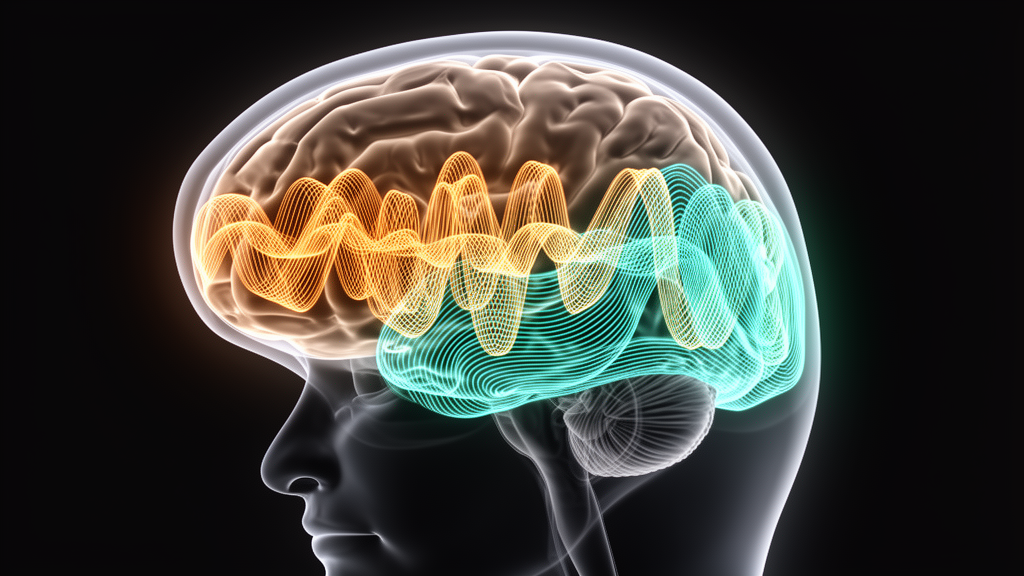
Rather than preselecting frequency bands and electrode sites as most previous studies have done, the team employed a data-driven mass-univariate approach spanning the entire scalp, frequencies from 3 to 60 Hertz, and the full time course of each trial. They contrasted switch trials, which required a change of rule set, with repeat trials, which did not, and used cluster-based permutation testing to identify statistically robust differences. Two distinct oscillatory signatures emerged. The first was a transient increase in theta power, roughly 4 to 8 Hertz, over frontal regions beginning a few hundred milliseconds after the cue. The second was a sustained suppression of alpha and beta power, roughly 8 to 30 Hertz, centered over left lateral parietal cortex, which appeared within 100 to 200 milliseconds of cue onset and persisted through target processing.
Both effects were stronger on switch trials than on repeat trials, confirming that they track the additional cognitive demands imposed by rule changes. But the two signatures told very different stories when the researchers probed their individual-difference properties. Using latent change structural equation modeling, a statistical technique that extracts the difference between switch and repeat conditions at the latent level while correcting for measurement error, the team tested whether each oscillatory effect reflected a common flexibility factor generalizing across all three tasks. The frontal theta effect, despite appearing in every task, showed no significant shared variance across tasks. Its variance was statistically indistinguishable from zero, and a constrained model with the flexibility factor fixed to zero fit the data nearly five times better according to Akaike weights. In other words, theta enhancement appears to index task-specific control processes, tailored to the particular demands of each switching paradigm, rather than a general capacity for flexibility.
The alpha/beta suppression, by contrast, behaved like a true trait marker. Cue-related and target-related alpha/beta effects each loaded significantly onto a latent flexibility factor spanning all three tasks, with excellent reliabilities of 0.95 or higher. When the two models were combined, the cue-related and target-related flexibility factors correlated at r = 0.98, sharing 96 percent of their variance, suggesting they tap the same underlying construct. This sustained suppression, the authors argue, reflects domain-general attentional reconfiguration: the reallocation of attentional resources that begins the moment a cue signals a rule change and must be maintained until the target has been processed. The pattern lends strong support to two-stage models of task switching, which propose that cues trigger goal-shifting and rule retrieval while targets require stimulus-response mapping, and that the attentional processes initiated during the first stage must remain active through the second.
Perhaps the most striking finding concerns what the neural flexibility measures did not correlate with. Neither the cue-related nor the target-related alpha/beta flexibility factor showed a significant association with fluid intelligence, measured with the Berlin Intelligence Structure Test, or with working memory capacity, assessed with a battery of span and updating tasks. This dissociation is theoretically consequential. Influential frameworks such as process overlap theory posit that domain-general executive functions act as bottlenecks underlying the positive correlations observed across diverse cognitive tasks, and resource-based accounts predict that individuals with greater executive resources should perform better across the board. The present results complicate that picture: flexibility, at least as indexed by alpha/beta suppression, appears to be a neurally coherent dimension that is largely independent of general cognitive ability. The authors caution that their confidence intervals do not exclude small to medium correlations, but the pattern is consistent with prior evidence of a dissociation between flexibility and intelligence.
The study also connected the neural data to behavior in an unexpected way. Using the drift-diffusion model, a computational framework that decomposes reaction time distributions into parameters such as drift rate, the speed of evidence accumulation, and non-decision time, the duration of perceptual and motor processes outside the decision itself, the researchers derived process-based behavioral measures of flexibility. Stronger cue-elicited alpha/beta suppression was associated with smaller switch costs in non-decision time, suggesting that individuals whose brains suppress alpha/beta power more vigorously upon seeing a switch cue prepare their task sets more effectively. Drift rate, by contrast, did not correlate with the neural flexibility measures, indicating that the oscillatory signature captures preparatory attentional processes rather than the efficiency of evidence accumulation itself. This dissociation underscores that neural and behavioral measures of flexibility are not interchangeable operationalizations of the same construct but reflect partially distinct facets of a multi-component ability.
Methodologically, the study sets a new standard for individual-differences research in cognitive neuroscience. The authors note that the reliability of neural flexibility measures has received insufficient attention in the field, despite reliability being a prerequisite for valid individual-differences research. Raw difference scores between switch and repeat conditions proved poorly reliable, ranging from 0.00 to 0.10 for theta and 0.35 to 0.53 for alpha/beta, which would have doomed any correlational analysis. The latent change score framework circumvented this problem by modeling change as a latent variable, partitioning true score variance from measurement error. Combined with the large sample, the three-month test-retest design, and the use of three distinct tasks to eliminate task-specific confounds such as processing speed and stimulus familiarity, the approach provides a template for how oscillatory brain measures can be validated as meaningful psychological constructs.
The findings also carry clinical relevance. Reduced cognitive flexibility characterizes numerous conditions, including schizophrenia, depression, and autism spectrum disorder, and individual differences in flexibility predict academic achievement, problem-solving ability, and mental health outcomes. If alpha/beta suppression proves to be a reliable neural marker of domain-general flexibility, it could eventually inform the assessment of cognitive control capacities, the development of targeted interventions, and the understanding of why some individuals adapt readily to changing demands while others struggle. The authors emphasize, however, that their operationalization captures goal-directed set shifting within the task-cueing paradigm and may not encompass broader, more ecologically valid forms of flexibility such as those assessed by the Wisconsin Card Sorting Test.
Limitations remain. The 32-electrode montage lacks the spatial resolution to precisely localize effects, the 3 to 60 Hertz analysis window excluded higher gamma activity, and the central stimulus presentation precluded examination of lateralized attentional patterns. Cluster-based permutation testing, while controlling false positives, can reduce sensitivity to smaller effects and does not permit exact localization of cluster extent. Future work should test whether alpha/beta suppression generalizes beyond cued task switching using broader cognitive batteries and higher-density recordings. Nevertheless, the core conclusion stands: the brain’s oscillatory dynamics offer a measurable window into one of cognition’s most essential capacities, and the sustained dampening of alpha and beta rhythms over parietal cortex may be the most faithful neural echo of the mind changing gears.
Subject of Research: Oscillatory neural signatures of cognitive flexibility in cued task switching
Article Title: Task-specific theta enhancement and domain-general alpha/beta suppression as oscillatory signatures of cognitive flexibility
Article References: Hülsemann, M., Löffler, C., & Schubert, A.-L. (2026). Task-specific theta enhancement and domain-general alpha/beta suppression as oscillatory signatures of cognitive flexibility. Communications Psychology, 4(1), Article 140. https://doi.org/10.1038/s44271-026-00521-9
Image Credits: AI Generated
DOI: 10.1038/s44271-026-00521-9
Keywords: cognitive flexibility, task switching, EEG, theta oscillations, alpha suppression, beta suppression, executive functions, attentional reconfiguration, individual differences, working memory, fluid intelligence, drift-diffusion model
Cite Scienmag News
Cassandra Pierce. (October 16, 2026). Brain Waves Reveal How the Mind Switches Gears: Two Distinct Oscillatory Signatures of Cognitive Flexibility Identified. Scienmag. https://scienmag.com/brain-waves-reveal-how-the-mind-switches-gears-two-distinct-oscillatory-signatures-of-cognitive-flexibility-identified/
Cassandra Pierce. "Brain Waves Reveal How the Mind Switches Gears: Two Distinct Oscillatory Signatures of Cognitive Flexibility Identified." Scienmag, 16 October 2026, https://scienmag.com/brain-waves-reveal-how-the-mind-switches-gears-two-distinct-oscillatory-signatures-of-cognitive-flexibility-identified/. Accessed 16 October 2026.
Cassandra Pierce. "Brain Waves Reveal How the Mind Switches Gears: Two Distinct Oscillatory Signatures of Cognitive Flexibility Identified." Scienmag. October 16, 2026. https://scienmag.com/brain-waves-reveal-how-the-mind-switches-gears-two-distinct-oscillatory-signatures-of-cognitive-flexibility-identified/


