


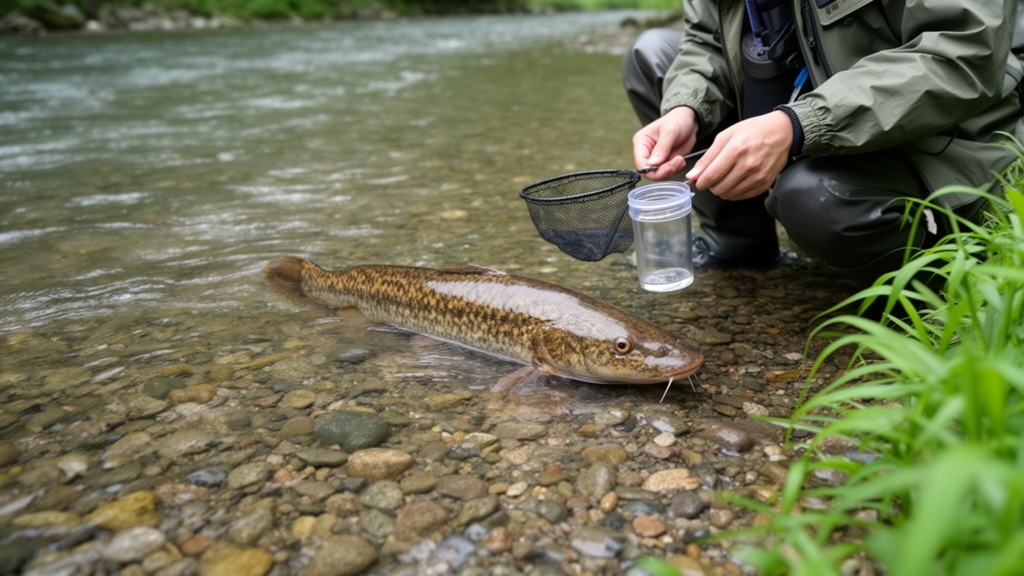
On a cold December day in 2025, researchers hauling baited traps from a river in Goseong-gun, Gangwon-do, on South Korea’s northeastern coast, pulled out loaches that did not quite fit. The fish looked superficially like the weather loaches already known from the peninsula, but something about their proportions was off: the bodies were longer, the tails slimmer, the whole silhouette more elongated than any Misgurnus previously documented in South Korean waters. A new study in Acta Ichthyologica et Piscatoria now confirms what those suspicious proportions hinted at. The specimens belong to Misgurnus mohoity, the snake weatherfish, a species never before recorded from the Korean Peninsula.
The discovery matters because the genus Misgurnus has long been a taxonomic headache. These freshwater loaches, distributed across Europe and East Asia, are defined by a slender body, three pairs of maxillary barbels, a suborbital spine hidden beneath the muscles, a rounded caudal fin edge, and the absence of a regular row of spots. Ten valid species are currently recognized worldwide, but the group is notoriously unstable, with persistent controversies driven by identification errors rooted in morphological variation tied to sex, life history, and environment. Recent revisions in China, Russia, and Japan have described new species such as M. nikolskyi, M. chipisaniensis, and M. amamianus, often relying on geometric morphometrics alongside traditional counts and measurements to untangle cryptic relatives.
Against that backdrop, the Korean Peninsula had seemed comparatively simple. Only three Misgurnus species had ever been reported there: M. dabryanus and M. anguillicaudatus in South Korea, and M. buphoensis in the lower reaches of the Tumen River in North Korea. Yet Russian studies had repeatedly suggested that unrecorded species might lurk on the peninsula, a hypothesis tied to biogeographical connections between Korean waters and the Amur River drainage, northeastern Mongolia, northeastern China, and the upper reaches of the Liao River. The Goseong specimens provide the first specimen-based confirmation of that prediction, specifically validating the view of Perdices and colleagues, who treated M. bipartitus as a junior synonym of M. mohoity and proposed a distribution stretching from the Amur basin and northeastern China down to Korea.
The evidence rests on 61 specimens representing two species. Twenty-two of the suspicious loaches came from Goseong-gun, while 39 reference specimens of M. anguillicaudatus were collected from Eumseong-gun, Iksan-si, Sinan-gun, and Jeju-do. All fish were captured with baited traps and hand nets, anesthetized with MS-222 before fixation to minimize distress and physical distortion, preserved in 10% neutral formalin and then 70% ethanol, with pelvic fin clips fixed in 99.5% ethanol for genetics. To avoid growth-related morphological noise and account for secondary sexual characteristics, only specimens of at least 70 millimeters standard length were analyzed.
The morphological case is built on a dense battery of measurements and counts. Using digital calipers accurate to 0.01 millimeter, soft X-ray radiographs for fin ray and vertebral counts, and Alizarin Red S staining to reveal the lamina circularis, the team found that the Korean specimens carry 48 to 50 total vertebrae, 19 to 20 caudal vertebrae, and 164 to 180 lateral line scales. Mature males bear a poleaxe-shaped lamina circularis with a shallow neckline at its base, and the fish possess a slender, elongated caudal peduncle with a caudal peduncle length to depth ratio exceeding 1.7 and an LPC/DPA ratio above 1.1. Each of these traits separates the Goseong fish from M. anguillicaudatus, which shows 43 to 46 total vertebrae, 17 to 18 caudal vertebrae, 144 to 161 lateral line scales, a deeper neckline on the lamina circularis, and a stubbier tail. The poleaxe shape itself distinguishes the new arrivals from the narrow, rod-shaped structure of M. mizolepis and the spatula-shaped one of M. buphoensis.
Statistics sharpened the picture. Principal component analysis of standardized morphometric traits split the two species into clusters with minimal overlap, with the first two components accounting for 56.2% of total variance, 41.2% on the first axis and 15.0% on the second. The separation was driven largely by the caudal region: caudal peduncle length, the projected length from the posterior edge of the anal fin base to the base of the caudal fin, and the distance from anal fin origin to caudal fin base loaded positively, defining the slender posterior profile of M. mohoity, while body depth and caudal peduncle depth loaded negatively, marking the deeper-bodied M. anguillicaudatus. Canonical discriminant analysis then achieved complete separation along the first function, and univariate comparisons of the CPL/CPD and LPC/DPA ratios confirmed highly significant differences, with p values below 0.0001.
Genetics sealed the identification. The team amplified the mitochondrial cytochrome b gene with universal primers, sequenced the products, and reconstructed evolutionary relationships by maximum likelihood in MEGA12, selecting the substitution model with the lowest Bayesian Information Criterion and assessing nodal support with 1000 bootstrap replicates. The resulting tree resolved two major monophyletic groups, each with 100% bootstrap support. The Korean specimens clustered tightly within the M. mohoity clade alongside reference sequences from Russia, North Korea, and China, while the indigenous South Korean populations grouped with M. anguillicaudatus from China and Japan. Kimura 2-parameter distances told the same story: the mean interspecific distance between the two species was 10.04%, dwarfing the low intraspecific variation of 1.26% within M. mohoity and 1.16% within M. anguillicaudatus.
The phylogeny also settles a long-running nomenclatural dispute. The Korean M. mohoity clustered with Russian M. mohoity and with Chinese populations recorded as M. bipartitus, genetically supporting the taxonomic view that M. bipartitus is a synonym of M. mohoity. Vasil’eva had concluded through morphological comparisons that the fish called M. bipartitus in Chinese literature is actually M. mohoity, while the species previously misidentified as M. mohoity is in fact the distinct M. nikolskyi. Although both names still circulate interchangeably in some Chinese literature, the new genetic data demonstrate clearly that Chinese records of M. bipartitus correspond taxonomically to M. mohoity.
Biogeography gives the find its deeper resonance. Unlike the M. mohoity population in Tokyo, Japan, which is classified as an alien species introduced as bycatch among loaches imported from China for bait or consumption, the Goseong population is considered indigenous. Its presence reflects the historical connectivity between the Amur River and the Korean Peninsula within a transition zoogeographical zone lacking a major faunal break between the two regions. The established biogeographical division of the peninsula places the northern East Coast, including Goseong, in the East north Korea Subdistrict, a region defined by high faunal affinity with the Amur River system. A single albino individual had been noted in Korea before, but no wild population record existed until now.
The researchers propose a new Korean common name, ga-neun-mi-ggu-ri, meaning roughly the slender weatherfish, in honor of the fish’s most distinctive feature: an elongated body and tail marked by high CPL/CPD and LPC/DPA ratios. Much remains unknown about how widely M. mohoity ranges within the peninsula and by what routes it dispersed southward, and the authors call for follow-up studies to reconstruct its evolutionary and dispersal history in Northeast Asia. For now, the snake weatherfish stands as a quiet reminder that even well-surveyed temperate countries can still harbor unrecorded native species, provided someone looks closely enough at the shape of a tail.
Subject of Research: First record of the weather loach Misgurnus mohoity in South Korea based on morphology and mitochondrial DNA
Article Title: New record of Misgurnus mohoity ( Actinopterygii , Cypriniformes , Cobitidae ) from South Korea
Article References: New record of Misgurnus mohoity ( Actinopterygii , Cypriniformes , Cobitidae ) from South Korea. (n.d.). https://doi.org/10.3897/aiep.56.197412
Image Credits: AI Generated
Keywords: Misgurnus mohoity, weather loach, Cobitidae, South Korea, new record, taxonomy, mitochondrial cytochrome b, phylogenetics, morphometrics, biogeography, Amur River, freshwater fish
Cite Scienmag News
Patricia Pace. (October 16, 2026). A slender new weatherfish slips into South Korea’s fish list. Scienmag. https://scienmag.com/a-slender-new-weatherfish-slips-into-south-koreas-fish-list/
Patricia Pace. "A slender new weatherfish slips into South Korea’s fish list." Scienmag, 16 October 2026, https://scienmag.com/a-slender-new-weatherfish-slips-into-south-koreas-fish-list/. Accessed 16 October 2026.
Patricia Pace. "A slender new weatherfish slips into South Korea’s fish list." Scienmag. October 16, 2026. https://scienmag.com/a-slender-new-weatherfish-slips-into-south-koreas-fish-list/


