


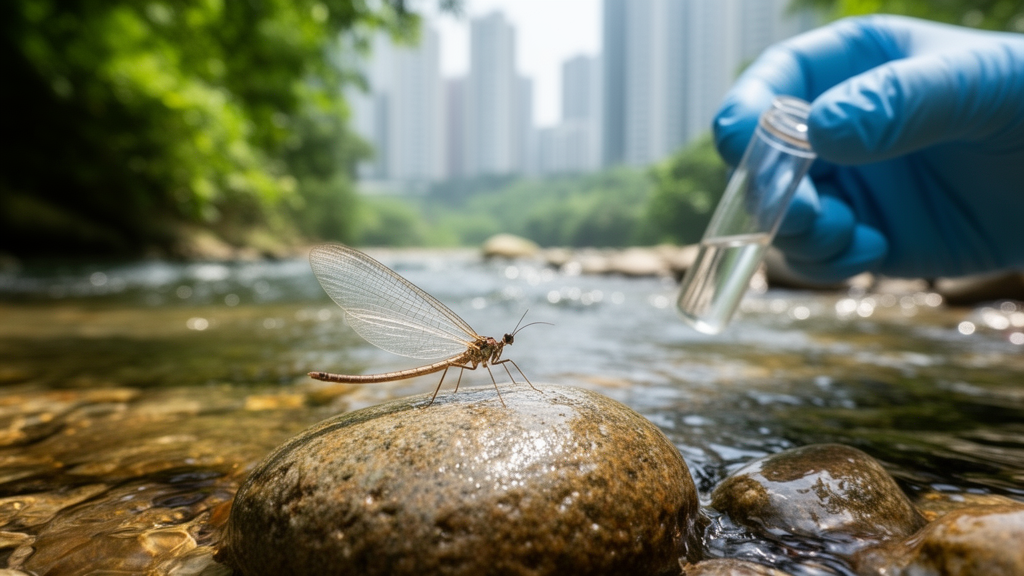
In the steep, subtropical streams that thread through Hong Kong’s country parks, a tiny aquatic insect has become the unlikely star of a major biodiversity breakthrough. Mayflies, the delicate nymphs of which spend most of their lives clinging to streambed stones, have long served as sentinels of freshwater health. Yet until now, no comprehensive DNA barcode reference library existed for the mayflies of Hong Kong or, remarkably, for China as a whole. A new study, published in Metabarcoding and Metagenomics, has changed that, cataloguing the region’s mayfly diversity with molecular precision while simultaneously documenting a sobering pattern of species loss along the city’s urbanization gradient.
The research team, working from the University of Hong Kong’s eDNA & eEcology Lab, sampled 30 stream sites spanning a dramatic natural-to-urbanized gradient within a compact geographic area. Hong Kong is a paradoxical landscape: roughly seven million people are packed into a territory where population density peaks above 57,000 individuals per square kilometre, yet approximately 70 percent of the land remains undeveloped, with 40 percent designated as country parks. This mosaic of high-density urban cores, fragmented agricultural land, rural settlements, and protected woodland creates an ideal natural laboratory for studying how human pressure reshapes freshwater communities.
Fieldwork took place across two sampling campaigns, in September 2022 and November 2023, using a standardized three-minute kick sampling protocol with a 500-micrometre mesh D-frame net swept across all available microhabitats. The effort yielded a staggering 12,155 mayfly nymphs. Initial morphological sorting produced 31 taxonomic groups, but integrative analysis combining dissection of mouthparts, gills, legs, and paraprocts under high magnification with molecular sequencing ultimately resolved 45 distinct morphospecies across 28 genera and six families.
The molecular backbone of the study is the cytochrome c oxidase subunit I gene, the standard 658-base-pair barcode region of the mitochondrial genome. Of 207 specimens selected for DNA extraction, 154 COI sequences were generated, averaging nearly four sequences per morphospecies. When standard Folmer primers failed to amplify certain recalcitrant taxa, the team designed custom mayfly-specific primers, MayF1/R1 and MayF2/R2, which boosted overall amplification success by 21.4 percent and eliminated incomplete sequence traces entirely. The resulting library comprises 146 validated barcodes assigned to 53 Barcode Index Numbers, or BINs, within the Barcode of Life Data System.
The scale of the molecular gap the study fills is striking. Fully 67.3 percent of the BINs generated were new registrations in BOLD, meaning these genetic signatures had never before been documented in any public database. Only 26.4 percent of sequences produced high-confidence matches to existing global records. Before this work, Chinese mayfly accessions accounted for roughly 3.6 percent of the 3,102 Ephemeroptera BINs registered globally; the study alone raised that figure to 5.3 percent. For a region sitting at the heart of one of the planet’s great biodiversity hotspots, the underrepresentation is stark, and it has real consequences for conservation planning, vulnerability assessment, and biogeographic research.
The barcode library also delivered taxonomic surprises. Four new regional species records and seven putative undescribed lineages were identified, expanding Hong Kong’s existing mayfly checklist by 14 percent. Genetic analysis revealed a clean barcoding gap: maximum intraspecific divergence averaged just 1.4 percent, while minimum interspecific divergence averaged 22.4 percent, with no overlap between the two. Three taxa, Bungona fusina, Paegniodes cupulatus, and Isca purpurea, exceeded the conventional 2.2 percent divergence threshold used to flag cryptic diversity, with Isca purpurea showing up to 8.2 percent internal divergence. These deeply divergent lineages, concentrated in country parks such as Tai Lam Wu and Pak Tam, hint at unexplored genetic reservoirs that may warrant urgent protection.
Beyond cataloguing diversity, the study quantified the ecological cost of urbanization. Species richness peaked at 26 taxa in the most pristine sites and fell to zero in the most degraded urban streams. A negative binomial generalized linear model confirmed that richness declined significantly with increasing urban cover (β = –0.308, p = 0.007) and, more powerfully, with rising conductivity (β = –0.427, p = 0.002), a proxy for ionic pollution from urban runoff and wastewater. Elevation showed a marginal negative effect. The conductivity result is particularly telling: even modest increases in dissolved solids appear to impose physiological stress on sensitive mayfly taxa, filtering them out of affected streams and leaving behind simplified, generalist-dominated communities.
Indicator species analysis added ecological texture to the pattern. Choroterpes elliptica HK01, a lineage not yet formally described in the scientific literature, was significantly associated with natural sites, consistent with its delicate filamentous gills and reliance on well-oxygenated, coarse-bottomed headwaters. Two generalist taxa, Tenuibaetis pseudofrequentus and Caenis lubrica, were flagged as indicators of peri-urban habitats, reflecting their broader tolerance for moderate nutrient enrichment and siltation. Caenis lubrica, for instance, possesses operculate gills that shield its respiratory surfaces from fine sediment, an adaptation well suited to transitional environments. Crucially, no species was indicative of urbanized sites, suggesting that intense environmental filtering in these streams exceeds the tolerance thresholds of nearly all mayfly lineages, a signature of biotic homogenization.
The peri-urban zone emerged as a critical buffer in the study’s findings. These moderately disturbed habitats, characterized by low-density residential or agricultural matrices with retained ecological connectivity, supported a distinct assemblage of moderately tolerant species and appear to preserve a substantial fraction of regional biodiversity. Prior research has suggested peri-urban systems can retain 70 to 90 percent of regional taxa, and the Hong Kong data align with that pattern, reinforcing the idea that these transitional landscapes deserve explicit conservation attention rather than being written off as degraded space.
The implications extend well beyond mayflies. The publicly available barcode library, complete with digital micrographs, geographic metadata, and sequence trace files uploaded to BOLD under dataset DS-HKMAYFLY, provides the reference infrastructure needed for environmental DNA metabarcoding, a technique that can detect species from water samples without ever catching an insect. As urban pressures intensify across Hong Kong and the wider Southeast Asian region, where taxonomic expertise is scarce and molecular databases remain fragmented, this curated resource offers a scalable path toward rapid, standardized biodiversity assessment. The study’s authors argue that integrating traditional morphology with molecular methods is essential for accurately reflecting true regional diversity, and their work demonstrates exactly how that integration can be achieved, one barcode at a time, in one of the world’s most densely populated landscapes.
Subject of Research: DNA barcoding of Hong Kong mayflies to build a regional reference library and assess urbanization impacts on freshwater biodiversity
Article Title: The Hong Kong mayfly ( Ephemeroptera ) DNA barcode library: Integrative taxonomy enables regional species inventories and highlights the effect of urbanization on species loss
Article References: Wong, K., Han, W., Zhang, C., Tsang, H. F., Si, Z., Tong, X., & Seymour, M. (2026). The Hong Kong mayfly (Ephemeroptera) DNA barcode library: Integrative taxonomy enables regional species inventories and highlights the effect of urbanization on species loss. Metabarcoding and Metagenomics, 10, Article e199829. https://doi.org/10.3897/mbmg.10.199829
Image Credits: AI Generated
Keywords: mayflies, Ephemeroptera, DNA barcoding, COI, urbanization, freshwater biodiversity, Hong Kong, BOLD, eDNA metabarcoding, integrative taxonomy, indicator species, stream ecology
Cite Scienmag News
Gavin Prescott. (October 16, 2026). DNA Barcodes Reveal Hidden Mayfly Diversity and Urban Decline in Hong Kong Streams. Scienmag. https://scienmag.com/dna-barcodes-reveal-hidden-mayfly-diversity-and-urban-decline-in-hong-kong-streams/
Gavin Prescott. "DNA Barcodes Reveal Hidden Mayfly Diversity and Urban Decline in Hong Kong Streams." Scienmag, 16 October 2026, https://scienmag.com/dna-barcodes-reveal-hidden-mayfly-diversity-and-urban-decline-in-hong-kong-streams/. Accessed 16 October 2026.
Gavin Prescott. "DNA Barcodes Reveal Hidden Mayfly Diversity and Urban Decline in Hong Kong Streams." Scienmag. October 16, 2026. https://scienmag.com/dna-barcodes-reveal-hidden-mayfly-diversity-and-urban-decline-in-hong-kong-streams/


