


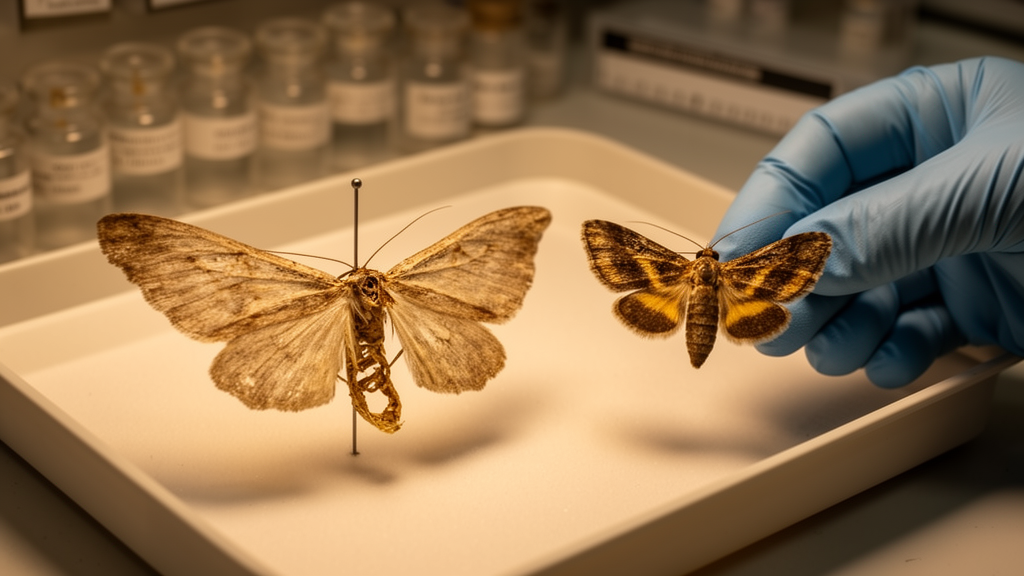
Every moth pinned in a museum drawer is a shadow of the insect that once flew. According to a new study published in Nota Lepidopterologica, drying and other standard preservation procedures strip away so much mass that a prepared specimen retains only about 30 to 40 percent of the body weight it carried when alive. The finding matters because body mass is one of the most ecologically informative traits an insect can offer: it shapes flight performance, metabolic rate, reproductive investment, and the way a species fits into food webs. If researchers treat the weight of a dry specimen as a stand-in for the living animal, they systematically underestimate nearly every quantity that depends on it.
The research team, led by scientists working with laboratory colonies, field collections, and museum material, set out to quantify exactly how much mass is lost at each step of the journey from living moth to labelled drawer specimen. Their answer came in the form of practical correction factors: simple multipliers and equations that allow fresh or live body weight to be reconstructed from dry specimens with surprisingly low uncertainty. For ecologists who depend on century-old collections to track change through time, the work offers a way to make preserved material speak the language of living insects.
Body weight in insects is far more than a number on a balance. It reflects size, physiological condition, and energetic reserves, and it feeds directly into functional traits such as wing loading, which determines how much power an insect must generate to stay airborne. Fresh weight, measured on a living or recently dead animal, is the most informative measure because it captures hydration and lipid content that structural proxies like wing length ignore. Yet fresh weight is rarely recorded in large biodiversity surveys or tropical fieldwork, where logistics favour killing, drying, and pinning specimens for later study. Preserved material has therefore become the primary source of body-mass data in museum-based ecology, despite the distortions that preservation introduces.
The problem begins the moment an insect dies. Water evaporates rapidly from tissues, and small species suffer disproportionately because their high surface-to-volume ratio accelerates desiccation. Drying also causes deeper structural damage: membranous structures collapse, proteins change conformation, and the cuticle itself alters in texture and hydration capacity. Previous work has even shown that drying changes wing length and area in Lepidoptera, biasing morphometric measurements. Rehydration, the standard technique for softening dry specimens before spreading and mounting, restores flexibility but not mass. Most of the moisture regained during rehydration is simply lost again when the specimen is dried for permanent preparation.
To capture the full sequence of mass change, the researchers assembled three complementary datasets, each representing a common workflow. The first came from the laboratory: 81 individuals of the Egyptian cotton leafworm Spodoptera littoralis, reared on artificial diet at the Max Planck Institute for Chemical Ecology in Jena, Germany, and weighed as pupae, as newly emerged live adults, and again after death and ten days of air-drying. The second consisted of 71 freshly collected moths from 13 families, gathered alive in July 2024 at a nature reserve in Thuringia, Germany, and weighed before and after air-drying. The third comprised 30 geometrid moths collected in Peru in 2023, which had been frozen at minus 18 degrees Celsius, shipped to Germany, rehydrated in a humid chamber for 24 hours, mounted, and dried again, mirroring the standard path from fieldwork to museum drawer.
All weighing was done on a precision balance readable to 0.1 milligrams, and the team analysed log-transformed weights with linear mixed-effects models that accounted for repeated measurements of the same individuals. The laboratory dataset revealed how dramatically metamorphosis itself reshapes body mass. Pupae averaged 0.268 grams, but live adults averaged only 0.137 grams, roughly half the pupal figure, reflecting water loss, excretion of meconium, and the shedding of the pupal case during emergence. Drying then cut adult mass by about another 70 percent, leaving dry adults at a mean of just 0.041 grams, roughly 85 percent below pupal weight. Females were consistently heavier than males at every stage, a pattern of sexual size dimorphism well documented across moth lineages, while the presence of eggs had no measurable effect on female mass, consistent with an income-breeding strategy in which resources for egg production are gathered gradually after emergence rather than stored beforehand.
The German field dataset quantified the cost of drying alone. Freshly dead moths, kept in near-saturated humidity overnight to prevent post-mortem desiccation, averaged 0.085 grams, but after ten days of air-drying their mean weight fell to 0.033 grams, a loss of roughly 63 percent of fresh mass. Regression analysis showed a nearly proportional relationship between fresh and dry weight, with a slope close to one and no significant differences among families, meaning a single correction equation describes the drying effect across the taxonomic spectrum sampled. The Peruvian dataset added the museum dimension: rehydration raised specimen weight by about 61 percent above the prepared dry state, but rehydrated moths remained far lighter than their estimated fresh condition. The incomplete recovery likely reflects limited water penetration into internal tissues, because desiccation collapses muscle fibres and damages lipid membranes in ways that reduce the tissue’s capacity to reabsorb water. Rehydration mainly affects outer cuticular layers and hemolymph spaces rather than deeply embedded structures.
Bringing the three datasets together produced remarkably consistent correction factors. Live adult Spodoptera weighed on average 3.53 times their dry mass, with a bootstrap 95 percent confidence interval of 3.36 to 3.70. Fresh dead moths from Germany weighed 2.77 times their dry mass, with a confidence interval of 2.67 to 2.87. Rehydrated Peruvian geometrids weighed 2.32 times their prepared dry mass, with a tight interval of 2.23 to 2.40. Regression-based calibration confirmed strong predictive relationships in all three datasets, with coefficients of determination reaching 0.98 and 0.996 in the field and museum datasets respectively. One notable nuance emerged in the laboratory data: the regression slope between dry and live weight fell well below one, indicating that smaller individuals lose proportionally more mass during preservation than larger ones, a size dependence that researchers applying corrections to very small specimens should keep in mind.
The ecological implications reach well beyond curation. Uncorrected dry weights underestimate the energy reserves, wing loading, and flight capacity that ecologists try to infer from mass, and they distort comparative analyses that pool data from fresh and preserved sources. Because fresh specimens are rarely available for large-scale surveys, the authors argue that applying correction factors, reporting specimen condition, and documenting preservation history in trait databases will substantially improve the comparability and reliability of trait-based research. The correction factors are explicitly order-level approximations rather than species-specific physiological models, and the team notes that air-drying under laboratory conditions, rather than oven-drying at high temperatures, may leave some residual moisture, but the workflows studied deliberately mirror real curatorial practice.
What emerges from the study is a reassuring message wrapped around a cautionary one. Preservation-induced mass loss in moths is large, but it is also systematic and predictable, following quantifiable scaling relationships across taxa and preparation methods. A dry specimen that appears to weigh a fraction of a living moth can, with the right multiplier, be translated back into an estimate of the functional mass that once powered its flight. For museum collections, which hold millions of Lepidoptera specimens gathered over centuries and across continents, that translation could unlock a far richer picture of how insect bodies, and the ecological roles they support, have changed through time.
Subject of Research: Effects of preservation methods on body mass in moth specimens and correction factors for estimating live weight
Article Title: From fresh to dry: Moth body weight changes through preservation
Article References: Correa-Carmona, Y., Böttger, D., Holzmann, K. L., Alonso-Alonso, P., Pinos, A., Yon, F., Steffan-Dewenter, I., Keller, A., Peters, M. K., & Brehm, G. (2026). From fresh to dry: Moth body weight changes through preservation. Nota Lepidopterologica, 49, 35-50. https://doi.org/10.3897/nl.49.181245
Image Credits: AI Generated
DOI: 10.3897/nl.49.181245
Keywords: Lepidoptera, body mass, museum specimens, preservation, desiccation, rehydration, correction factors, Spodoptera littoralis, geometrid moths, wing loading, trait-based ecology, insect curation
Cite Scienmag News
Gavin Prescott. (October 16, 2026). Museum moths lose most of their body weight, and new correction factors can bring it back. Scienmag. https://scienmag.com/museum-moths-lose-most-of-their-body-weight-and-new-correction-factors-can-bring-it-back/
Gavin Prescott. "Museum moths lose most of their body weight, and new correction factors can bring it back." Scienmag, 16 October 2026, https://scienmag.com/museum-moths-lose-most-of-their-body-weight-and-new-correction-factors-can-bring-it-back/. Accessed 16 October 2026.
Gavin Prescott. "Museum moths lose most of their body weight, and new correction factors can bring it back." Scienmag. October 16, 2026. https://scienmag.com/museum-moths-lose-most-of-their-body-weight-and-new-correction-factors-can-bring-it-back/


