


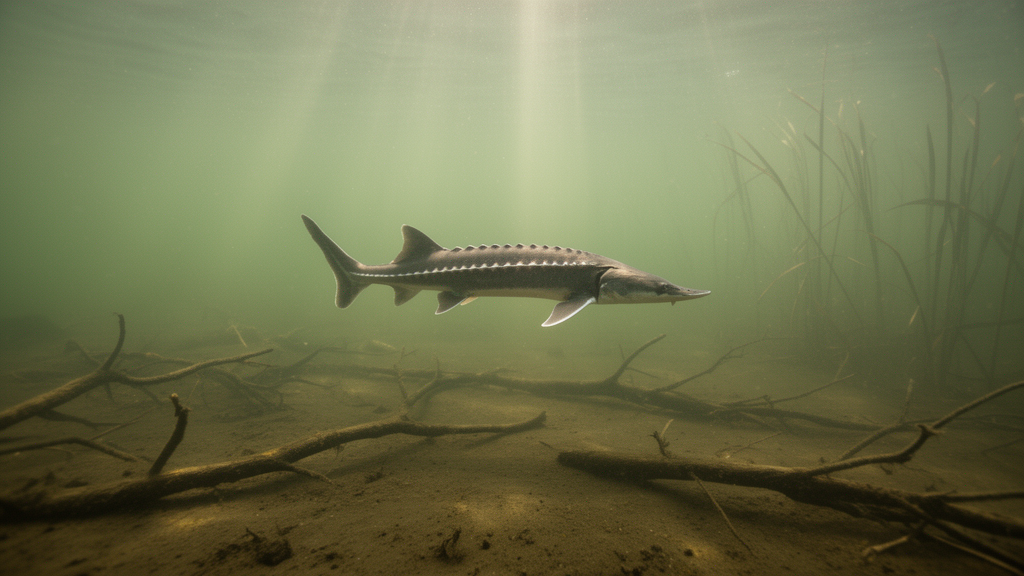
In the shallow, weed-choked oxbows and backwaters of the Carpathian Basin swims a fish that predates most of the mammals now grazing beside those wetlands. The European mudminnow (Umbra krameri), a small esociform predator endemic to the Middle and Lower Danube Basin, belongs to an ancient lineage that has persisted for roughly 60 million years. Yet a sweeping new countrywide assessment, published in the journal Nature Conservation, reveals that this living relic has quietly vanished from nearly half of its historically documented localities in Hungary over the past five decades, and that the survivors are increasingly confined to small, fragmented, and often artificial habitats.
The study, compiled from published faunistic records, grey literature, and standardized field surveys spanning 1975 to 2025, assembled a database of 200 documented mudminnow localities across 12 Hungarian geographic regions. The findings are sobering. Confirmed persistent populations survive at only 45.5 percent of historical sites, comprising 17 large and 74 small populations. Another 15 sites, or 7.5 percent, show only occasional recent records, while the species has disappeared entirely from 44 percent of its formerly known localities. In other words, the fish that nineteenth-century accounts described as so abundant it filled entire traps, and was even fed to livestock, now clings to existence in scattered wetland fragments.
The historical context makes the decline all the more striking. Mudminnows have been documented in Hungary since the mid-nineteenth century, when they thrived across the extensive floodplain wetlands of the Tisza, Körös, Danube, and Dráva rivers and around Lake Balaton. But Hungary’s wetland landscapes have since undergone profound transformation. Large-scale drainage, river regulation, and agricultural expansion have destroyed approximately 90 percent of the country’s natural wetland habitats. The regulation of the Tisza River alone dramatically reshaped its floodplain: permanently inundated areas shrank from roughly 4,400 square kilometers following engineering works carried out between 1846 and the 1930s, while channel shortening reduced the river’s length from 1,419 to 966 kilometers and more than 4,200 kilometers of levees severed the lateral connections between river and floodplain.
These hydrological interventions lowered groundwater tables and weakened the flood pulses that once sustained remnant wetlands, rendering them increasingly vulnerable to drying. Twentieth-century agricultural intensification added fertilizer and pesticide inputs that drove eutrophication and water-quality degradation, while overstocking of Chinese herbivorous carps and common carp in remaining waters stripped away macrophyte cover and increased turbidity, conditions fundamentally unsuitable for a wetland specialist. Rising drought frequency since the late twentieth century has compounded these pressures, fragmenting formerly continuous wetland networks into small, isolated patches where dispersal pathways and gene flow are disrupted, inbreeding rises, and natural recolonization after local extinctions becomes impossible.
The spatial pattern of decline is far from uniform, and this heterogeneity is one of the study’s most revealing findings. The Danube–Tisza Interfluve, which historically contained the highest number of localities at 57 sites, also suffered the greatest absolute loss, with 33 disappeared sites, a collapse attributed primarily to hydrological degradation in a region where groundwater decline and habitat loss are widespread. In stark contrast, the Fertő–Hanság–Szigetköz Region in the country’s northwest has emerged as the most important refuge, currently supporting 21 persistent populations, including three large ones, with remarkably low invasion pressure. The Zámoly Basin, meanwhile, has suffered complete regional extinction. Western and some eastern floodplain systems now function as refugial strongholds, while large parts of the central lowlands have been emptied of the species.
To disentangle the relative importance of competing threats, the researchers applied a binomial generalized linear model to the 194 sites with known status, coding each documented pressure as a binary predictor. The result was unambiguous: desiccation emerged as the only clear independent predictor of reduced persistence at the national scale. Sites affected by drying showed an odds ratio of 0.33 for persistence, with a 95 percent confidence interval of 0.17 to 0.64 and a p-value of 0.001, meaning that mudminnow populations at desiccating sites were roughly three times less likely to persist than those at sites without documented drying. Mechanistically, desiccation acts through multiple pathways: direct habitat loss, reduced water permanence, disrupted connectivity among habitats, and heightened vulnerability to stochastic events, any of which can drive local extinction even in the absence of strong biotic interactions.
Perhaps the most counterintuitive result concerns the Amur sleeper (Perccottus glenii), an invasive fish that arrived in Hungary only in the late twentieth century and has since colonized floodplain wetlands and oxbow habitats with remarkable speed. Previous studies have documented substantial negative effects on mudminnow populations, particularly along the Tisza River and in the Kis-Balaton Region. Yet in the national-scale model, invasion showed no significant independent effect on persistence, with an odds ratio of 1.33 and a p-value of 0.372. The explanation lies in spatial structure: invasive species were documented most frequently in eastern floodplain systems, especially along the Tisza and its tributaries, where more permanent waterbodies still exist. Relatively high persistence under invasion-only conditions should not be read as a benign effect of the invader, but rather as a reflection of where invasion records cluster, namely in hydrologically stable waters where mudminnows can still hang on. Invasion pressure, the authors conclude, is regionally structured and context-dependent rather than a uniform national determinant of decline.
One of the study’s most consequential observations is the shifting geography of survival itself. Mudminnows are increasingly found in artificial canal systems rather than natural floodplain habitats, a marked transition toward what ecologists call secondary refugia. These anthropogenically modified waterbodies provide relatively stable hydrological conditions in landscapes where natural wetlands have largely disappeared, and previous research has identified similar patterns elsewhere in the species’ range. But secondary refugia carry their own risks. Canals are subject to intensive management, including dredging and water-level regulation, and they may facilitate the spread of invasive species. Without ecologically coordinated management, timed to avoid spawning and overwintering periods and maintaining residual water levels during drought, these canal habitats could function as ecological traps rather than secure refuges.
The conservation implications are urgent and specific. The authors prioritize hydrological restoration and groundwater stabilization, particularly in the Danube–Tisza Interfluve and other drought-affected regions, through landscape-scale water retention, restoration of natural hydrological regimes, and reconnection of floodplain habitats. They call for strengthened monitoring and early detection of invasive species using environmental DNA (eDNA) surveillance, which has proven highly effective at detecting Amur sleeper expansion in structurally complex wetlands where traditional sampling fails. For populations threatened by desiccation, pollution, or invasion, ex situ measures such as emergency translocations, controlled propagation, and gamete cryopreservation have already demonstrated feasibility, and the study advocates a coordinated national, ideally basin-wide, living and DNA gene bank to preserve rapidly eroding genetic diversity.
The broader significance of this work extends well beyond Hungary’s borders. As the first countrywide baseline assessment of the species’ status in its historical core area, the study provides a template for evaluating wetland-specialist declines across the Carpathian Basin and adjacent lowland river systems, where similar patterns of fragmentation and refuge-dependent persistence have been reported in Austria and Romania. The central lesson is one of hierarchy: broad-scale habitat constraints, above all hydrological stability, determine whether populations persist at all, while biotic interactions such as competition and predation shape local outcomes only under suitable hydrological conditions. For a fish lineage that has endured some 60 million years of planetary change, the decisive threats are now unmistakably human, and the window for integrated, system-level conservation across the Danube Basin is narrowing with every dried wetland.
Subject of Research: Long-term distribution change and conservation status of the European mudminnow in Hungary
Article Title: Changes in the distribution of the European mudminnow ( Umbra krameri Walbaum, 1792) in Hungary over the last 50 years
Article References: Sallai, Z., Lehoczky, I., Harka, Á., & Takács, P. (2026). Changes in the distribution of the European mudminnow (Umbra krameri Walbaum, 1792) in Hungary over the last 50 years. Nature Conservation, 65, 49-63. https://doi.org/10.3897/natureconservation.65.190429
Image Credits: AI Generated
DOI: 10.3897/natureconservation.65.190429
Keywords: European mudminnow, Umbra krameri, Hungary, wetland conservation, desiccation, invasive species, Amur sleeper, Danube Basin, floodplain restoration, eDNA monitoring, habitat fragmentation, secondary refugia
Cite Scienmag News
Margaret Porter. (October 16, 2026). Hungary’s Living Fossil Fish Vanishes From Nearly Half Its Historic Wetland Homes. Scienmag. https://scienmag.com/hungarys-living-fossil-fish-vanishes-from-nearly-half-its-historic-wetland-homes/
Margaret Porter. "Hungary’s Living Fossil Fish Vanishes From Nearly Half Its Historic Wetland Homes." Scienmag, 16 October 2026, https://scienmag.com/hungarys-living-fossil-fish-vanishes-from-nearly-half-its-historic-wetland-homes/. Accessed 16 October 2026.
Margaret Porter. "Hungary’s Living Fossil Fish Vanishes From Nearly Half Its Historic Wetland Homes." Scienmag. October 16, 2026. https://scienmag.com/hungarys-living-fossil-fish-vanishes-from-nearly-half-its-historic-wetland-homes/


