


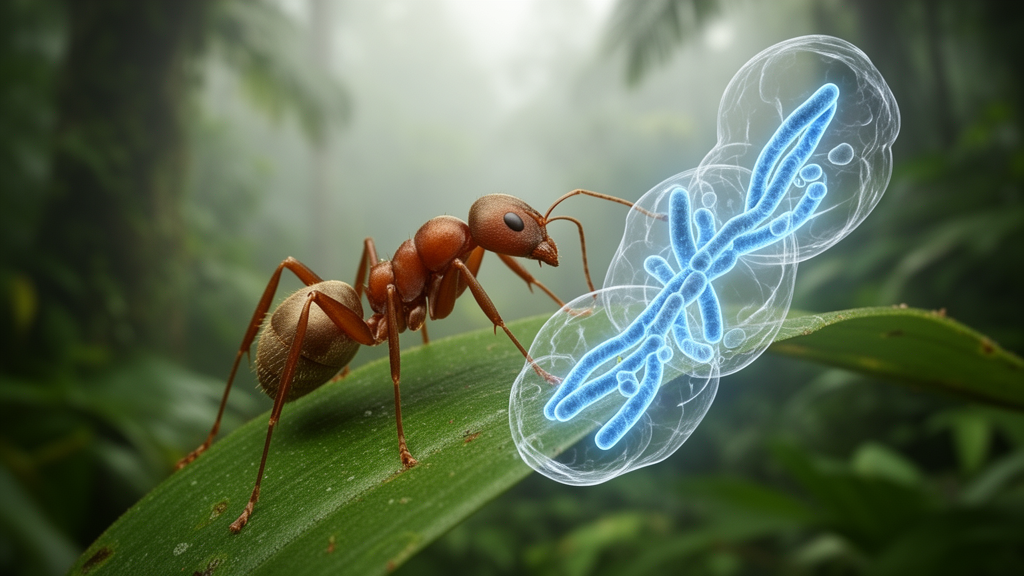
Deep in the Guiana Shield, the northernmost stretch of the Brazilian Amazon, a team of cytogeneticists has been peering into the cells of some of the rainforest’s most unassuming architects: the fungus-growing ants. These insects, members of the subtribe Attina, survive entirely on the fungi they cultivate, a partnership that has fueled one of the most successful evolutionary experiments in the insect world. Now, a study published in Comparative Cytogenetics has provided the first chromosomal portraits of five species from two genera, Cyphomyrmex and Apterostigma, collected near the town of Oiapoque in Amapá state, revealing chromosome counts and DNA repeat patterns that both confirm old suspicions and upend assumptions about how ant genomes evolve.
…` (truncated in thought; final content below in answer). Need 1400–1600 words. That’s long. I must actually write ~1450 words of article body. Let me plan 9 paragraphs of ~160 words each ≈ 1440. I’ll write carefully, sticking to source facts, no fabricated quotes. Use technical explanations: karyotypes, FISH, rDNA, microsatellites (GA)n, Minimal Interaction Theory, centric fission, pericentric inversions, heterochromatin, haploid/diploid counts, species complexes, first records, methodological failure of rDNA probe in Apterostigma,{
The chromosome counts reported for the two Cyphomyrmex species fit neatly into a picture that has been emerging from decades of karyotypic work on the genus. Cyphomyrmex transversus, with 2n = 24 chromosomes arranged as 18 metacentrics and 6 submetacentrics, adds yet another entry to what is already one of the most variable chromosome-count profiles known among fungus-growing ants. Previous studies had documented diploid numbers of 18, 24, and 42 in different populations of this species, a spread so wide that researchers have begun to question whether the name C. transversus actually covers more than one biological entity. The Guiana Shield population, matching the 2n = 24 count reported elsewhere, strengthens the case that this number represents a distinct lineage within the species complex rather than random intrapopulational variation.
Cyphomyrmex laevigatus presents a different kind of interest. The individuals sampled in Oiapoque were haploid, with n = 7 chromosomes, all metacentric. Haploid males are the norm in ants, which use haplodiploid sex determination, so male karyotypes are routinely reported as half the diploid female count. What matters here is that the haploid complement of seven corresponds to a diploid number of 14, which aligns with the lowest chromosome count recorded for the genus so far. The contrast between C. laevigatus at 2n = 14 and C. transversus populations reaching 2n = 42 illustrates the remarkable range of karyotypic divergence that can exist even within a single genus of ants, a range that in many other insect groups would be taken as evidence of generic-level separation.
The placement of ribosomal DNA clusters in both Cyphomyrmex species follows a pattern that cytogeneticists consider informative. In C. transversus, the 18S rDNA sites were located on the long arm of the largest submetacentric pair, while in C. laevigatus they occupied the short arm of the fifth chromosome in the haploid set. In both cases, the rDNA signals were restricted to a single chromosome pair, which is consistent with earlier findings for C. rimosus and other populations of C. transversus. A single rDNA-bearing pair appears to be the ancestral condition in many ant lineages, and deviations from it, such as multiple rDNA sites, are often interpreted as derived states that can help diagnose species or populations. The consistency of this single-pair pattern across Cyphomyrmex species studied to date suggests that the number of rDNA sites is a relatively stable character in this genus, even as chromosome numbers themselves fluctuate dramatically.
The failure of the FISH protocol to localize rDNA sites in the three Apterostigma species is a methodologically significant result in its own right. Fluorescence in situ hybridization depends on probe binding, and a lack of signal can stem from several causes: sequence divergence between the probe and the target DNA, low copy number of the ribosomal genes, chromatin condensation that masks the target regions, or differences in the chemical composition of the chromosomes themselves. The fact that the same protocol worked well for Cyphomyrmex but not for Apterostigma suggests that something about the genome organization or chromosomal structure of Apterostigma differs in a way that interferes with standard hybridization conditions. This kind of genus-specific technical limitation is not unusual in cytogenetics, and resolving it typically requires adjustments to denaturation temperatures, hybridization stringency, or probe design. Until those adjustments are made, the rDNA architecture of Apterostigma remains unmapped, leaving a gap in comparative data for this lineage.
The chromosome counts within Apterostigma are arguably the most striking findings of the study. Apterostigma tropicoxa, with 2n = 54, now holds the record for the highest chromosome number documented in the genus, substantially exceeding the previous maximum of 2n = 46 recorded for an unidentified species of the pilosum group. Meanwhile, A. jubatum at 2n = 22 and A. andense at n = 11, which corresponds to a diploid count of 22, share the same diploid number yet differ markedly in karyotype structure. This combination, identical counts but divergent chromosome morphologies, is a classic signature of karyotypic rearrangement. Chromosome numbers can remain constant while inversions, translocations, and shifts in centromere position alter the relative arm lengths of individual chromosomes, producing karyotypes that look very different under the microscope even though the total genetic content is packaged into the same number of units.
The Minimal Interaction Theory, proposed by Imai and colleagues, offers a framework for interpreting these patterns. According to this theory, karyotype evolution in ants proceeds primarily through centric fission events, in which a single chromosome splits at the centromere into two smaller ones. As chromosome number increases, average chromosome size decreases, and the smaller products of fission are structurally fragile. The theory holds that the accumulation of heterochromatin, densely packed and largely non-coding DNA, stabilizes these small chromosomes by providing structural support. Under this model, a genus like Apterostigma, which now spans chromosome counts from 2n = 20 to 2n = 54, would be expected to show a gradient in chromosome size and heterochromatin content that tracks the variation in diploid number. Testing this prediction in Apterostigma will require heterochromatin-specific staining techniques, such as C-banding, which were not part of the current study’s protocol but represent a logical next step.
The distribution of (GA)n microsatellite sequences across the chromosomes of the five species adds another layer of comparative information. Microsatellites are short tandem repeats, in this case alternating guanine and adenine nucleotides, that can proliferate across genomes and occupy characteristic positions. In C. laevigatus and C. transversus, as well as in A. jubatum, the (GA)n signals were scattered across all chromosomes, a dispersed pattern that suggests these repeats have colonized many genomic locations. This scattered distribution matches what has been reported for other ant species, where (GA)n repeats tend to reside in euchromatic regions rather than clustering at centromeres. The ubiquity of the signal in these three species implies that the repeat family is ancient and widespread within their genomes, having had time to accumulate across many chromosomal sites.
In contrast, the two remaining Apterostigma species showed more restricted and patterned distributions. In A. andense, the (GA)n signals were concentrated at the terminal regions of some chromosomes, suggesting preferential accumulation at chromosome ends. In A. tropicoxa, the signals were nearly absent from the short arms of several submetacentric and subtelocentric chromosomes, implying that those regions either lack the repeat or contain it in quantities below the detection threshold of the FISH technique. These species-specific patterns indicate that the genomic dynamics of microsatellite evolution differ among closely related ants, possibly reflecting differences in genome size, repetitive DNA turnover rates, or the activity of transposable elements that can carry microsatellite sequences to new chromosomal locations.
The geographic context of the study deserves attention. The Guiana Shield, one of the oldest geological formations in South America, harbors exceptionally high levels of endemism, and the Amazonian portion of Amapá state remains one of the least surveyed areas for ant cytogenetics. Most cytogenetic data on Neotropical ants have come from the Atlantic Forest, the Cerrado, and Central America, leaving vast stretches of the Amazon basin essentially uncharacterized at the chromosomal level. By sampling in Oiapoque, near the border with French Guiana, this study begins to fill that gap and provides baseline data against which future collections from other Amazonian localities can be compared. Whether the karyotypes observed here are typical of Amazonian populations or represent regional variants distinguishable from conspecific populations elsewhere is a question that only broader geographic sampling can answer.
The broader significance of this work lies in its contribution to species delimitation. Fungus-growing ants include numerous species complexes whose members are difficult to distinguish by morphology alone, and cytogenetic markers offer an independent line of evidence for resolving these ambiguities. The case of C. rimosus, where Atlantic Forest and Central American populations show starkly divergent karyotypes despite morphological similarity, exemplifies how chromosomal data can reveal cryptic diversity. Similarly, the multiple karyotypes documented within C. transversus hint at underlying taxonomic complexity that morphology has not captured. For Apterostigma, the new chromosome counts expand the known range of variation in the genus and provide reference points for future studies. As molecular cytogenetic techniques continue to be refined and applied to more species across the Attina, the accumulating dataset will allow increasingly rigorous tests of karyotypic evolution models and may ultimately contribute to a more complete understanding of how ant genomes diversify across the landscapes of the Neotropics.
Subject of Research: Cytogenetic analysis of some species of Cyphomyrmex Mayr, 1862 and Apterostigma Mayr, 1865 ( Formicidae , Myrmicinae ) from the Guiana Shield
Article Title: Cytogenetic analysis of some species of Cyphomyrmex Mayr, 1862 and Apterostigma Mayr, 1865 ( Formicidae , Myrmicinae ) from the Guiana Shield
Article References: Lod, R. B., Barros, L. A. C., Silveira, L. I., Leitão, E. D. A., Teixeira, G. A., & de Aguiar, H. J. A. C. (2026). Cytogenetic analysis of some species of Cyphomyrmex Mayr, 1862 and Apterostigma Mayr, 1865 (Formicidae, Myrmicinae) from the Guiana Shield. Comparative Cytogenetics, 20, 99-113. https://doi.org/10.3897/compcytogen.20.175870
Image Credits: AI Generated
DOI: 10.3897/compcytogen.20.175870
Keywords: Cytogenetic, analysis, some, species, Cyphomyrmex, Mayr, Apterostigma, Formicidae, Myrmicinae, Guiana, Shield, scientific research
Cite Scienmag News
Roger Howard. (October 16, 2026). Chromosomes Reveal Hidden Diversity in Amazonian Fungus-Growing Ants. Scienmag. https://scienmag.com/chromosomes-reveal-hidden-diversity-in-amazonian-fungus-growing-ants/
Roger Howard. "Chromosomes Reveal Hidden Diversity in Amazonian Fungus-Growing Ants." Scienmag, 16 October 2026, https://scienmag.com/chromosomes-reveal-hidden-diversity-in-amazonian-fungus-growing-ants/. Accessed 16 October 2026.
Roger Howard. "Chromosomes Reveal Hidden Diversity in Amazonian Fungus-Growing Ants." Scienmag. October 16, 2026. https://scienmag.com/chromosomes-reveal-hidden-diversity-in-amazonian-fungus-growing-ants/


