


Every time a processor or FPGA flips millions of transistors at once, it sends a burst of electrical noise racing through the copper planes that deliver its power. On a mixed-signal circuit board, where delicate analog and radio-frequency circuits share that same power supply with fast digital logic, this simultaneous switching noise can wreck the performance of the most sensitive components. A research team at the Bharath Institute of Higher Education and Research in Chennai, India, now reports a strikingly simple-sounding fix: carve the power plane itself into a metamaterial pattern and build it on diamond. The design, described in Frontiers in Carbon, suppresses noise by roughly 72 decibels at 14 gigahertz and keeps suppression better than 30 decibels across the entire 8 to 20 gigahertz band.
The problem the team attacked is fundamental to modern electronics. Power delivery networks in multilayer printed circuit boards are typically built from closely spaced power and ground planes that form a low-impedance path for current. But that sandwich of metal and dielectric also behaves as a parallel-plate waveguide, supporting cavity resonance modes that let noise travel laterally across the board. When digital circuits draw abrupt current spikes, they excite these resonances, and the resulting voltage fluctuations couple into adjacent signal traces and sensitive analog blocks, producing electromagnetic interference that degrades signal integrity.
Conventional remedies run out of steam at high frequencies. Banks of discrete decoupling capacitors, the traditional workhorse of power integrity engineering, are hobbled by their own parasitic inductance and mounting constraints, so they lose effectiveness well below the gigahertz range where modern processors operate. Electromagnetic bandgap structures and metamaterial-inspired geometries have emerged as the leading alternative, introducing stopband characteristics that block the propagation of cavity modes. Researchers have demonstrated a zoo of such designs, including cascaded spiral patches, double-square geometries, spiral-slot structures, and pinwheel and meandered plane configurations, all of which achieve meaningful broadband noise suppression.
What most of these designs share, however, is a reliance on conventional dielectric substrates such as FR4, the fiberglass material used in ordinary circuit boards. FR4 suffers from a relatively high loss tangent, poor thermal conductivity, and limited high-frequency performance, all of which constrain how well any noise-suppression scheme etched onto it can work. The Chennai team, led by L. K. Aishwaryaa with S. Chitra, R. Hema, and M. Sundararajan, saw an opening in this gap: instead of only optimizing geometry, why not also upgrade the material underneath?
Diamond is an unusual but compelling choice. It has an ultra-low dielectric loss tangent of roughly 0.0001, a stable relative permittivity of about 5.5 to 5.7, and an exceptionally high thermal conductivity near 2000 watts per meter-kelvin, which is several times better than copper. That combination means electromagnetic energy is not wasted as heat in the dielectric, and whatever heat is generated by the circuits above can be whisked away efficiently. The researchers designed a two-layer board measuring 30 by 30 millimeters with a diamond substrate between 0.5 and 1 millimeter thick, topped with a patterned power plane.
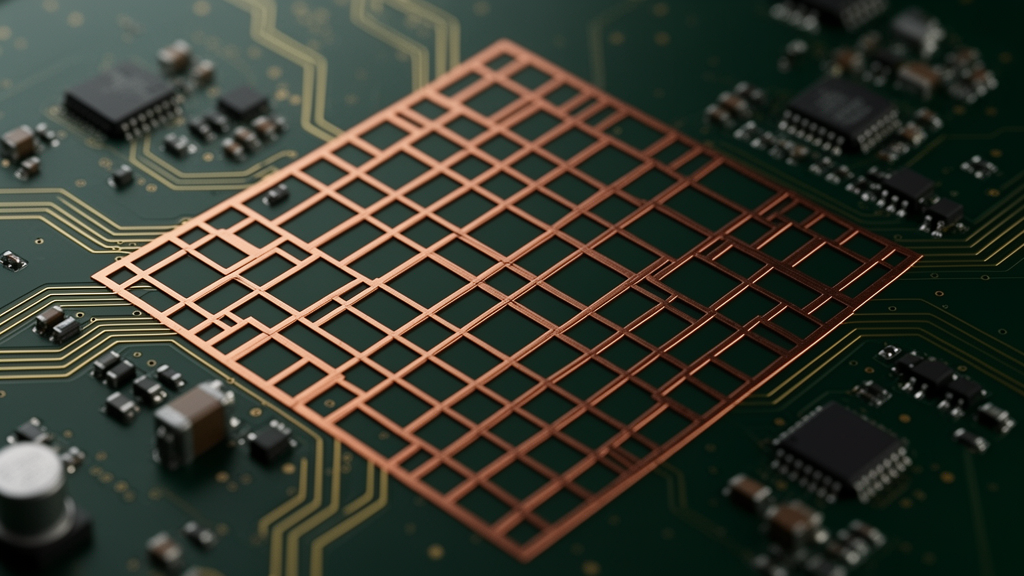
The pattern itself is a lattice of square metallic patches connected by narrow bridge lines, forming what the team calls a square power island metamaterial. Each unit cell, sized between 3 and 5 millimeters to operate in the subwavelength regime, behaves like a tiny resonant filter. The bridge lines contribute inductance, while the capacitive coupling between adjacent patches and between the power and ground planes supplies capacitance. Together they form a parallel LC resonant circuit whose stopband center frequency is set by the product of those two values. Lengthening or narrowing the bridge lines increases inductance and pushes the stopband lower in frequency while broadening it, and shrinking the inter-patch gap tunes the capacitive side of the equation.
The team evaluated three progressively more sophisticated configurations using full-wave electromagnetic simulations. A single square power island unit cell produced a deep attenuation notch of about 59 decibels at 10 gigahertz, with sustained suppression better than 30 decibels from 8 to 20 gigahertz. At resonance, the LC behavior dramatically raises the impedance of the power distribution path, so transient switching currents are confined locally instead of spreading across the plane. Cascading multiple identical unit cells along the power path increased the electrical length of the noise propagation route, accumulating distributed inductive and capacitive effects and creating multiple resonant impedance peaks that widened the stopband further.
The long-bridged variant connected neighboring cells with extended bridge lines, adding series inductance proportional to the bridge length and shifting the resonance toward lower frequencies. The final and best-performing design added vertical vias, small plated holes that connect the power and ground planes. These vias introduce additional vertical current paths and their own inductance, while enhancing capacitive coupling between the planes to form a three-dimensional LC resonant network. The combined effect of the square geometry, the long bridges, and the vias yielded the headline result: peak noise suppression of approximately 72 decibels at 14 gigahertz, with the wideband floor holding better than 30 decibels across the full 8 to 20 gigahertz range. In the cascaded and long-bridged configuration without vias, the maximum attenuation reached about 65 decibels at 19 gigahertz.
Beyond raw suppression numbers, the diamond dielectric delivered thermal dividends. Compared with FR4 and Rogers substrates, the simulations showed lower transmission loss, reduced voltage ripple, improved current return paths, and lower temperature rise under high-frequency operation. Tolerance and yield analyses added a practical note of confidence: parametric and statistical process-variation simulations produced only small resonance shifts under dimensional deviations, and suppression performance remained largely unchanged, suggesting the design is robust to the realities of fabrication and via parasitics.
The authors are candid about the limits of the current work. The study relies on a two-layer printed circuit board and full-wave simulations rather than real-time measurements of switching noise, and diamond substrates remain expensive and challenging to fabricate at scale. Future work will focus on experimental validation, FPGA-based implementation, integration with package-level power delivery networks and 2.5D and 3D integrated circuit systems, and AI-assisted design optimization for adaptive noise mitigation. Still, the compact unit-cell geometry is compatible with standard PCB processes, and the material’s extraordinary thermal conductivity supports feasible integration in advanced packages. If the simulation results translate to hardware, diamond-patterned power planes could become a powerful tool for keeping 5G, AI accelerator, and FPGA platforms quiet, cool, and reliable.
Subject of Research: Diamond-based via-loaded square power island metamaterial structures for suppressing simultaneous switching noise in mixed-signal power delivery networks
Article Title: Power integrity enhancement in mixed-signal PDNs using diamond-based via-loaded square power island metamaterial structures
Article References: Aishwaryaa, L. K., Chitra, S., Hema, R., & Sundararajan, M. (2026). Power integrity enhancement in mixed-signal PDNs using diamond-based via-loaded square power island metamaterial structures. Frontiers in Carbon, 5, Article 1876908. https://doi.org/10.3389/frcrb.2026.1876908
Image Credits: AI Generated
DOI: 10.3389/frcrb.2026.1876908
Keywords: power integrity, power delivery network, metamaterial, diamond substrate, simultaneous switching noise, electromagnetic bandgap, mixed-signal PCB, LC resonance, thermal conductivity, via loading, signal integrity, high-speed electronics
Cite Scienmag News
Neil Sanderson. (October 16, 2026). Diamond-Patterned Power Planes Crush High-Frequency Chip Noise in New Design. Scienmag. https://scienmag.com/diamond-patterned-power-planes-crush-high-frequency-chip-noise-in-new-design/
Neil Sanderson. "Diamond-Patterned Power Planes Crush High-Frequency Chip Noise in New Design." Scienmag, 16 October 2026, https://scienmag.com/diamond-patterned-power-planes-crush-high-frequency-chip-noise-in-new-design/. Accessed 16 October 2026.
Neil Sanderson. "Diamond-Patterned Power Planes Crush High-Frequency Chip Noise in New Design." Scienmag. October 16, 2026. https://scienmag.com/diamond-patterned-power-planes-crush-high-frequency-chip-noise-in-new-design/


